


Houston investment surges with Lilly’s GLP-1 plant
Key points:
- • Eli Lilly began building a $6.5 billion pharmaceutical plant at Houston’s Generation Park.
- • The plant will create more than 600 permanent jobs and about 4,000 construction jobs.
- • It will make Foundayo, Lilly’s oral GLP-1 weight-loss drug, with completion set for 2030.
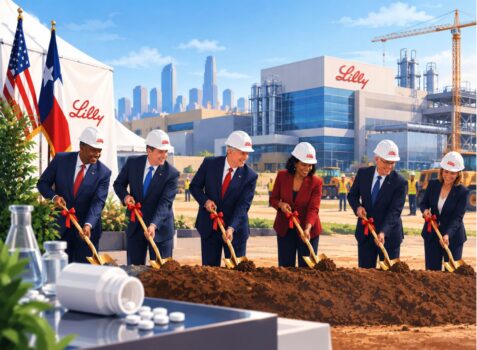 October 2026 — Houston has broken ground on what the administration of Gov. Greg Abbott called the largest active pharmaceutical ingredient project in Texas history, a milestone that moves the region’s life sciences ambitions from the research lab onto the factory floor. Houston investment centers on Eli Lilly’s $6.5 billion manufacturing plant at Generation Park in northeast Houston, where construction began Sept. 21.
Join us at the Invest: Houston 3rd Edition Leadership Summit! This premier event brings together hundreds of Houston’s business and regional leaders to discuss the challenges and opportunities for businesses and investors. Buy your ticket now!
The project is expected to create more than 600 permanent jobs and about 4,000 construction positions before its targeted completion in 2030.
The scale of the facility is difficult to overstate. The plant will cover 1 million square feet inside Generation Park, a 4,300-acre master-planned development in Harris County built by locally based McCord Development, REBusinessOnline reported. Its primary product will be Foundayo (orforglipron), Lilly’s first synthetic oral GLP-1 weight-loss medicine, but the plant is also designed to manufacture other small-molecule medicines and advanced therapeutics, including oligonucleotides. That mix matters: it positions the Houston plant as a long-term production asset rather than a single-product line tied to the fortunes of one drug.
Timing matters
Foundayo is the reason the timing matters. The drug is currently under regulatory review in more than 40 countries, with a global rollout anticipated in 2027, and Lilly is researching additional uses beyond weight loss, including type 2 diabetes and obstructive sleep apnea. Oral GLP-1 medicines have become one of the most closely watched categories in pharmaceuticals because a pill can reach patients who won’t or can’t use injectables, and the manufacturers able to produce active ingredients at volume are the ones positioned to capture that demand. By building capacity in Houston years ahead of need, Lilly is effectively reserving supply for a market it expects to keep expanding.
The workforce plan is equally deliberate. The 600 permanent roles are high-paying positions for engineers, scientists, and lab technicians, and Lilly has committed $12.5 million to San Jacinto College for workforce training infrastructure plus $2.5 million to the San Jacinto College Foundation for student scholarships.
Edgardo Hernandez, executive vice president of Lilly Manufacturing Operations, framed the plant as one that will run on local talent, pointing to the college partnership and regional hiring plans, according to Axios Houston. For Houston, that means a pipeline of technical jobs filled from within the region and a community college system that becomes a direct feeder into advanced manufacturing.
The plant will also be among the more technologically ambitious manufacturing sites in the region. Lilly plans to run operations using machine learning, artificial intelligence, digitally integrated systems, and advanced data analytics, a model that treats production data as a competitive asset. That design choice has implications beyond Lilly’s own fence line, since suppliers, logistics firms, and engineering contractors working with the plant will need to integrate with those systems, raising the technical bar for the local vendor base that grows up around Generation Park.
Long recruitment campaign
The groundbreaking is also the payoff of a long recruitment campaign. McCord Development began courting life sciences companies to Generation Park in 2023 before landing Lilly in fall 2025.
Houston has long been known for medical research and healthcare, but large-scale pharmaceutical production is a different business, one that brings capital-intensive construction, long-term operating payrolls and a supplier ecosystem. Landing an anchor of this size gives the northeast Houston corridor a credible pitch to the next manufacturer weighing a Gulf Coast site, and it further diversifies a regional economy still closely associated with energy.
Nationally, the Houston plant is one piece of a broader domestic buildout. It is one of five U.S. active pharmaceutical ingredient facilities Lilly has announced since 2020, joining sites in Richmond, Virginia; Huntsville, Alabama; and two in Lebanon, Indiana, and it is among 10 U.S. manufacturing facilities the company currently has under development.
Investors have rewarded that strategy: Lilly’s stock closed at $1,164.89 on Sept. 21, up 54.3% from $754.95 a year earlier. That market confidence gives the company room to keep committing capital to large projects like Houston’s, even as construction costs and supply chains remain a watch item for manufacturers everywhere.
The next four years will test how quickly Houston can turn a groundbreaking into an industrial cluster. If the 2030 timeline holds, pharmaceutical manufacturing could become as defining a part of Houston’s economic identity as the energy projects that shaped the region’s last century.
Want more? Read the Invest: Houston report.






