

Hurricane preparedness and the new era of fiscal policy
Key points:
- • Public officials across three states now treat hurricane preparedness as standing fiscal policy, not emergency contingency.
- • Federal and state dollars are flowing into water, sewer, road, and stormwater infrastructure with hard spending deadlines approaching.
- • Tourism numbers in Florida and North Carolina prove that communities that rebuild stronger recover their visitor economies faster.
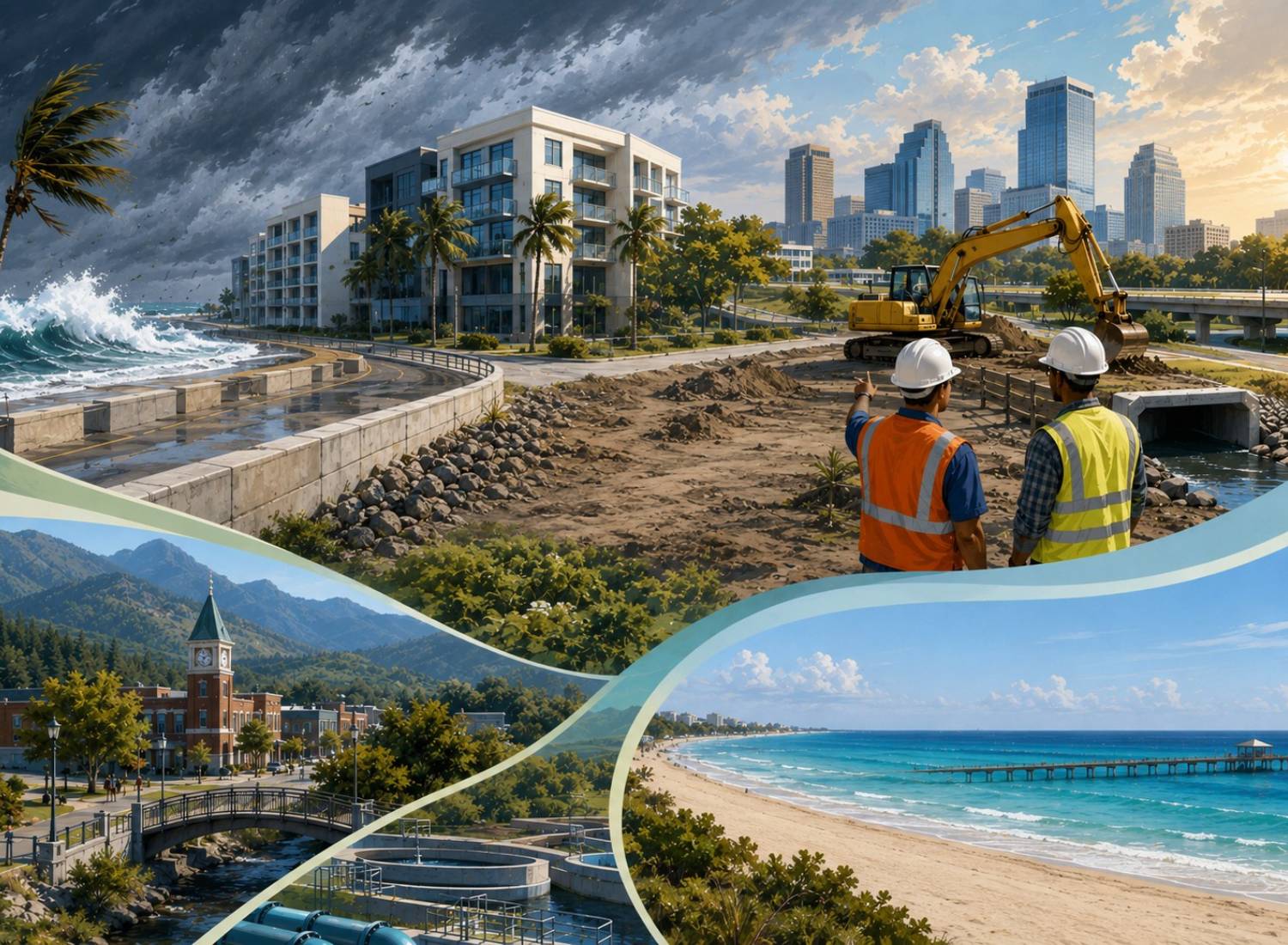 July 2026 — Frances Robustelli runs a barrier-island city that has twice felt the brunt of storms that brew off the Gulf of Mexico, and she now treats hurricane preparedness as fiscal policy rather than contingency. “It is not a question of if it will happen,” said Robustelli, the St. Pete Beach city manager. “We know we live in hurricane country, so the question is whether we can be better prepared.”
Across Florida, North Carolina, and Texas, public officials are spending federal and state dollars to make the answer a resounding “yes.”
Join us at caa’s upcoming leadership summits! These premier events bring together hundreds of public and private sector leaders to discuss the challenges and opportunities for businesses and investors. Find the next summit in a city near you!
Build back better
Robustelli’s commission adopted resilience as policy after the 2024 storms battered Pinellas County. Every rebuild now carries one test. “In everything we are doing, we are looking at whether there is a way to build it back so it can sustain the weather patterns we expect,” she said in an interview with Invest: Tampa Bay. The standard raises upfront costs, but the math favors it — every $1 not invested in disaster resilience today can cost communities up to $33 in lost future economic activity, according to the 2025 Resilience Report from the U.S. Chamber of Commerce and Allstate.
The payoff shows up in visitors. St. Pete Beach logged its strongest January and February on record, and 1Q26 spending confirmed the turnaround. “That is a signal that we are beyond recovery,” Robustelli said. “People see us as an opportunity.” She expects the trend to hold, with one caveat : managing residents’ quality of life when the peak-season population doubles by the day.
Sixty miles south, Sarasota County sees the same lesson in its drainage maps. County Administrator Jonathan Lewis points to the prior season’s rainfall as the trigger for sustained stormwater spending, and for a harder conversation with residents. “You are never going to stop all bad things from happening, so setting realistic expectations and improving preparedness are part of the work,” he said in an interview with Invest: Tampa Bay. The 2024 season, he added, reinforced the case for investing in stormwater infrastructure and helping residents understand what those dollars can and cannot prevent.
Spending the storm money
Further west, Brazoria County, on the Gulf south of Houston, has routed most of its remaining federal relief into hard assets. “We have to spend that ARPA funding by the end of this year, and Brazoria County has used most of it toward infrastructure,” said County Judge Matt Sebesta in his interview with Invest: Houston. It also landed a $43 million hazard mitigation grant now flowing into city and county roads. “The goal is improving resilience so we are better prepared the next time Mother Nature throws challenges at us, whether that’s hurricanes, flooding, or freezing events,” Sebesta said.
The clock is the operative detail for executives and contractors. ARPA obligation deadlines and grant-spend windows close in 2026, which front-loads procurement and construction activity into the back half of the year. Hurricane preparedness, in budget terms, has become a near-term spending event with a fixed expiration date.
North Carolina shows the model reaching well inland. West Jefferson, a mountain town hit by Hurricane Helene, has chased grant funding to rebuild its core systems. “Water and sewer infrastructure are always a big thing,” said Town Manager Brantley Price in an interview with Invest: Raleigh-Durham. “We just applied for a $6.2 million EDA grant. We have gotten some funds to redo sidewalks, redo some sewer lines, and help with our water treatment.” State and federal money, he noted, opened up after the storm — and the town moved to capture it.
Tourism as the proof
The return on that spending registers statewide. Visit NC Executive Director Wit Tuttell frames the past 18 months around disaster and recovery, with one number that reframes the stakes for investors. “Even in the year when we experienced the largest hurricane disaster in North Carolina’s history, visitor spending still increased by 3.1% statewide,” Tuttell said in an interview with Invest: Charlotte. That lift carried total spending to a record $36.7 billion in 2024, surpassing the prior year’s high. “That says a lot about the strength, breadth, and diversity of our tourism economy.”
Tuttell credits the result to a deliberate shift from rebuilding to fortifying. “Instead of simply rebuilding, we’ve focused on strengthening these areas and better preparing for future challenges,” he said, pointing to collaboration across state and federal agencies and the tourism industry itself. The encouraging signal, he added, is that resilience-led recovery works, and the visitor economy rewards it.
Forecasters give these leaders a narrow window to keep building. NOAA’s 2026 Atlantic outlook calls for a below-normal season of eight to 14 named storms, with three to six hurricanes, but agency officials stress that it only takes one storm to define a bad year.
Want more? Read the Invest: reports.