Orlando business news: Job growth cools, still leads state
Key points:
- • Orlando added just 8,800 jobs in 2025, far below its 2015–2019 average of 44,300.
- • Despite the slowdown, Orlando ranked 7th-fastest-growing among the 30 largest U.S. metros.
- • Healthcare and hospitality drove hiring; retail and professional services shed jobs.
 July 2026 — In the latest Orlando business news, Central Florida’s labor market posted its weakest year of hiring in over a decade — and still outperformed nearly every other large American metro, a split verdict that captures where the U.S. economy stood in 2025.
Join us at the Invest: Greater Orlando 4th Edition Leadership Summit! This premier event brings together hundreds of Greater Orlando’s business and regional leaders to discuss the challenges and opportunities for businesses and investors. Buy your ticket now!
According to the Orlando Economic Partnership’s April 2026 market commentary, drawing on revised Florida Department of Commerce employment data, the Orlando metro added 8,800 jobs in the 12 months ending December 2025 — a figure revised upward from an initial estimate of just 3,700.Still, the pace marks a sharp break from Orlando’s recent history: the region averaged 44,300 new jobs annually between 2015 and 2019, and 43,900 a year between 2022 and 2024. By comparison, 2025’s growth rate of 0.6% is a fraction of what residents and employers have come to expect from a metro that spent most of the past decade among the nation’s fastest-growing.
A relative bright spot
What makes the number notable is not the slowdown itself but the company Orlando kept while slowing down. The 0.6% growth rate was still enough to rank Orlando 7th among the 30 most populous U.S. metro areas in 2025, according to the same Orlando Economic Partnership report. Tampa managed just 0.2% growth over the same period, while Miami and Jacksonville both lost jobs outright. Nationally, 14 of the 30 largest metros shed jobs in 2025 — the weakest showing for U.S. metro-level employment since the pandemic.
Set against that backdrop, Orlando’s modest gain suggests the region’s underlying economic base has more ballast than headline job counts suggest.
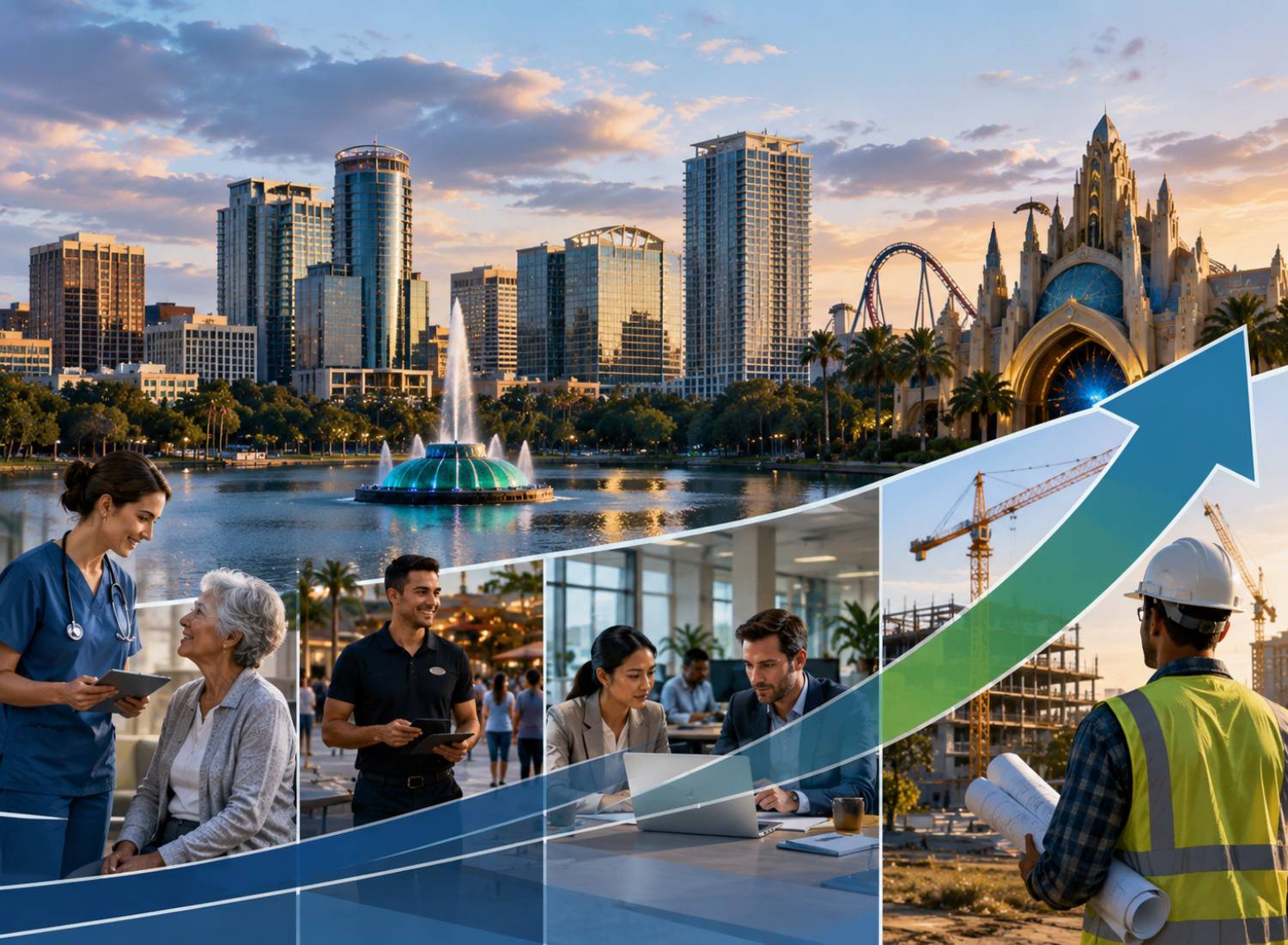
The composition of that growth matters as much as the total. Healthcare and leisure and hospitality were the two biggest job creators in the Orlando metro in 2025, with hospitality getting a direct boost from Universal’s Epic Universe, which opened in May 2025 and has been ramping up staffing ever since. Those gains were partly offset by real contraction elsewhere: retail lost 3,900 jobs, professional and business services shed 3,500, accommodation and food services gave back 700, and construction lost 800. That mix — durable demand in healthcare and experiential tourism, softness in retail and professional services — mirrors shifts playing out in metros nationwide as consumer spending patterns and white-collar hiring both cool.
Orlando Economic Partnership researchers have framed the shift as a move away from raw headcount growth toward productivity-driven expansion, pointing to AI adoption inside existing firms as one factor allowing companies to do more with smaller teams. That reframing matters for how local officials and site-selection consultants talk about the market going forward: a metro that grew primarily by adding warm bodies for a decade is now being asked to demonstrate it can grow output and wages even as job counts flatten.
What employers should track
For business leaders evaluating Central Florida, the Orlando business news of the moment is less about a single soft year and more about which sectors prove durable through it. Healthcare’s steady expansion reflects an aging regional population and continued investment in medical campuses around Lake Nona and the University of Central Florida’s health sciences corridor. Hospitality’s resilience is tied directly to Epic Universe’s ongoing staffing ramp, which industry watchers expect to continue through at least the next full year of operations as the park works toward full attraction capacity.
Both trends suggest Orlando’s growth engine has shifted rather than stalled — a distinction that matters enormously to commercial real estate investors deciding whether the pause in job growth justifies caution on new development, or whether it is simply a breather before the next expansion phase.
The national context makes Orlando’s performance worth watching well beyond Florida. If 2025 was genuinely the weakest year for U.S. metro job growth since the pandemic, then regions that still managed positive, sector-diversified gains — rather than losses — offer a template for what resilient regional economies look like in a slower-growth national environment. Orlando’s combination of healthcare demand, tourism reinvestment, and an emerging AI-driven productivity narrative gives it a stronger claim to that label than most Sun Belt peers managed in 2025 — and it’s fast becoming the defining Orlando business news storyline of the year.
The next data releases from the Florida Department of Commerce, expected later this year, will show whether Orlando’s second half kept pace with a slow start or accelerated as Epic Universe staffing matures and healthcare capital projects come online. Executives with hiring or expansion plans in Central Florida should watch those releases closely, along with any updated guidance from Universal on park staffing, before assuming the current soft patch is temporary or structural.
Want more? Read the Invest: Orlando report.