


Orlando business news today: Downtown’s new spine
Key points:
- • Church Street’s first phase runs from Garland Avenue to Magnolia Avenue with a curbless design.
- • The project is part of the Downtown Orlando Action Plan to revive the district for visitors.
- • All three construction phases are expected to reach completion by summer 2028.
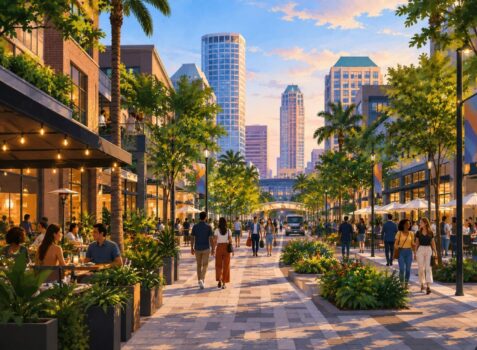 September 2026 — Construction crews are reshaping the street that gave downtown Orlando its identity decades before theme parks did. Orlando business news today centers on Church Street, where the city broke ground earlier in the summer on a redesign that strips out a conventional road in favor of a curbless, pedestrian-first “festival street,” WKMG ClickOrlando reported.
Join us at caa’s upcoming leadership summits! These premier events bring together hundreds of public and private sector leaders to discuss the challenges and opportunities for businesses and investors. Find the next summit in a city near you!
The first phase, running from Garland Avenue to the railroad tracks, replaces the old roadway with two narrow 11-foot travel lanes, a semi-pervious surface built to handle foot traffic as easily as cars, dedicated loading zones for the block’s restaurants and bars, and expanded landscaping meant to make the corridor feel more like a plaza than a thoroughfare. The scope of the entire project runs from Garland Avenue to Magnolia Avenue.
City of Orlando Commissioner Shan Rose, whose district includes the project, has framed the redesign as an attempt to restore a sense of place that Church Street lost as the city’s growth shifted toward the theme park corridor and suburban office parks. “Church Street is the spine of downtown, so how do we reimagine that?” Rose said in the WKMG report, describing a corridor that once anchored the city’s nightlife and retail scene around the old Church Street Station entertainment complex before suburban competition and, later, the pandemic hollowed out much of its foot traffic.
The design leans on lessons from that earlier era: narrower lanes and a level, curbless surface are meant to slow traffic and blur the line between sidewalk and street, encouraging the kind of lingering that supports restaurants and small retailers rather than pass-through commuting.
Rose has been explicit that the ambitions extend beyond one block. “Ultimately, we are bringing back the Church Street Station thought process, but we are also doing the full east-west extension,” she said, referring to plans for a second phase stretching from the railroad tracks to Orange Avenue and a third phase beyond that, with the full corridor targeted for completion by summer 2028. The project sits inside the broader Downtown Orlando Action Plan, the city’s framework for drawing visitors and shoring up small businesses in a core that competes for attention with Camping World Stadium’s event crowds and the entertainment-district gravity of International Drive.
From Car-Centric to Pedestrian Corridors
Orlando’s bet mirrors a strategy playing out in downtowns nationally, where cities from Denver to Providence have converted car-centric streets into pedestrian-oriented corridors to counter the retail vacancies and thinner foot traffic that outlasted the pandemic’s disruption of office commuting. The appeal for a market like Orlando is specific: a metro whose economy still leans heavily on tourism and hospitality has an incentive to give visitors and residents alike a walkable reason to spend an evening downtown rather than confining their trip to the theme park corridor several miles away.
Curbless, festival-style streets also carry a practical advantage for city planners — they can double as venues for parades, markets, and festivals without the cost of closing a conventional road, giving downtown Orlando a flexible public space it has largely lacked since Church Street Station’s decline.
For the businesses that operate along the corridor now, the redesign is as much a bet on construction patience as it is on long-term foot traffic. Restaurants and bars that depend on evening business will need to operate through phased construction extending over roughly two more years, a tradeoff downtown boosters are wagering will pay off once the full corridor opens as a continuous, walkable stretch rather than a single reworked block.
Rose’s framing leaned into that optimism directly: “This is a catalyst for downtown to really shine and show the rest of the world: come downtown,” she said, positioning the project as a signal to prospective tenants and visitors that the city is willing to invest in its historic core rather than let it compete on the margins of the suburban growth Orlando has otherwise chased for decades.
What happens next will hinge on execution as much as design. City officials have said the first phase remains on schedule, but the two remaining phases — including the more complex extension across the railroad tracks to Orange Avenue — will test whether Orlando can deliver a multiyear streetscape project without the delays that have slowed similar efforts in other cities.
Local business owners along Church Street, downtown property owners weighing new leases, and visitors deciding where to spend an evening will all be watching whether a redesigned street can do what suburban development alone has not: give downtown Orlando back its spine.
Want more? Read the Invest: Orlando report.






