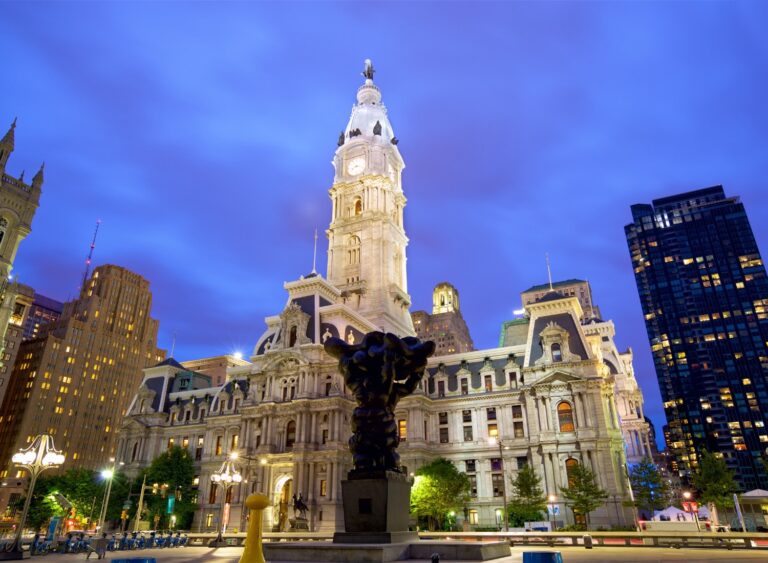

Philadelphia transit underpins regional business access

Key points:
- • Center City offers a river-to-river walkable core that can be crossed in under an hour, while SEPTA connects workers and visitors across the broader region.
- • High housing costs and cross-county commuting are increasing the importance of reliable transit for regional employers and workers.
- • King of Prussia’s Class A office vacancy has fallen to 11% as the district invests in sidewalks, multiuse trails, and other amenities tied to the employee experience.
 November 2026 — “Our economies do not stop at county lines,” said Laura Manion, president and CEO of the Chester County Chamber of Business and Industry, in an interview with Invest: Philadelphia.
Join us at caa’s upcoming leadership summits! These premier events bring together hundreds of public and private sector leaders to discuss the challenges and opportunities for businesses and investors. Find the next summit in a city near you!
You can walk from the Delaware River to the Schuylkill in under an hour, but the workers who fill those offices often start their day in another county, and roughly 800,000 daily trips across five counties depend on SEPTA to get them there. That reliance links Philadelphia’s walkability advantage directly to the performance of its regional transit network.
A city you can cross on foot
That compact corridor links 125-year-old food halls, major medical campuses, and corporate headquarters on foot. “Our location on the I-95 and Amtrak corridors, Philadelphia International Airport, walkability, and affordability all work together,” said Gregg Caren, president and CEO of the Philadelphia Convention and Visitors Bureau in an interview with Invest. “A river-to-river walk across the core of the city takes less than an hour, connecting places such as the Philadelphia Museum of Art, the historic district, the convention center, and Reading Terminal Market… Visitors can use Philadelphia as a hub for the region, including Valley Forge and King of Prussia, while businesses benefit from access to other Northeast markets and the world.”
That foot-traffic density only pays off if suburban workers can cross municipal borders to reach it, and they rely on SEPTA to do so. SEPTA’s FY2027 budget avoids fare increases and service cuts, but the authority still faces a $192 million structural deficit. The current budget relies on the second and final year of a $394 million transfer from capital funds to support operations, leaving SEPTA without a permanent state funding solution beyond FY27. At the same time, systemwide average daily ridership reached 822,753 trips in September 2026, its highest level since February 2020, reinforcing the scale of the region’s reliance on transit.
The commute problem
The friction is greatest where transit gaps meet high housing costs. Chester County has some of the highest residential prices in Pennsylvania, while many entry-level and mid-wage employees commute across county lines to reach jobs in the county.
“We advocate for the workforce, both employers and employees, so issues like childcare, access to public transit, and cost of living are important,” Manion said. “We have very high housing costs here in Chester County, and that is a workforce issue… Employers cannot recruit and retain talent if workers cannot afford to live in the region or reliably get to their jobs.”
According to SEPTA’s Capital Budget and 12-Year Program, tackling that infrastructure gap requires $14 billion over the next 12 years just to modernize core assets and maintain a state of good repair, including over $3 billion dedicated specifically to replacing aging rail vehicle fleets.
“We’re in an area of Southeast Pennsylvania where we have real infrastructure needs, whether that is roads and bridges or mass transit with SEPTA,” Manion noted. “Mass transit funding is always an issue in the Pennsylvania budget. I think SEPTA has done a phenomenal job listening to concerns from our legislature about safety and quality and making sure it is getting people back on public transit post-pandemic… We need to continue making investments in mass transit and infrastructure, so people have a safe, reliable way of moving around the region.”
King of Prussia is building sidewalks
King of Prussia’s overall office vacancy rate stood at 11.3% in 1Q26, the lowest among the suburban peer markets tracked by the King of Prussia District. At the same time, the district and its partners have invested in multimodal trails and pedestrian connections linking retail, commercial, and residential areas as they work to make the historically auto-centric community more walkable.
“King of Prussia has not historically been a walkable community. It is very auto-centric, but we are changing that quickly,” said Eric Goldstein, president and CEO of the King of Prussia District. “We and our partners, including the township and county, have invested considerable time and money in expanding sidewalks and multiuse trails. Those connections matter because they link retail areas with commercial and residential communities. Improving them is part of how our organization is responding to the market’s evolution.”
“Since 2020, many more human resources managers have participated in site-selection meetings because the employee experience has become much more important,” Goldstein said. “Companies no longer want only a good location close to the CEO. They want a location that gives employees a reason to come to the office, including things to do before, during, and after work. Employees want doctors, retailers, dining, and entertainment nearby rather than having to go straight home. The employee experience now weighs much more heavily in a location decision.”
For employers evaluating long-term locations, access increasingly extends beyond the building itself to transit, nearby services, and the broader employee experience. Philadelphia’s walkable core and King of Prussia’s investments in pedestrian infrastructure illustrate different approaches to that demand, while both remain connected to the region’s ability to move workers across county lines.
Want more? Read the Invest: Philadelphia report.