Pittsburgh business news: A new robotics hub lands
Key points:
- • Impossible Metals will open an Advanced Marine Robotics Hub in Pittsburgh.
- • The hub will add high-paying engineering and science jobs to the region.
- • Pittsburgh is already home to more than 140 robotics companies.
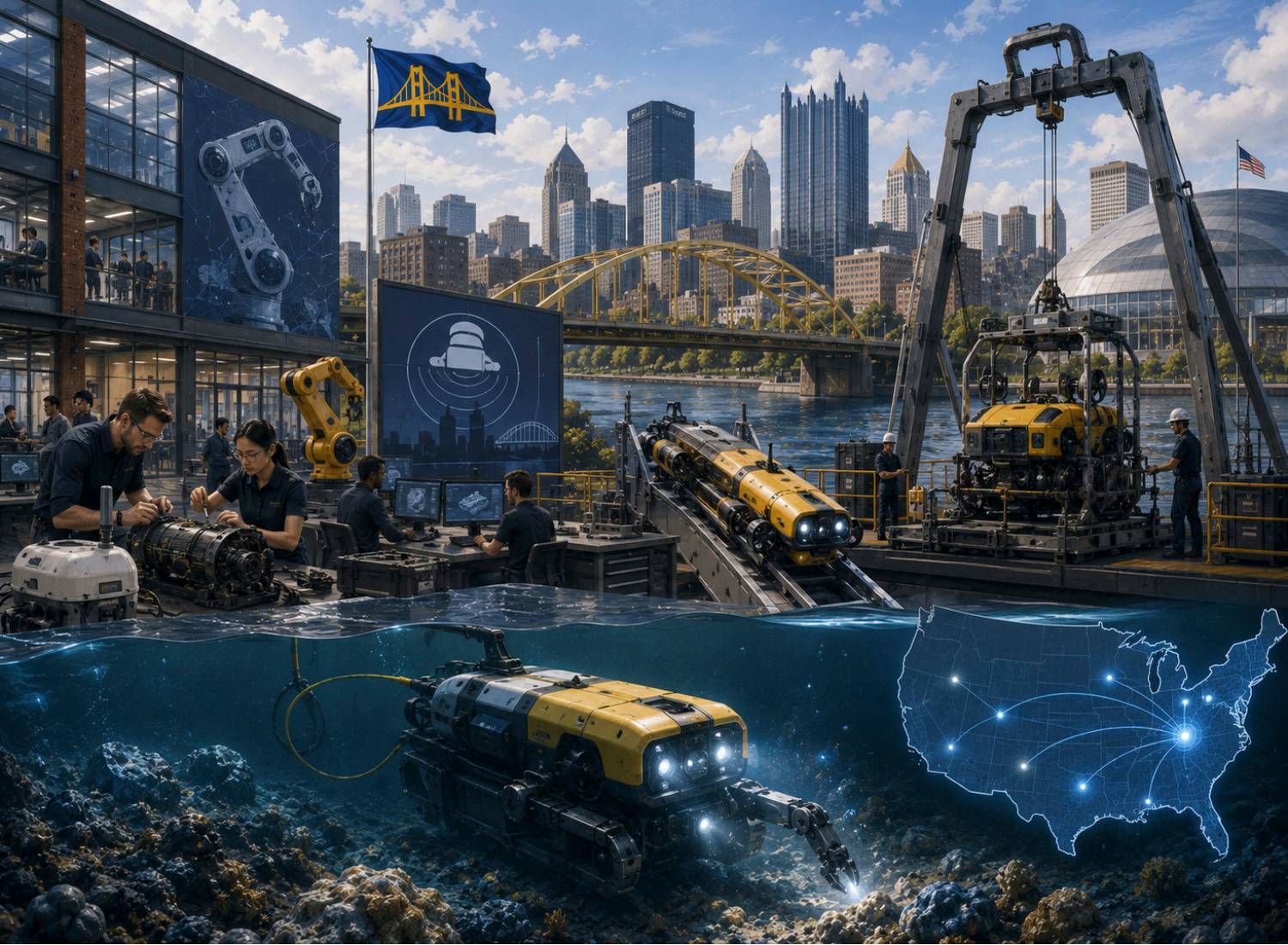 August 2026 — Pittsburgh business news this week added a new name to its robotics roster: Impossible Metals, a deep-sea critical-minerals technology company, says it will open an Advanced Marine Robotics Hub in the city, citing Pittsburgh’s dense concentration of robotics talent.
The announcement, made at the Pennsylvania Defense and Innovation Summit in Carlisle, ties Pittsburgh into two of 2026’s biggest industrial narratives at once: the race to secure critical minerals outside of China, and the broader boom in physical-AI and robotics investment.
Join us at caa’s upcoming leadership summits! These premier events bring together hundreds of public and private sector leaders to discuss the challenges and opportunities for businesses and investors. Find the next summit in a city near you!
According to Impossible Metals’ announcement, the new hub will create more than a dozen high-paying engineering and science jobs to start, “with room to grow,” and the company plans to pursue research partnerships with local colleges and universities, including student opportunities and a possible annual robotics competition.
The company builds autonomous underwater platforms — branded Eureka — along with what it calls Smart Launch and Recovery Systems, designed to collect seabed nickel, cobalt, copper and manganese without the dredging methods that have drawn environmental criticism in other deep-sea mining proposals. Executive Chairman Steve Curnutte and Chief Growth Officer Mike Regan are named in the release as the company’s public face for the expansion, and the announcement explicitly states that specific investment figures and a site location will be disclosed in the coming months.
A magnet for robotics capital
What makes the announcement notable for Pittsburgh business news readers is less the initial job count than the reason the company gave for choosing the city at all. Impossible Metals’ release states that Pittsburgh is home to more than 140 robotics companies, a density built over two decades on the back of Carnegie Mellon University’s robotics research programs and a steady stream of spinout companies.
That existing base has already produced well-known names in autonomous vehicles, industrial inspection and defense robotics, and it gives newcomers like Impossible Metals a labor market that competitors in most other U.S. cities simply cannot match. For a critical-minerals company whose core technology is fundamentally a robotics problem — building machines that can operate autonomously thousands of feet underwater — that talent pool is arguably more valuable than any single tax incentive a city could offer.
Minerals meet robotics
The bigger story is how a critical-minerals company ended up choosing a robotics hub at all. Nickel, cobalt, copper and manganese are essential inputs for batteries and defense electronics, and the United States has spent much of 2026 pushing to reduce reliance on Chinese-controlled mineral supply chains.
Impossible Metals’ pitch is that autonomous seabed vehicles can collect those minerals without the ecological footprint of traditional dredging, but building and operating that hardware reliably requires exactly the kind of engineering talent Pittsburgh has spent years cultivating. That overlap between defense-driven industrial policy and physical-AI investment is becoming a recognizable pattern nationally, and Pittsburgh is positioned to capture more of it than most peer metros because the underlying talent base already exists rather than needing to be built from scratch.
National investors reading this round of Pittsburgh business news should note that the city is increasingly winning on infrastructure that already exists — talent, universities and prior robotics deals — rather than on incentive packages alone, a distinction that tends to produce more durable, harder-to-poach employers over time.
The timing also matters locally. Pittsburgh’s economy has spent years trying to translate Carnegie Mellon’s research strength into durable, well-paying jobs rather than watching promising graduates and spinouts leave for the coasts. A steady drumbeat of robotics and defense-tech companies choosing to expand in the city, rather than simply license technology developed there, suggests that translation is starting to work. Impossible Metals joins a broader wave of robotics and autonomous-systems investment tied to the current Pennsylvania defense-manufacturing push, and each additional company that lands in the city adds to the density argument the next company will use to justify its own decision to locate there.
Want more? Read the Invest: Pittsburgh report.