Spotlight On: Alison Barlow, Executive Director, St. Petersburg Innovation District
 January 2025 — Executive Director of the St. Petersburg Innovation District Alison Barlow talked to Invest: about the ways the District has leveraged partnerships across multiple sectors to spur growth in the Tampa Bay region, especially with the goal of strengthening and supporting the blue economy and local entrepreneurs.
What were the milestones or key projects for the St. Petersburg Innovation District in the past year?
Over the past year, we had two major projects. One involved launching a master planning activity as the District celebrates eight years of operation. We are fortunate to be the home of several anchor institutions, including Orlando Health Bayfront Hospital, Johns Hopkins All Children’s Hospital, and USF St. Petersburg, several government entities, and multiple city properties. This master plan integrates each entity’s “campus plans” to foster innovation and collaboration.
The other major activity involved participation in a National Oceanic and Atmospheric Administration initiative as one of four teams nationally to grow data and tech companies focused on ocean solutions. Partnering with Tampa Bay Wave, USF, Seaworthy Collective (South Florida), Braid Theory (California), Ocean Exchange, and the World Ocean Council. Focus areas include startups across diverse topics like hazard mitigation and coastal resilience, ocean renewable energy and marine ecosystem management.
We refer to this endeavor as The Continuum, and it is an effective representation of our support for startups at all stages, from ideation to scaling. Entrepreneurs benefit from tailored resources provided by the district and its partners, ensuring a continuum of services.
READ MORE: Blue economy making waves in Tampa Bay
What is the District’s strategy to continue incubating projects while mitigating challenges like rising costs and higher interest rates?
Through partnerships across Tampa Bay, we conducted a mapping of support organizations, culminating in an ecosystem map funded by Duke Energy. This tool aids entrepreneurs by clearly outlining available resources.
On a hyperlocal level within the District, we opened a coworking space three years ago called the Maritime and Defense Technology Hub, which specifically targets tech companies that are in industries that we want to see grow. We offer them flexible rental rates, as well as services and connections to support their growth. While I can’t affect interest rates, there are plenty of ways I can assuage other costs and bolster growth.
How are you encouraging entrepreneurs to transit from the nonprofit sector and into the profitable side?
Particularly in areas such as life science and marine science, the people who are interested in these sectors instinctively want to start nonprofits. That’s an admirable intention, but we are rather saturated in nonprofits and do not have enough giving. The question is how to transform their ideas into viable businesses. We are coaching many organizations by partnering with them to encourage innovation. Identifying and enhancing the “sellable” aspects of ideas. While they may stay with a nonprofit mindset or integrate a for-profit element, we try to help nonprofits scale their efforts in effective ways.

With over 50 member organizations, what types of members are you adding to the District?
We have two classifications for members: geographical members within the District’s 560-acre footprint and strategic partners that do not have a footprint within the district but which are closely aligned with our values, such as St. Petersburg College, Foundation for a Healthy St. Petersburg and St. Petersburg Downtown Partnership.
The District focuses in particular on expanding partnerships in maritime and ocean tech, collaborating with organizations like Port Tampa Bay, Port of St. Petersburg and private tech companies like Saildrone and Digital Twin Marine. We are excited to see these partnerships continue to grow.
What are the main challenges faced by Blue Economy professionals in South Florida?
First and foremost, the ocean remains an underexplored and undervalued resource, despite Florida’s extensive coastline. The ocean is critical for us, but we are operating on minimal, outdated maps, and the high cost of testing and commercializing solutions are a massive barrier. Efforts to allay these issues include deploying advanced unmanned vessels and buoys to generate actionable data for industries like commercial shipping and flood management.
How important is cross-industry expertise to the blue economy, like fintech and cybertech?
I believe there is significant potential within both of those industries. I would highlight cybersecurity’s relevance to marine operations and the financial modeling required for emerging solutions like carbon sequestration credits. A bridge exists between marine and life sciences, and it is in the best interest of both sectors to explore the impacts of ocean health on human health. This can be seen through studies on PFAS chemicals and red tide effects on respiratory conditions.
The District’s Innovation Ecosystem Framework notes three types of assets. How do these benefit the South Florida region?
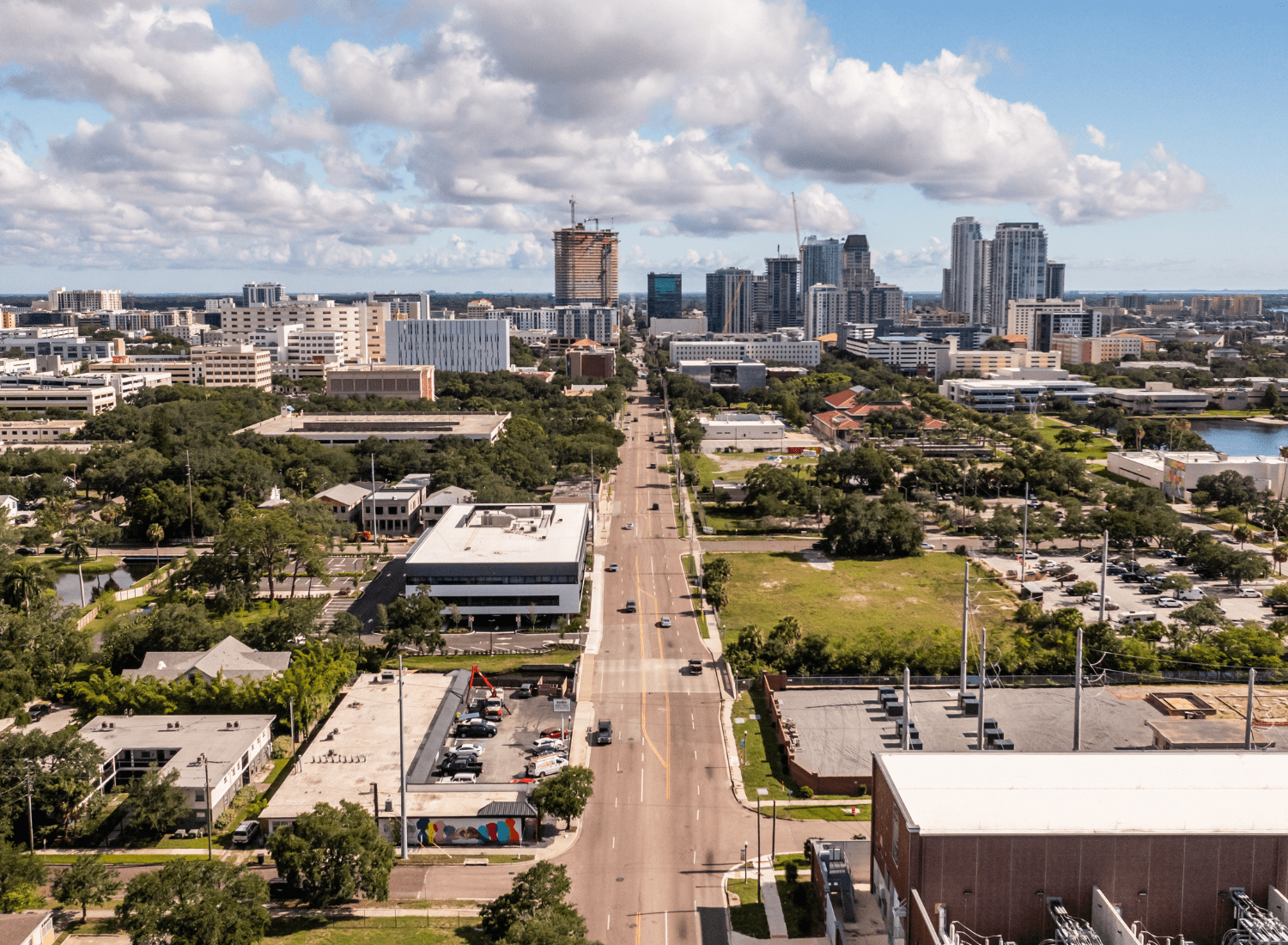
The codified innovation district model listed three necessary items – place assets, economic assets and networking assets. Place assets are encouraged through our master planning efforts and seek to create dynamic spaces like public-facing restaurants on hospital campus and the new purpose-built technology incubator, ARK Innovation Center. Our economic assets involve recruiting external businesses and fostering local industry clusters to support career growth within the region. Cultivating networking assets occurs through cross-industry events like discussions on future air mobility and artificial intelligence.
Looking ahead to the next five years, what goals will be at the forefront of the St. Petersburg Innovation District’s efforts?
Our master plan will be finalized in 2025, and then we will focus on implementing our priority projects. I foresee us doubling down on maritime technology by leveraging Tampa Bay’s unique strengths and breadth of private, academic and public entities. I also look forward to the advancement of life sciences across the Tampa Bay region, and the collaborations that will result as each area leverages their specialized expertise. There will likely be expansion into new technology areas, including space exploration, as successful endeavors such as Lonestar Lunar’s commercial data service to the moon demonstrate Tampa Bay’s growing role in supporting the space industry.
Images provided by St. Petersburg Innovation District
For more information, please visit: