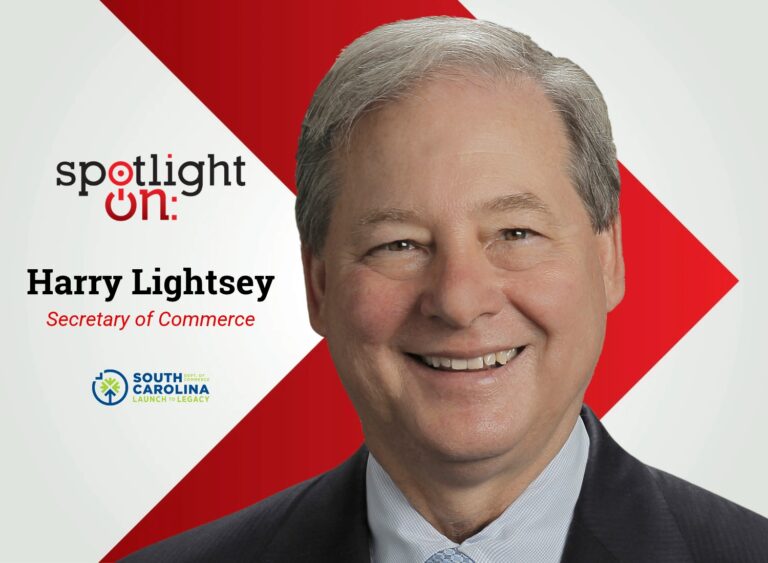

Spotlight On: Harry Lightsey, Secretary of Commerce, South Carolina Department of Commerce
Key points:
- • South Carolina’s advanced energy tech hub is among 12 funded nationwide.
- • Through readySC, technical colleges train workers for new companies at no cost.
- • Rural areas accounted for about 40% of 2025 announced investment and jobs.
 November 2026 — In an interview with Invest:, Harry Lightsey, secretary of commerce for the state of South Carolina, discussed the forces driving the state’s economic momentum and its strategy for attracting investment. Lightsey highlighted emerging opportunities in advanced energy and life sciences, the role of workforce development and international partnerships, and efforts to extend growth into rural communities. “I would say our secret sauce is our people,” Lightsey said.
Join us at caa’s upcoming leadership summits! These premier events bring together hundreds of public and private sector leaders to discuss the challenges and opportunities for businesses and investors. Find the next summit in a city near you!
What has driven South Carolina’s sustained economic success?
The past few years have been the culmination of several factors. Following COVID, many businesses realized how vulnerable their supply chains were and began looking for ways to onshore operations to make their businesses more secure and resilient in the face of disruptive events. Larger technology shifts have also created significant investment opportunities, and South Carolina has capitalized on those trends in some of our stronger sectors.
South Carolina has also become better known in certain parts of the world. Businesses increasingly think of us when they consider establishing operations in the United States or North America.
How is the Department of Commerce positioning South Carolina to capitalize on emerging technologies?
About three years ago, we announced a new strategic plan that prioritized sectors in which we believed South Carolina could be highly competitive. We will continue building our established automotive and aerospace sectors, which are already recognized throughout the world, while pursuing industries with strong future growth potential.
The first of those is advanced energy. We anticipated that energy demand would grow dramatically as businesses became more energy-intensive. Energy is now a compelling factor when companies evaluate locations, and we expect a continuing revolution in advanced energy.
That strategy led South Carolina to apply for designation as a technology hub focused on advanced energy. The U.S. Department of Commerce named us one of 31 tech hubs with the assets to be a global leader in a technology important to national security and the economy. We were then among 12 hubs to receive funding and the only funded hub in the energy space.
The U.S. Department of Commerce this year expanded our tech hub statewide, including areas near Charlotte that were not previously covered. That has already created additional opportunities, including our Carolinas Grid Engine in partnership with UNC Charlotte and others in the region being designated recently as one of 12 NSF Engines by the U.S. National Science Foundation.
We are positioning South Carolina to participate in changes across the electric grid, including new technologies and more distributed generation. Companies in this space are already coming to the state.
We are also emphasizing life sciences and biotechnology. OctaPharma recently decided to locate its U.S. headquarters and first U.S. manufacturing capabilities in Rock Hill. We have seen additional progress across the sector.
Our third focus includes research and development and headquarters. South Carolina is a beautiful state where many executives vacation or own homes. Our message is that if executives value South Carolina enough to own a home here, they should consider bringing their headquarters here as well.
How is the state developing the workforce needed to support these industries?
South Carolina is a growth story. On a per capita basis, we have been the fastest-growing state in the country for the past two years. More people are working in South Carolina than ever before, and workforce participation among employable residents is at a historic high by percentage and exceeds that of many states in our region.
We also have seven major military bases, each with a transition station where people leaving military service can learn about employment opportunities in South Carolina. Veterans make great employees — they understand discipline, chain of command and the responsibility of showing up on time. We work with those transition stations to connect service members with opportunities here. South Carolina is also military-friendly, and military retirement benefits are exempt from state taxes.
Our technical colleges are another major strength. South Carolina established a statewide technical college system in the 1960s, and it continues to be a leading example globally. Through workforce programs like readySC, the system works with businesses locating in the state at no cost to determine the skills they need. Teams can visit companies’ overseas operations, study their facilities, and bring those observations back to South Carolina. They then work with nearby technical colleges to create relevant curricula, recruit employees and train them before bringing them into the workplace. That’s been a game changer. The same support is available to existing South Carolina businesses preparing to expand.
South Carolina’s four-year colleges and universities are becoming increasingly integral as businesses require more advanced capabilities. Technology is becoming more a part of nearly every industry, creating demand for higher-level technical and programming skills. We work with institutions across the state to explain which businesses are coming and what capabilities they will need.
Companies repeatedly tell us that the people of South Carolina make the difference. They value their relationships with employers, enjoy their work and have proven that they are productive, innovative and creative. Boeing and BMW have told us that their South Carolina operations are among their most productive facilities worldwide. I would say our secret sauce is our people.
How has South Carolina’s international investment strategy evolved?
South Carolina is a small state geographically, and many people around the world primarily associate the United States with places such as New York City or Los Angeles. It is vitally important for us to explain who we are, where we are located and why international companies should consider South Carolina when entering the United States.
We celebrated the 50th anniversary of our European office last summer, so this has been a dedicated strategy for decades. We now have six offices around the world representing South Carolina and telling our story.
We have also signed memorandums of understanding with multiple countries to increase collaboration among South Carolina businesses, universities and international partners. We signed an agreement with Ontario, which shares our strengths in automotive and aerospace manufacturing and is working extensively in advanced energy, including small modular nuclear reactors. South Carolina is also highly interested in nuclear energy.
Last year, South Carolina became the first U.S. state to sign a cooperation agreement with Germany. Many companies operating here come from Germany, and we have strong relationships with Bavaria. We have also signed agreements with Taiwan and the United Kingdom. These relationships have generated reciprocal missions and university research collaborations. Our approach is to proactively tell South Carolina’s story.
How is the department helping rural communities participate in the state’s economic growth?
South Carolina has historically been an agricultural state, and many rural communities have experienced economic distress and population loss, while other areas have grown. Addressing that challenge has been a priority for several years.
The results are encouraging. In 2025, South Carolina announced more than $9 billion in capital investment and over 14,000 jobs. About 40% of both totals were in rural parts of the state. That tells us that 20 years of work helping rural areas prepare for investment is starting to pay off.
The state has invested heavily in rural infrastructure. South Carolina has essentially achieved statewide broadband access, making us one of the first states to reach that point. We continue investing in water and sewer systems and working with power providers, particularly rural utilities, to ensure industrial parks have the infrastructure required to support businesses.
We also provide strategic consultants at no cost to our most rural and economically distressed counties. These consultants help communities create strategic plans and prioritize development projects. After completing that process, communities can receive a $250,000 grant for their highest-priority initiative. Iva, for example, transformed an abandoned downtown fire station into a library, while Walterboro and McCormick are pursuing downtown beautification efforts.
Active downtowns with attractive, growing small businesses can influence how companies view a community. Small towns offer a strong sense of community, and a company can see how locating there can make a meaningful impact while creating opportunities that allow younger residents to remain in their hometowns.
And projects are following.
Ferrara recently announced an $675 million facility expected to employ 1,000 people in Orangeburg, a historically rural, agricultural community. That is tremendously exciting for the area and illustrates the impact major investment can have on a rural community.
Want more? Read the Invest: South Carolina report.