
Spotlight On: Scot Johnson, Principal & Chief Investment Officer, Adell Harriman & Carpenter Inc.
Key points:
- • AI is creating new investment opportunities across multiple industries.
- • Personalized strategies help investors navigate volatility and long-term goals.
- • Talent and succession planning are central to the firm’s continued growth.
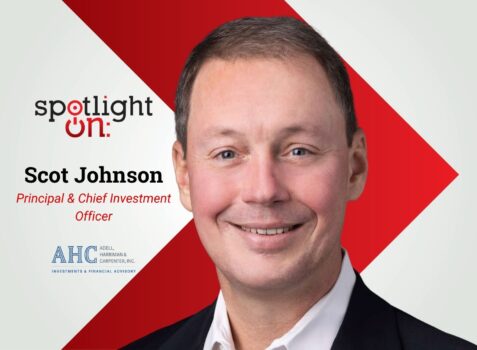 October 2026 — Invest: spoke with Scot Johnson, principal and chief investment officer of Adell Harriman & Carpenter Inc., about how the firm is navigating market volatility, scaling a highly personalized investment approach, and positioning itself for the next phase of growth in Houston’s evolving economy. “Houston is one of the few major metros in the United States with a relatively even mix of the country’s major ethnic backgrounds. That creates a dynamic cultural and economic environment,” Johnson said.
Join us at the Invest: Houston 3rd Edition Leadership Summit! This premier event brings together hundreds of Houston’s business and regional leaders to discuss the challenges and opportunities for businesses and investors. Buy your ticket now!
What market or economic trends are shaping your investment strategy heading into 2026?
One of the biggest themes over the past few years has been artificial intelligence. From an investment perspective, we have watched that evolution happen in stages. Initially, the primary beneficiaries were the companies producing the semiconductor chips and hardware. Then it moved to the businesses building infrastructure around that hardware. Now we are entering the phase where companies are using artificial intelligence to monetize it and improve efficiency within their operations.
From a portfolio-management standpoint, our focus is on identifying companies that stand to benefit at each stage of that cycle. It is not just about the headline names, but also the broader ecosystem, including software, cybersecurity, data infrastructure, and the businesses that can turn productivity gains into durable cash flow. That evolution is ongoing, and we think it will continue to be a meaningful driver of investment opportunity over the coming years.
As the firm continues to grow, how do you maintain a personalized, hands-on approach while scaling?
It comes down to staffing and infrastructure. Over the past year, we hired three new team members who work directly with clients to help us preserve that personal touch. We also hired our first in-house counsel, who serves as our chief compliance officer.
That addition allows us to provide more guidance to clients with complex legal or structural questions before we bring in outside counsel. Whether it is estate planning considerations or how best to own a particular asset, those conversations are increasingly important. For example, clients may be thinking about updating estate plans, deciding whether to hold a piece of property personally or through a trust, or evaluating whether a corporate structure is the right fit for what they are trying to accomplish.
We are also making sure we have the systems and processes in place to support growth without losing the individualized approach that defines how we work with clients. The goal is to keep the experience high-touch while building the depth behind the scenes so the service stays consistent as the firm expands.
Investor confidence has held up despite rising rates and inflation. How are your clients feeling, and how do you keep them focused on long-term goals?
That is sometimes easier said than done. We have had three strong years in the stock market, and coming into 2026 it is reasonable to expect returns to be more moderate. That said, the underlying economic fundamentals remain solid. Publicly traded companies are showing record profitability and strong margins, which is a good backdrop.
The market is forward-looking, and some of that good news is already priced in. Our role is to help clients think about where we are in the broader business cycle and what the next six, 12, or 18 months might look like. We remind them that volatility is part of investing, and that short-term moves can feel loud even when the long-term trend remains constructive.
We don’t go up in a straight line, but stocks continue to go up. Over time, it tends to be a series of two or three steps forward and a step back. Sometimes it is two or three steps forward and four or five steps back. We focus on owning companies with management teams that can improvise and adapt to overcome the challenges they inevitably face. That ability to navigate change, allocate capital well, and protect profitability is central to long-term performance.
How are priorities shifting among the multigenerational families and investors you work with?
One of the advantages of managing portfolios on an individualized basis is that we can tailor strategies to what each client is trying to accomplish. For some families, the priority is peace of mind. For others, it is building a legacy for future generations or creating opportunities for charitable giving.
Rather than offering a menu of products, we start by listening. We want to understand what clients want their assets to do for them, how they define success, and what trade-offs they are willing to accept along the way. Then we build portfolios to match those goals, whether that means emphasizing liquidity, building long-term growth, generating cash flow, or supporting planned giving. That approach is central to how we work, and it is a big reason clients value the relationship.
Technology continues to evolve rapidly. Where has it made the biggest impact, and where does human judgment still matter most?
The human element is still essential, especially when it comes to client conversations. Most clients want to work with people, not machines. They want someone who can understand their situation, interpret what is happening in markets, and connect those dots back to their goals.
That said, technology has been helpful on the analytical side. Artificial intelligence allows us to process large volumes of information more efficiently, such as summarizing lengthy earnings calls and identifying key takeaways. It can reduce the time it takes to get through the basic information so we can spend more time on interpretation, debate, and decision-making.
There are also areas where we are still exploring how to automate repetitive processes. Some of it is a work in progress, figuring out which parts of our workflow can be standardized without sacrificing quality. There are parts of our business that we do not want to automate because doing so would risk losing the personal touch. Judgment gained through experience matters. It is not just about what information says, but what it means.
What qualities matter most as you attract talent and prepare the firm for the future?
Cultural fit is critical. We are a team of about 15 people, and it is important that new hires put the team first and clients above everything else. That mindset is what makes someone successful here, especially in a smaller organization where everyone’s work touches the client experience.
As a smaller firm, recruiting can be more challenging than it is for large organizations with structured pipelines of new graduates. We are typically looking for experienced professionals who are already working elsewhere, and that means recruiting often comes down to relationships and having the right conversations at the right time. We believe we have a compelling story to tell and a strong environment for professionals who want to do high-quality work in a collaborative setting, but finding the right fit takes patience and focus.
From a broader perspective, what makes Houston a strong fit for your business and for companies considering investment in Texas?
There are several factors. Demographics are a big one. People continue to move to Houston and Texas more broadly because of the opportunities here. The state’s tax framework is business-friendly, and the lack of a state income tax is attractive to many individuals.
Houston also benefits from its diversity. The city brings together people from a wide range of backgrounds, which drives creativity and innovation. That diversity shows up across industries, and it contributes to the region’s resilience and long-term growth. One of the neat things about Houston is that you can see the breadth of the community in everyday life, including the variety of cultures and the kinds of businesses that thrive here. Different backgrounds bring different ideas, and that sparks innovation and evolution in a good way.
How does Houston’s demographic makeup support your long-term outlook?
Houston is one of the few major metros in the United States with a relatively even mix of the country’s major ethnic backgrounds. That creates a dynamic cultural and economic environment. Different perspectives lead to different ideas, and that diversity strengthens the city’s ability to evolve and adapt over time.
It also supports long-term growth by widening the talent base and encouraging new business formation. When you have a broad mix of people, you tend to see new networks form, new approaches to problem-solving, and a level of dynamism that is hard to replicate in more homogeneous regions. From an economic standpoint, that kind of environment is a good foundation for opportunity.
Looking ahead, what are your top priorities as you guide the firm into its next chapter?
Talent is the top priority. We celebrated our 30th anniversary last year, and as part of that milestone, we are focused on succession and continuity. Some long-tenured team members are beginning to think about retirement, so we must continue building the next generation of advisors.
Two of our founders are still actively engaged in the business, and we have been building out our second generation of advisors, which includes me. We plan to continue investing in advisor talent over the next several years. We are also expanding our client support team as assets under management grow. Last year, we surpassed $2 billion in assets, which was a significant milestone. As we continue to grow, adding the right people, maintaining service quality, and preserving our culture will remain the primary focus.
Want more? Read the Invest: Houston report.