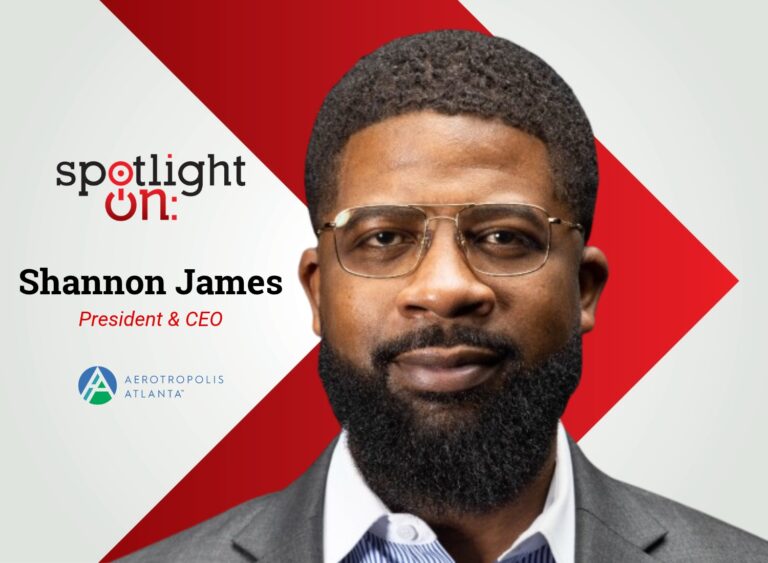

Spotlight On: Shannon James, President & CEO, Aerotropolis Atlanta Alliance
Key points:
- • The Alliance opened its first headquarters, anchoring training and entrepreneurship programs.
- • Housing, healthcare training, and transportation connections are priorities for South Metro Atlanta.
- • Microsoft joined the board and committed $1 million to Fulton County Schools.
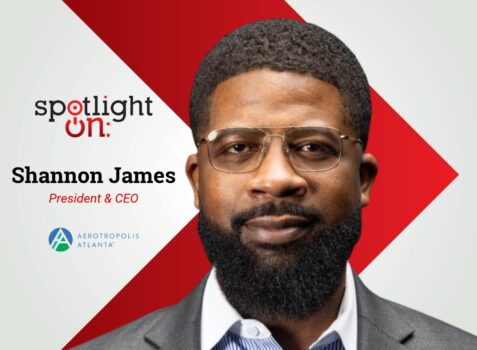 November 2026 — In an interview with Focus:, Shannon James, president and CEO of the Aerotropolis Atlanta Alliance, discussed the organization’s new headquarters, workforce development, transportation initiatives, entrepreneurship programs, and the long-term vision for South Metro Atlanta. “Our organization was ultimately created to help strengthen our regional economic competitiveness,” James said.
Join us at the Focus: Atlanta 8th Edition Leadership Summit! This premier event brings together hundreds of Atlanta’s business and regional leaders to discuss the challenges and opportunities for businesses and investors. Buy your ticket now!
How has the past year been for Aerotropolis Atlanta Alliance, and what milestones are you most proud of?
The past year has been productive for us. We opened our first headquarters in August 2025. It is roughly 10,000 square feet of flex space dedicated to training, entrepreneurship, and innovation through our “Land Here. Take Off” Center. A coworking space with dedicated offices, hot desks, innovation lab, podcast room, and lounge located in College Park, Clayton County, near the Georgia International Convention Center (GICC) and the Gateway Center Arena. We are literally connected to the airport via Skytrain, which is ideal for the work we do.
Beyond the headquarters, we have been pushing several major initiatives. One is a housing study in Clayton County. We received a Community Development Assistance Program grant through the Atlanta Regional Commission (ARC) and are working with KB Advisors on community engagement, data gathering, built environment analysis, and housing inventory to better plan for future development.
That study came on the heels of a Livable Centers Initiative (LCI) grant through ARC for Tara Boulevard. The top priority from that work was housing, which surprised us, and led us to pursue a broader housing study. This is part of an implementation plan outlined inside the Tara Boulevard Corridor Study and connecting the dots on work we are doing inside Clayton County.
We have also been active with Blueprint 2.0, our five- to seven-year marketing game plan for the region. We identified catalytic sites and have activated our number one catalytic site with the formerly vacant Owens Illinois property in East Point, GA. We are also actively implementing our workforce development strategy.
Healthcare emerged as a major need in our region, especially after Wellstar vacated East Point. During the first quarter of 2026, we launched our first healthcare cohort, with about 21 Clayton County residents participating in a free eight-week program in partnership with STRIVE Atlanta and LISC Atlanta. The cohort participants graduated in late March and are being placed into the healthcare industry.
Transportation is another major focus. We have focused on bike + trail connectivity to complement that work, including first- and last-mile connections. During 2024, The ARC received $64.9 million from the U.S. Department of Transportation to extend the Atlanta Beltline further south inside our Aerotropolis region; However, that funding was lost under the current White House administration. Thanks to our partnership with ARC, we were able to keep the momentum going through the South Metro Trails Leadership Alliance.
ARC set aside $3 million for bike + trail development, and we are co-hosting/leading that effort across South Fulton, Clayton, Henry, Coweta, Spalding, and Fayette counties. The final transportation piece is advanced air mobility. We have been the leading voice in our region around flying taxis, eVTOLs, and vertiports. We recently hosted discussions through ConnectATL, an ARC’s initiative, and brought together partners including Delta Air Lines, Joby Aviation, Georgia Department of Transportation (GDOT), Wing, Metro Atlanta Chamber, and Georgia Tech. We hope to launch a pilot here within the next 12 months.
How has the discussion around data center development evolved, and what opportunities and challenges does it create for the region?
The data center discussion has been active across our region because we have land for development and opportunity. Since our last discussion, Microsoft joined our board, and Trina Clark James is our representative. We have been able to work with Microsoft on future site selections and influencing their civic responsibility within our communities.
The challenge is identifying sites that are compatible and desirable for that land use and ensuring data center developers are intentionally investing in our communities and schools. I am proud to announce a $1 million Microsoft commitment to Fulton County Schools in the South Fulton region, made possible through these efforts. By listening to our K-12, post-secondary, and community stakeholders, we brought Microsoft an actual need and structure they could fully get behind.
How is the Alliance helping connect residents to the jobs and industries driving growth around the airport?
We have been focused on two major initiatives to connect current talent and legacy residents to pathways. This year, we hosted our seventh annual Career, College and Resource Expo. We recruited about 50 corporations, resource partners, and post-secondary partners to work with juniors and seniors from South Fulton and Clayton County at the GICC. We typically bring together 500 to 600 students and spend half a day exposing them to companies and resources such as Delta Air Lines, Grady Health System, Porsche Cars North America, Chick-fil-A, Georgia Power, Atlanta Gas Light, Hartsfield-Jackson Atlanta International Airport, STRIVE Atlanta, Construction Ready, the Atlanta Center for Self-Sufficiency, and post-secondary institutions.
Some students may not be interested in college, but they may want a skill, trade, or certification. We want to help them understand what is around them so when they graduate, they are moving toward a career, not just a job.
As a spin-off, we hosted our Second Annual Aerotropolis Community Hiring Fair in May. We had just over 600 local residents attend and roughly 50 corporate and resource partners in the room. That allowed industry to come directly into the community and hire local talent. Those fairs, along with our training/placement cohorts and exposure events, are helping create more aware and credentialed residents who can be deployed into industry.
What entrepreneurship opportunities is the Alliance helping support?
We recently partnered with Access to Capital for Entrepreneurs (ACE) and LISC Atlanta to host an Access to Capital workshop series for local entrepreneurs. We found that many small business owners struggle to understand the capital process, nuances required for a successful response from the capital market, and different vehicles available to pursue capital.
ACE and LISC are both Community Development Financial Institutions (CDFI’s). This series helped entrepreneurs understand they do not have to solely think about traditional banks. There are other tools and resources available. Having our headquarters allowed us to successfully launch phase one of capital programming for the “Land Here. Take Off.” Center (LHTO). We are positioning phase two for entrepreneurs who are more advanced, especially developers, who need more support and/or relationships to craft proposals and projects that can come to fruition.
Looking ahead five to 10 years, what are your top priorities for the Aerotropolis Atlanta Alliance?
Our region is South Fulton and Clayton County. We cover 176 square miles and 15 jurisdictions, and we are big on data. We monitor several data points, including the share of renters versus owners, quality of life elements, household income, per capita income, job creation, starting salaries, livable wages, transportation gaps, housing affordability, and housing quality.
Our organization was ultimately created to help strengthen our regional economic competitiveness. When we think about competitiveness, we think about communities thriving and corporations thriving. They are not mutually exclusive. Housing has become a significant priority, and we cannot talk about housing without transportation. Over the next five years, we hope to serve as a solution to the ongoing imbalance of data.
We want to see more homeownership, which means pushing for single-family home development, townhomes, and condo-type products while monitoring price points and supporting the right incentive packages. We also want to see a greater diversity of industries coming to our area so more local residents can participate, rather than people from outside the region coming in to take those jobs.
Once those elements begin moving, rooftops increase, residents scale up, and more homeowners enter the market. Then, more retail options and placemaking projects begin to locate in our region, and the quality of life improves. The goal is clear: support households living paycheck to paycheck, expand access to opportunity, attract grocers and industry, improve public safety, and strengthen our schools.
Want more? Read the Focus: Atlanta report.