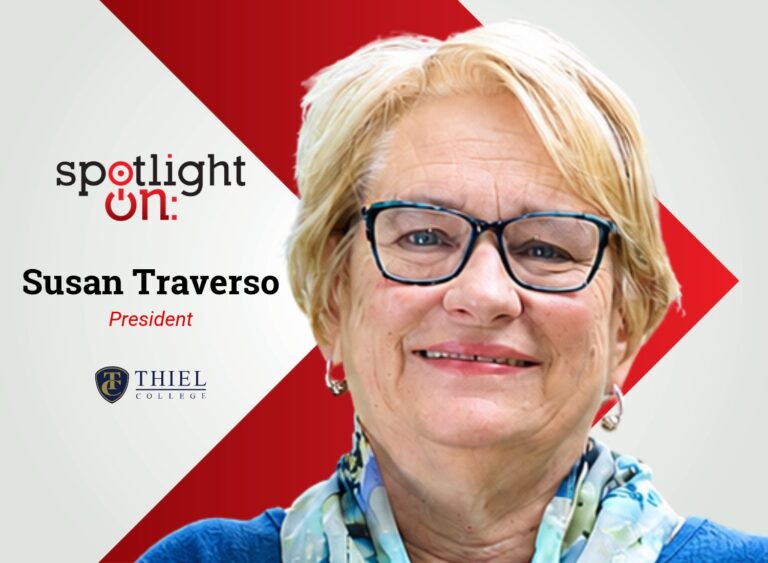

Spotlight On: Susan Traverso, President, Thiel College
Key points:
- • Thiel has grown enrollment while expanding career-focused and graduate programs.
- • A LECOM partnership will offer students an accelerated pathway to medical school.
- • Thiel has raised close to $95 million for scholarships, programs, and facilities.
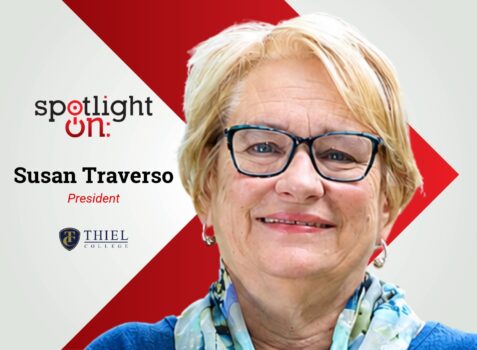 November 2026 — Invest: spoke with Susan Traverso, president of Thiel College, about career preparation, graduate programs, regional partnerships, philanthropy, and campus investment. “Education should have a long-term outcome, but it must also help graduates begin meaningful careers that can grow over a lifetime,” Traverso said.
Join us at caa’s upcoming leadership summits! These premier events bring together hundreds of public and private sector leaders to discuss the challenges and opportunities for businesses and investors. Find the next summit in a city near you!
How is Thiel preparing students for careers and meaningful lives?
Thiel is a comprehensive liberal arts college founded in 1866. We remain committed to the liberal arts: understanding information, asking critical questions, and learning about cultures that are different from one’s own. Thiel has always emphasized programs that prepare students for careers and meaningful lives.
Education should have a long-term outcome, but it must also help graduates begin meaningful careers that can grow over a lifetime. That mission is especially urgent because many of our students are the first in their families to attend college and are pursuing professional opportunities in nursing, teaching, business, and other fields. They must be ready on day one to use those opportunities.
We are closely connected to Penn-Northwest Development Corporation, the Allegheny Conference, and economic development organizations that surround us. We follow workforce data for northwestern Pennsylvania and eastern Ohio. The region needs qualified business leaders, accountants, allied health professionals, and educators, so we have strengthened those programs while maintaining liberal arts pathways to graduate study.
How is the college adapting to changes in higher education?
Thiel has grown enrollment over the past several years while many small colleges have contracted. Our mission fits today’s marketplace and student expectations. We have added professional degrees, brought nursing back, established sports management, and moved forward with a new undergraduate degree in nutrition. We are also developing a fully online, one-year graduate nutrition program for fall 2027.
We remain unquestionably committed to deep learning while responding to regional demand. Thiel historically focused on undergraduates, but we began adding graduate programs in 2020 and will continue. Each program must connect to an existing strength so we can deliver it with excellence, and it must address a demonstrated regional need. Local businesses and health systems told us they could not find enough qualified nutritionists and offered to support clinical placements and field experience. We have seen similar demand for nursing.
The proposed graduate nutrition program will have online coursework with in-person internships. A student could spend four undergraduate years on campus and move directly into the master’s program, while graduates of other colleges could also enroll. That design expands access without separating the program from the regional employers asking for qualified professionals.
Our academic portfolio also includes sports management, business, an MBA, and bachelor’s communication sciences degree and a master’s degree in speech-language pathology. The graduate pathway is important because careers such as speech pathology require education beyond the bachelor’s degree. We want students to see a clear connection between undergraduate learning, advanced study, and regional careers.
Students educated here are more likely to remain in northwestern Pennsylvania. Many graduates also go to Pittsburgh, but the largely rural region north of the city needs more professionals in allied health, business, and education.
How does Thiel contribute to regional economic development?
Our mission has two parts: developing undergraduate and graduate students for careers and lives of meaning and purpose, and serving as an asset to the region. That second responsibility is written directly into our mission.
We provide local students with educational and economic opportunity, including approximately $21 million in undergraduate scholarship aid. We are the largest employer in Greenville and create professional and workforce opportunities on campus. During the past five years, we have invested close to $20 million in the physical plant and hired local contractors. We are beginning construction on a $10 million athletic and recreation building designed and built by a local firm.
Those scholarships can make a high-quality college education possible for students who live nearby and may not initially consider attending the institution just up the street. The employment and construction activity then extend the college’s economic role beyond students alone.
We also open the campus for community events, conferences, cultural programs, and weddings. The Greenville Symphony Orchestra performs here, and our facilities serve as a regional gathering place. In addition, for the last five years, Thiel has served as an overnight stop for the Bike MS Escape to the Lake event that has cyclists pedaling from Lake Arthur in Butler County to Lake Erie in northeast Ohio.
The campus investment has an immediate economic impact because local companies design and construct the facilities. It also creates long-term capacity for the community to hold programs and events here. That combination reflects our responsibility as both an employer and a regional institution.
Our students contribute through service and philanthropy. One fraternity has spent more than 50 years walking from Greenville to UPMC Children’s Hospital of Pittsburgh each December, raising money along the route and presenting a substantial annual donation. That creates a meaningful connection between Thiel and Pittsburgh.
How are partnerships expanding pathways for students?
We have entered a partnership with Lake Erie College of Osteopathic Medicine (LECOM), one of the country’s largest medical schools. Thiel has long provided graduates with a traditional undergraduate pathway to medical school, but beginning next fall, students can complete three years of undergraduate study in two years by attending year-round and then move directly into four years of medical school.
Students admitted as first-years will be accepted to both Thiel and LECOM. The program will save substantial time and money while helping high-quality students reach their goal of becoming physicians. Because many doctors practice near where they attend medical school, the partnership can also address the region’s shortage of trained physicians.
This pathway extends Thiel’s connections both south toward Pittsburgh and north toward Erie. It gives students an accelerated route to a medical career while supporting a part of Pennsylvania that needs more physicians.
How are alumni and donors supporting Thiel’s mission?
Thiel benefits from generous individuals and foundations. The Dietrich Foundation provides annual support that helps grow our endowment and sustain the honors program. Other foundations are also strongly committed to the college.
The heart of our philanthropic work is individuals who believe in Thiel, including graduates and friends of the college. During the past five or six years, we have raised close to $95 million by connecting donors with meaningful priorities. Gifts may support scholarships, the new Olympus Athletic and Recreation Center, academic programs, or college operations.
How are campus investments strengthening student life?
The new athletic and recreation center will serve varsity athletics, intramural programs, wellness, and health for students, faculty, staff, and community members. It reflects our commitment to community wellness and complements our allied health programs. Health should not begin only when someone reaches a hospital. Health should be a lifelong commitment.
We have also invested in residence halls to create modern gathering spaces where students can build friendships and participate in clubs.
Since 2020, the Daniel and Dorothy Spence Academic Center and the Rhodehouse Memorial Science Building have been renovated and modernized. The spaces support high-tech instruction while encouraging students and faculty to collaborate. Students should not simply attend class, take notes, and leave. The buildings are designed to foster continued conversation, study groups, and joint projects.
Want more? Read the Invest: Pittsburgh report.