
The cluster-based economic development model behind South Carolina’s growth
Key points:
- • SC Competes has run South Carolina’s cluster-based economic development model for nearly 23 years.
- • Charleston’s own cluster strategy was born out of crisis.
- • The model now reaches beyond aerospace and defense into artificial intelligence and rural infrastructure.
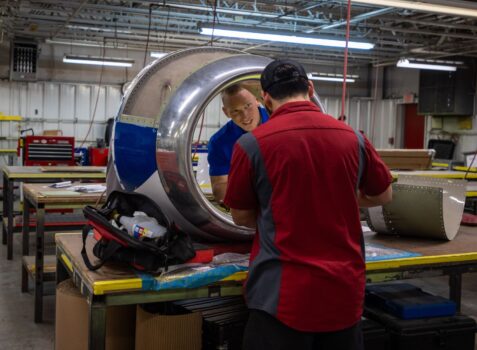 September 2026 — All F-16 fighter jet production in the United States happens in South Carolina. It is the kind of fact Susie Shannon, president and CEO of the South Carolina Council on Competitiveness (SC Competes), shares when she explains why South Carolina’s cluster-based economic development model works: the state did not attract that capability by accident, it built the ecosystem that made it the obvious landing spot.
Join us at caa’s upcoming leadership summits! These premier events bring together hundreds of public and private sector leaders to discuss the challenges and opportunities for businesses and investors. Find the next summit in a city near you!
A model nearly 23 years in
SC Competes has directed South Carolina’s cluster-based economic development model for close to 23 years. In an interview with Invest: South Carolina, Shannon traces its origins to a deliberate break from short-term thinking. “They also wanted the state to be better prepared to look around the corner and respond to potential economic downturns while also seeking out emerging opportunities,” she said of the organization’s founders. “We introduced the concept of clustering into the state’s economic development vocabulary decades ago.”
The model brings public agencies, private industry, academic institutions, and trade associations into a shared framework around common challenges, even when the companies inside a cluster compete with each other directly. “There is significant overlap in both their challenges and opportunities,” Shannon said. “The cluster model brings those constituencies into a collaborative framework where they can work on common priorities.”
That structure now underpins the state’s defense-sector strategy, built around the state’s eight major military installations and a steady flow of veterans into the civilian workforce. It also extends into technology. SC Competes launched the Palmetto AI Corridor in late 2021 to connect business leaders, universities, and state agencies around AI adoption, a cluster the organization says now touches sectors from advanced manufacturing to agriculture and public services. “We try to look around the corner at emerging technologies,” Shannon said.
South Carolina’s aerospace cluster alone connects over four hundred commercial aerospace firms and eight major military installations statewide, coordinated through SC Competes. The automotive and advanced manufacturing side of the same model is anchored by BMW, Volvo Cars, and Mercedes-Benz Vans, all competing for the same regional workforce and supplier base the cluster system was built to share. On the logistics side, SC Ports moves that supply chain by rail, sea, ground, and air, feeding the same manufacturers the aerospace and automotive clusters depend on.
Charleston wrote the playbook first
Charleston offers clear proof the model works as it was forged under pressure. The 1993 closure of the Charleston Naval Base and Naval Shipyard cost the region more than 22,000 jobs, according to David Ginn, president and CEO of the Charleston Regional Development Alliance (CRDA). “That unprecedented challenge brought the public and private sectors together with a shared purpose: rebuilding the regional economy,” Ginn said in an interview with Invest: South Carolina.
The region’s strategy evolved in stages over three decades — first recovery, then better jobs, then targeted industries, then high-impact clusters. Charleston now competes globally in aerospace, automotive, life sciences, defense, and information technology, anchored by companies including Boeing, Volvo Cars, and Mercedes-Benz Vans. CRDA reinforced that positioning in 2026 with a brand refresh and redesigned website, built to showcase regional data and workforce initiatives for site selectors and investors. Ginn said the next phase is not about adding more industries but deepening the ones already there. “The question isn’t simply ‘What’s next?’ or ‘How do we do more?'” he said. “The future of Charleston is driving innovation throughout all of those sectors.”
The model’s rural test
The cluster approach faces its hardest test outside the state’s metro cores, and South Carolina has been backing that effort with real capital. In July, the South Carolina Department of Commerce reported that its Rural Initiative Grant and Rural Broadband Grant programs, funded through a $65 million legislative allocation, have completed 21 counties’ worth of infrastructure projects, including a five-year broadband build finished in March. Separately, the state’s Coordinating Council for Economic Development awarded $61.48 million across 36 county governments this year, tied to a projected $4.9 billion in capital investment and more than 8,200 new jobs.
Shannon frames that rural push as inseparable from the cluster model itself. “South Carolina cannot compete and thrive without rural communities being part of the equation and having the resources they need,” she said. Population growth is starting to reach those communities too, she said, citing a 2023 SC Competes study on population “centroids” that found Columbia among the top U.S. metros for proximity to large concentrations of people.
“The population of South Carolina, and in fact the entire Southeast, is exploding; access to people is access to suppliers, it’s access to markets, it’s access to customers,” Shannon said.
Top image provided by SC Competes
Want more? Read the Invest: South Carolina report.