The new downtown bet: Sports and entertainment districts

Key points:
- • Sports and entertainment districts have become the anchor investment vehicle for downtown revitalization in Atlanta, Tampa Bay, and Jacksonville.
- • Executives across all three markets say a marquee sports asset de-risks adjacent mixed-use development.
- • Workforce and community terms are now built into district deals from the start, not added after the fact.
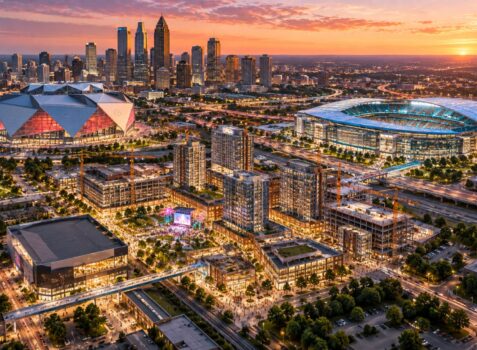 September 2026 — Atlanta’s $5 billion Centennial Yards is leading a regional boom in sports and entertainment districts, proving that pairing marquee venues with mixed-use development can unlock massive private capital and reshape dormant downtowns.
Join us at caa’s upcoming leadership summits! These premier events bring together hundreds of public and private sector leaders to discuss the challenges and opportunities for businesses and investors. Find the next summit in a city near you!
Atlanta often calls itself the sports capital of the Southeastern United States. Once Centennial Yards is complete, I believe Atlanta can become the sports capital of the world, attracting global visitors and strengthening its ability to secure major international events. We have hosted the World Cup, we are pursuing the Women’s World Cup, and the sky is the limit after that.” Brian McGowan, president of Centennial Yards, said in an interview with Focus: Atlanta.
Other cities are taking note.
Across three Southeastern markets, sports and entertainment districts are following the same playbook, pairing a marquee venue with hotels, housing, and retail to pull private capital into downtowns that public dollars alone could not move.
Atlanta bets on scale
Centennial Yards broke ground on its entertainment district in the summer of 2024. The seven-and-a-half-acre site includes four buildings totaling 500,000 square feet and a fan zone built for 2,000 to 3,000 people. Live Nation signed a lease for a 5,300-seat music theater it plans to make its U.S. flagship venue. Cosm, a sports-viewing concept built around a Las Vegas Sphere-style screen, took 70,000 square feet in the same district.
McGowan credits the financing structure CIM Group built with the city of Atlanta for unlocking a site complicated by multiple owners, active rail lines, and layered air and parking rights. Twenty percent of residential units are set aside as affordable for 99 years, and 38% of subcontractors are required to be minority- or female-led; the project currently sits at 35%.
Tim Zulawski, president of AMB Sports and Entertainment, sees the same dynamic playing out around Mercedes-Benz Stadium. “The uniqueness of sport is that it is a galvanizing agent,” Zulawski said in an interview with Focus: Atlanta. Navigate Research put the gross media value of Atlanta’s 2026 World Cup hosting at $27.4 billion, a figure Zulawski said justified more than $5 billion in private capital now flowing into south downtown redevelopment, Centennial Yards included. More than 2.5 million riders used MARTA during the tournament window, a data point Zulawski uses to argue that transit investment, not just stadium capacity, is what converts a global event into durable economic activity.
Jacksonville follows suit
Jacksonville Jaguars President Mark Lamping points to a similar multiplier. The team’s new headquarters, One Tower Court, is the first class-A office building built in downtown Jacksonville in nearly 20 years. It opened alongside continued construction on the team’s Stadium of the Future, targeted for completion in August 2028, and private projects along the St. Johns River, including the Four Seasons Jacksonville Hotel and Residences and a new adjacent marina.
Lamping frames the Khan family’s investment as a signal that pulled other capital off the sidelines, citing the Brooklyn neighborhood redevelopment, the Gateway Jax project, and the University of Florida’s decision to place a graduate campus downtown as evidence the strategy is working. “We need to have the type of organization that not only our fans, but our community can be proud of,” Lamping said in an interview with Invest: Jacksonville.
Tampa Bay ties in education
In Tampa Bay, the sports and entertainment districts model is colliding directly with higher education. When Invest: Tampa Bay spoke with Ken Atwater, president of Hillsborough Community College, the mixed-use development with the Tampa Bay Rays on the college’s 120-acre Dale Mabry campus was still under negotiation.
It has since closed: Tampa City Council and the Hillsborough County Commission approved definitive agreements for a $2.36 billion ballpark and surrounding district on Aug. 27 and 28, 2026, and the college has already selected a project management firm for its own $215 million campus redevelopment. Under the finalized plan, the ballpark moves to the front of the property while the Rays fund a new campus for the college elsewhere on the same site — a structure Atwater described as “live, learn, work, and play.”
Bob Rohrlack, president and CEO of the Tampa Bay Chamber, said the region’s housing and transportation constraints will determine whether that momentum holds. “If there’s a change that will have a negative impact on business, if it’s consistent, business will strategize a way to deal with it,” Rohrlack said in an interview with Invest: Tampa Bay. The chamber’s membership diversity has grown from 6% to 32% over the past decade, a trend Rohrlack ties to sustained in-migration driven partly by the region’s growing profile as a sports and entertainment destination. He named the effort to keep the Rays in Tampa Bay as the clearest near-term test of whether the region can convert that visibility into lasting economic impact.
Atwater put the stakes in personal terms. “A job changes everybody’s life. It changes your life, your family’s life, and your community life,” Atwater said, framing the college’s decision to stay on-site through the Rays redevelopment as protecting exactly that kind of access for the students it serves.
Want more? Read the Invest: reports.