




Charlotte business news today: AI data center pause
Key points:
- • Charlotte City Council unanimously enacted a 150-day ban on new data center construction in June 2026.
- • The AI data center boom prompted community resistance and peer moratoriums in Durham and Chatham County.
- • The 150-day review will set Charlotte’s data center zoning rules for the next decade.
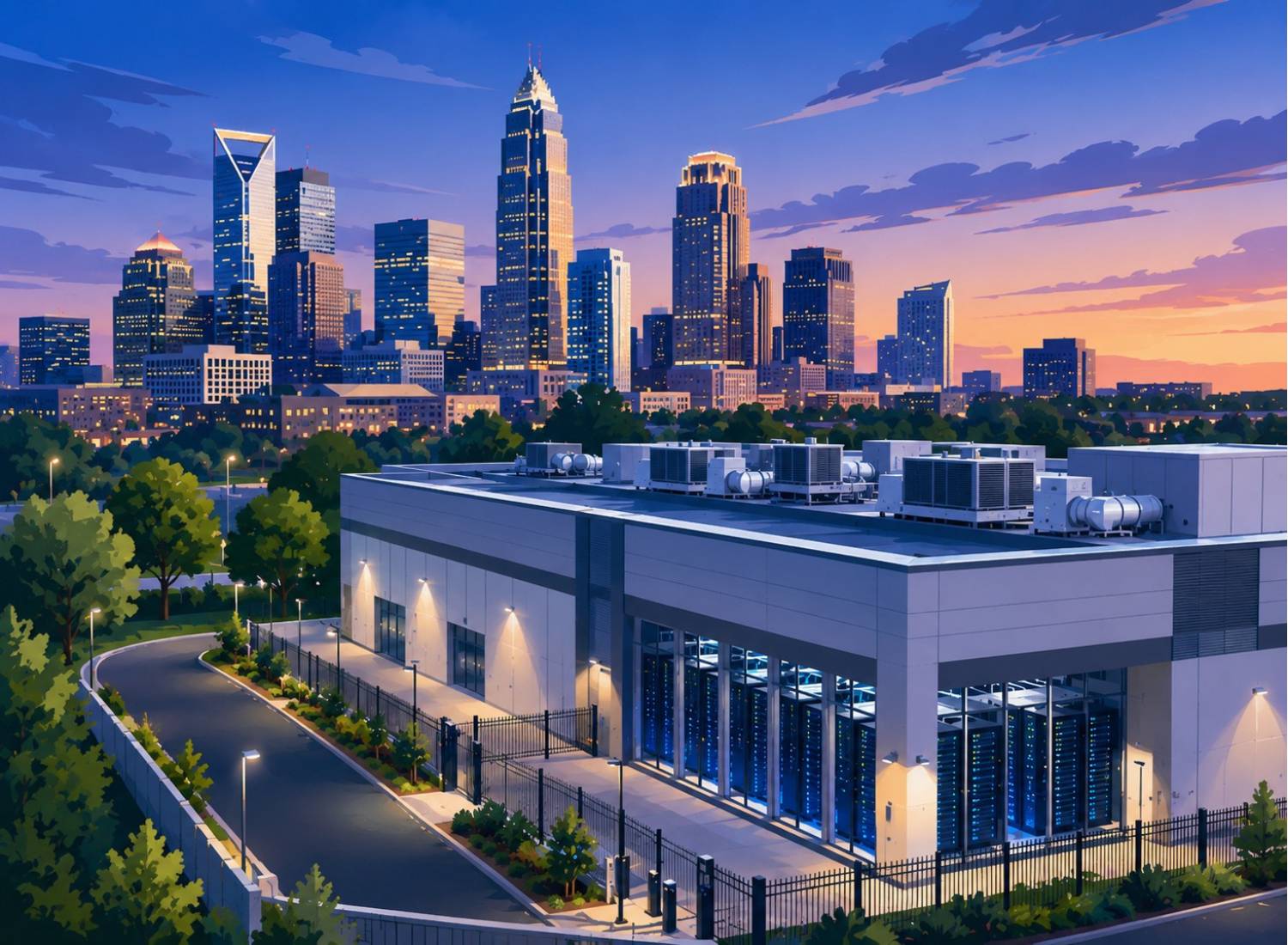 July 2026 — A unanimous City Council vote has reshaped Charlotte business news today, as Charlotte enacted a 150-day moratorium on new data center construction — a direct response to the AI infrastructure boom that has been transforming the city’s commercial real estate landscape faster than planners can keep pace.
Join us at the Invest: Charlotte 6th Edition Leadership Summit! This premier event brings together hundreds of Charlotte’s business and regional leaders to discuss the challenges and opportunities for businesses and investors. Buy your ticket now!
The decision marks a turning point in how one of the Southeast’s fastest-growing cities manages the collision between technology investment and residential quality of life.
Charlotte City Council voted unanimously on June 8 to halt new data center applications citywide for 150 days, according to official guidelines outlined in the City of Charlotte Data Centers Moratorium FAQ. Local leaders cited the speed at which artificial intelligence infrastructure had been proposed in or near residential neighborhoods. The moratorium was prompted in part by community opposition to localized projects.
Residents have gathered widespread pushback against initiatives like American Tower’s Rezoning Petition 2025-120 for an up-to-40,000-square-foot center in east Charlotte. While the pause doesn’t retroactively stop pipeline applications like American Tower’s that were already under formal review, the neighborhood outcry heavily catalyzed the municipal action.
Council member Dimple Ajmera framed the pause as an investment in long-term planning. “This 150-day pause today can prevent years of unintended consequences,” Ajmera wrote in her substack.
City planning staff will now study electricity costs, water usage, environmental effects, noise levels, aesthetics, and appropriate zoning classifications for data center development before Council acts.
The moratorium does not apply to projects already underway with valid building permits. Large-scale regional developments approved prior to June 8, including the first phase of the PowerHouse Charlotte campus in the University City area, will continue construction. But any new applications filed after June 8 are blocked until the planning review is completed and a new regulatory framework is adopted.
Charlotte’s current zoning code allows data centers in many zones without community input, including areas adjacent to homes and in the heart of uptown — a situation that long-term residents have found increasingly untenable as AI-era facilities grow in size, power consumption, and noise footprint.
Statewide trend
Charlotte is not alone. Municipalities across North Carolina have been grappling with the same tension between economic development and neighborhood impact. Neighbors in the Triangle saw the city of Durham enact a data center moratorium earlier this year following distinct environmental critiques. Chatham County went further, imposing a one-year pause as it evaluates cumulative demands on local power grids, water systems, and road infrastructure.
The pattern reflects a broader national reckoning: cities that welcomed data center development during the early cloud computing era are now facing a second generation of facilities, driven by AI model training and inference, that is larger, louder, and more power-hungry than anything that preceded it.
What investors need to watch
For the Charlotte business news today audience, the 150-day clock sets the timeline for a regulatory framework that will govern the next decade of data center investment in the city. The key variables are zoning: which areas will permit data center construction, whether community review will be required, what noise and environmental standards will apply, and how the city will balance economic contributions against infrastructure demands.
Charlotte’s cost of living is already under pressure — monthly rent is already around $2,000 as demand outpaces housing supply, according to Zillow. The politics of welcoming power-hungry data centers in that environment are materially different from a decade ago, and city leaders are responding accordingly.
The stakes are high in both directions. Data centers generate relatively few direct jobs but consume enormous quantities of power and water, and their construction cycles are fast — companies making site decisions today are building for AI workloads that are growing on a quarterly basis. Cities that produce clear, workable regulatory frameworks during their moratorium periods will attract the highest-quality facilities while managing community impacts. Cities that create restrictive or opaque regimes risk ceding the next wave of technology infrastructure investment to competing markets across the Southeast and Sun Belt.
Charlotte’s leaders are aware of this tension, and their 150-day deliberation is a critical test of the city’s capacity for governance in a fast-moving sector.
Managing growth intentionally
Beyond data centers, Charlotte’s broader Charlotte business news today reflects a city navigating rapid growth with increasing intentionality. Construction recently began on long-planned affordable housing in South End. Concurrently, the city is initiating a leadership transition following the resignation announcement of Mayor Vi Lyles, which prompted City Council to begin an appointment process for an interim mayor to serve out the remainder of her term.
Furthermore, a state bill to eliminate parking minimums statewide, which would reshape how Charlotte builds density, is moving toward passage. The data center moratorium is the most visible single decision in this pattern, but it is part of a wider effort by city leadership to shape, rather than simply absorb, the growth arriving in Charlotte.
As the 150-day moratorium runs through the fall of 2026, the decisions made by Charlotte’s planning staff and City Council will reverberate far beyond any single data center application. They will define how one of the fastest-growing cities in the Southeast integrates AI-era infrastructure with residential quality of life and long-term urban planning goals.
Executives in the technology sector, real estate developers, and community organizations are watching closely. What emerges will shapes the city’s competitive positioning for the decade ahead — and a model, or a cautionary tale, for how Sun Belt metros manage the infrastructure demands of the intelligence economy.
Want more? Read the Invest: Charlotte report.