Tampa Bay business news today: The data center reckoning
Key points:
- • AI, digital health, and telehealth are transforming how care is delivered and improving access for patients.
- • Healthcare organizations are addressing workforce shortages through technology, retention efforts, and new care models.
- • Rising costs and consumer expectations are driving demand for more affordable, transparent, and personalized healthcare.
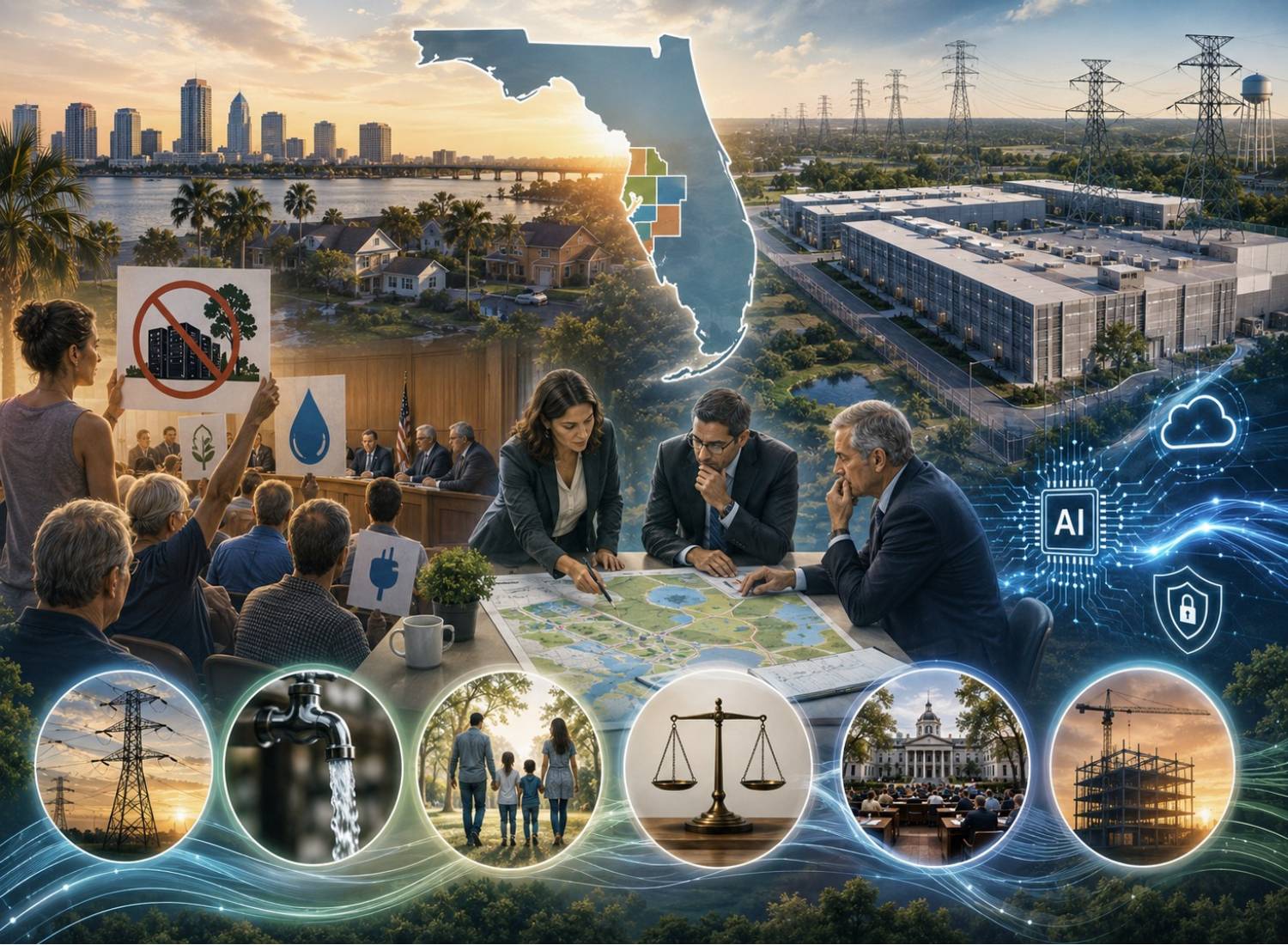 June 2026 — As Tampa Bay business news today reflects a region at an inflection point, local officials across Pasco, Hernando, and Pinellas counties are confronting an urgent question: how much of the national artificial intelligence buildout should Tampa Bay absorb, and at what cost to residents already worried about rising power bills and strained infrastructure?
Join us at caa’s upcoming leadership summits! These premier events bring together hundreds of public and private sector leaders to discuss the challenges and opportunities for businesses and investors. Find the next summit in a city near you!
The tension reached a peak this month when Pasco County planners officially enacted a one-year temporary moratorium on large-scale data centers in unincorporated parts of the county. The pause, passed on June 11, halts permitting while county staff evaluate the impact these facilities have on infrastructure, natural resources, and the environment. According to Axios Tampa Bay, current land development code provisions “don’t really regulate the use of data centers” — a gap that left officials moving proactively to implement safeguards. County Planning Director David Engel emphasized that the county currently has no active applications for data centers on file, framing the freeze as a necessary step to establish regulatory definitions before developers arrive.
Pasco is not acting alone. Hernando County commissioners voted recently to advance their own one-year moratorium, with a final vote expected in July. A Pinellas County commissioner floated a comparable pause earlier this year. In Lakeland, city leaders are actively discussing a similar 12-month timeout after intense public backlash over a proposed facility. And in Citrus County, hundreds of residents packed a town hall meeting to oppose a proposal to rezone approximately 800 acres for industrial use including data centers, according to reports captured across Tampa Bay business news today. The message from Tampa Bay’s communities has been unambiguous: residents want answers before large-scale infrastructure reshapes their counties.
The urgency is fiscal as well as environmental. Pasco County Tax Collector Mike Fasano told Axios that any potential tax revenue from a large-scale data center must be carefully weighed against the risk of its electricity demand driving up costs for consumers. These facilities house thousands of servers that power AI applications, cloud computing, and data storage — and they require enormous, sustained draws on local power grids and water supplies to keep equipment cool. For counties that have built their identity around quality of life and affordability, those are not abstract concerns.
The Florida data center push
The pushback in Tampa Bay arrives at a moment when the state is attracting serious interest from some of the world’s largest technology companies. Tech giants including Google, Microsoft, Amazon Web Services, Meta, and AI companies such as OpenAI and Oracle have been eyeing Florida for hyperscale data center expansion, according to the Data Center Coalition. Dan Dorio, the coalition’s vice president of state policy, told the Tampa Bay Times that Florida is firmly “in that conversation” as the industry looks for its next wave of growth markets. When evaluating expansion sites, industry leaders weigh access to power, available land, a skilled workforce, and the regulatory environment already on the books.
Florida has historically lagged behind other states in data center density. One major reason has been its hurricane exposure — disruptions to the electric grid are catastrophic for server-intensive operations. But as AI demand accelerates nationally, that calculus is shifting. Several large-scale proposals have already moved forward in Florida. In Polk County, a proposed development would occupy more than 1,300 acres near Fort Meade, a rural community of roughly 5,000 people south of Lakeland, which recently faced regulatory headwinds over water resource limits. In Citrus County, a firm has sought to rezone approximately 800 acres on the county’s north end for industrial uses. These are not theoretical scenarios — they are active proposals already facing active community opposition.
Regulation takes shape
The state legislature has been responsive. Florida Senate Bill 484 was officially signed into law by Gov. Ron DeSantis in May, establishing a first-of-its-kind customer protection framework. The legislation mandates that public utilities implement strict tariff structures to ensure that “large load customers”—defined specifically as facilities requiring 50 Megawatts (MW) or more at peak demand—fully pay for their own infrastructure costs rather than shifting those capital expenses onto residential ratepayers.
To balance local pushback with industry needs, the law explicitly preserves the zoning and comprehensive planning authority of municipal governments. However, it tightens transparency rules by eliminating the standard 12-month public records extension for state-level economic development agencies when dealing with data center projects, forcing disclosure if a confidential project involves the location or expansion of a data center. On environmental protections, the law targets heavy cooling infrastructure by requiring facilities to substitute potable water with reclaimed water systems wherever “environmentally, economically, and technically feasible.” The law’s rapid enactment signals that Tallahassee is tracking the same anxieties driving county-level moratoriums across the region.
The debate unfolding across Tampa Bay business news today is a local expression of a national reckoning. Communities from Virginia to the Midwest have wrestled with the same tradeoffs: the economic promise of data center development — jobs, tax revenue, and a stake in the AI economy — weighed against the pressure these campuses place on power grids, water supplies, and residential quality of life. The distinction in Tampa Bay is that the resistance is organized, vocal, and now actively shaping policy on a county-by-county basis before a single hyperscale facility has broken ground in the region.
For business leaders and investors tracking Tampa Bay’s long-term trajectory, this month’s regulatory moves are signals worth watching closely. The outcome — and whatever follows in Hernando, Pinellas, and Tallahassee — will determine not just where data centers land in the region, but how Florida balances its ambitions as an emerging AI infrastructure market against the demands of communities built around affordability and quality of life. Markets that establish transparent, resident-protective frameworks while remaining open to responsible growth will be best positioned to attract the kind of technology investment that strengthens a regional economy for a generation. Tampa Bay business news today shows that the window to get that balance right is open now — and closing fast.
Want more? Read the Invest: Tampa Bay report.