
Pittsburgh Business news: AI boom meets gas power
Key points:
- • At least 12 data center sites are planned or proposed in Southwestern Pennsylvania.
- • Most proposed sites, including one near Homer City, are expected to run on gas.
- • Big Tech’s clean-energy contracts hit 135 gigawatts, five times more than four years ago.
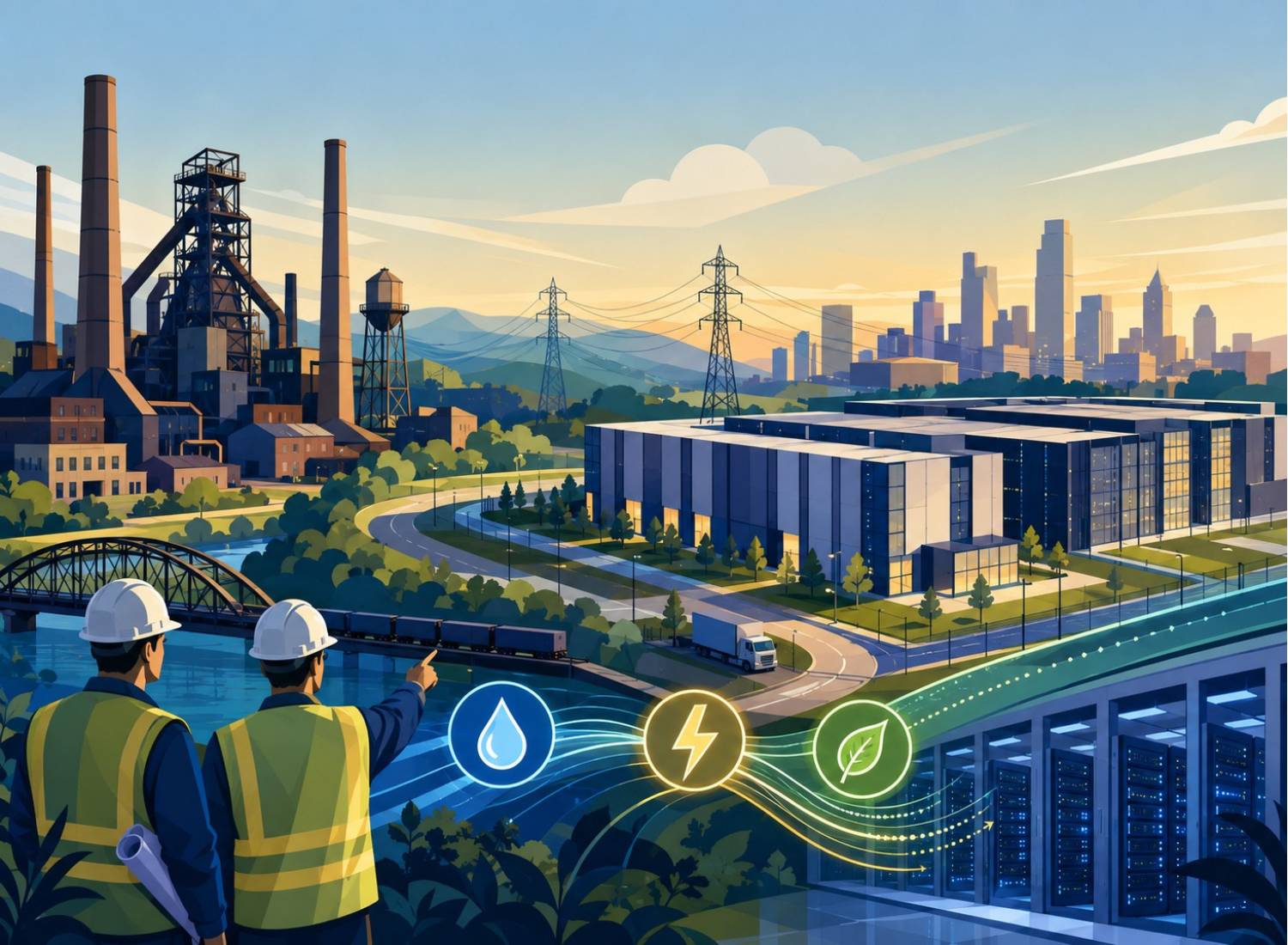 July 2026 — The biggest Pittsburgh business news story of the summer isn’t a single deal — it’s a dozen of them at once, as data-center developers race to plant AI infrastructure across Southwestern Pennsylvania’s former steel and coal country, forcing a fast decision about what powers the region for the next generation.
Join us at caa’s upcoming leadership summits! These premier events bring together hundreds of public and private sector leaders to discuss the challenges and opportunities for businesses and investors. Find the next summit in a city near you!
At least 12 data center sites are planned or proposed across Southwestern Pennsylvania. This is according to a PublicSource investigation, part of the Pittsburgh250 reporting collaborative with Technical.ly and City Cast Pittsburgh.
Statewide, estimates suggest roughly 130 data centers are operating, proposed, or under development. Because Pennsylvania has no official tracking system, the real total could be higher. While several massive local projects will draw directly from the electrical grid, others—including a large proposed campus near Homer City—are expected to run primarily on natural gas.
Gas, water, and what’s next
This localized dependency on fossil fuels sits awkwardly against a national trend. Google, Meta, Microsoft, and Amazon together now hold contracts for roughly 135 gigawatts of clean energy—five times what they held four years ago, according to S&P Global Market Intelligence data. Pennsylvania’s shale-gas wealth and legacy power infrastructure make it economically attractive for developers who want to move fast, even as the largest hyperscale operators publicly commit to renewable procurement elsewhere. That tension — cheap, available capacity versus a tech sector under pressure to decarbonize — is the defining question hanging over the region.
The power framework varies wildly by project design. In Westmoreland County, developer TECfusion’s proposed campus in Upper Burrell Township is expected to rely heavily on on-site, gas-fired generation. Meanwhile, in Allegheny County, developers from Allegheny DC Property Co. (now rebranded as Dynamo DC) confirmed that their planned 652,000-square-foot facility in Springdale Borough will tie directly into the electrical grid via FirstEnergy/West Penn Power. The Springdale project will relegate its 124 diesel generators strictly to emergency backup use.
Water use is emerging as the other local flashpoint, though design choices alter each project’s footprint. The Springdale Borough data center plans to deploy a closed-loop cooling system. This setup requires an initial water withdrawal equivalent to just one Olympic swimming pool, consuming a mere fraction of what traditional open-loop cooling systems pull on an ongoing basis.
Industry framing suggests Pennsylvania is still a secondary player compared with Virginia and Texas, the country’s two dominant data-center markets. However, it is growing faster than most alternatives, per commentary from the Data Center Coalition. National data center energy demand is projected to triple by 2030, according to McKinsey estimates. This means even a third-tier market like Southwestern Pennsylvania could see outsized absolute growth simply by capturing a small share of that expansion.
The stakes for the region
For Pittsburgh’s business community, the implications go well beyond the data centers themselves. Every gas-powered facility or major grid draw built now effectively locks in fossil-fuel dependencies in a region that spent the last twenty years working to diversify away from coal-era industry. Local economic development officials face a meaningful path-dependency question: welcoming data centers brings construction activity in the near term, but the underlying infrastructure will shape the region’s power mix and climate profile for decades.
At the same time, the sheer scale of proposed investment is difficult for a regional economy to turn away. The demolition of the 55-year-old coal-powered Homer City Generating Station underscores this transition. The site is slated for redevelopment into a multibillion-dollar natural gas power plant capable of supporting an adjacent data center campus.
Twelve data center projects, even if only a handful move forward, represent significant utility infrastructure upgrades and property tax revenue. Springdale Borough, Upper Burrell, and Homer City are exactly the kind of legacy industrial communities that have struggled to attract large capital investment since the decline of steel and coal. This structural reality explains why local officials have been receptive to developers, despite the complex water and energy tradeoffs.
Want more? Read the Invest: Pittsburgh report.