Reinvention: How economic diversification creates powerhouses
Key points:
- • Abby Lindenberg highlighted how economic diversification is reshaping America’s most successful cities.
- • Dallas-Fort Worth’s growth shows the power of building on, not replacing, legacy industries.
- • caa’s research identified the key traits shared by the nation’s most resilient regional economies.
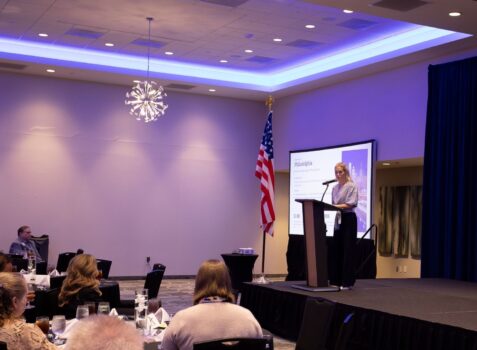 August 2026 — Abby Lindenberg, founder, president and CEO of business insights platform caa, delivered the keynote address at the Metrocrest Area Chamber’s 2026 Economic Development Summit on Thursday, drawing on more than a decade of caa’s market research to show how American cities have repositioned legacy industries through economic diversification to compete in a rapidly shifting economy.
Join us at caa’s upcoming leadership summits! These premier events bring together hundreds of public and private sector leaders to discuss the challenges and opportunities for businesses and investors. Find the next summit in a city near you!
Lindenberg’s keynote, titled “Reinvention: How Cities Have Reimagined Their Traditional Economies to Thrive in an Evolving Economic Landscape,” used data from caa’s Invest series of market reports to trace how regions including Philadelphia, Pittsburgh, Houston, Atlanta, Nashville, Charlotte, Miami, and Dallas-Fort Worth built new growth on top of their traditional economies rather than abandoning them.
“Successful companies understand the need to change. You can’t always be what you’ve been,” Lindenberg told the audience of business leaders, policymakers and regional economic development officials. “To move forward sustainably, however, you need clarity on what you have and what you want; collaboration so that everyone is rowing in the same direction; and most importantly, the conviction to pivot even when facing resistance.”
Lindenberg said caa’s research shows the most resilient regions share three traits: “clarity of vision, collaboration among leadership, and the ambition to repurpose their past rather than defend it.” She cited Houston’s shift from an oil-and-gas identity toward what one local investment leader called “the energy capital of the world,” Philadelphia’s rise from manufacturing roots into a Top 10 life sciences cluster, Atlanta’s evolution from a rail hub into a fintech and film-production powerhouse, and Pittsburgh’s transformation from steelmaking into artificial intelligence, robotics, and advanced energy infrastructure.
The keynote’s closing case study centered on Dallas-Fort Worth. Lindenberg noted that the region’s GDP grew from $534 billion in 2020 to $688.9 billion by 2022, powered by gains in aerospace, life sciences, and financial services. Dallas-Fort Worth now ranks No. 1 nationally in aerospace employment, is home to more than 1,300 life sciences establishments, and has become what Dallas Mayor Eric Johnson has described to caa as the nation’s No. 2 financial capital — “Y’all Street” — trailing only New York.
Lindenberg also pointed to Nashville, where metro GDP grew from $144.8 billion in 2019 to $204.8 billion in 2024 as the city added healthtech, fintech, and advanced manufacturing on top of its music-industry roots, and to Charlotte, where diversification beyond banking has produced 14 accelerators, six homegrown unicorns, and nearly $4 billion in capital invested since 2020. “Concentration is fragile, diversification is durable,” she said, describing the lesson both regions offer North Texas as it continues to broaden its economic base.
“Every region reaches a moment when it must choose between clinging to what built it, or build what will carry it forward,” Lindenberg said. “North Texas made that choice, and the numbers prove it.” She added that the region’s diversification across aerospace, biotech, finance, energy, and manufacturing has earned Dallas-Fort Worth an 82% score on Moody’s Diversity Index, with no single sector accounting for more than 21% of area employment.
Lindenberg closed her remarks by outlining four differentiators caa’s research has identified between regions that successfully pivot and those left behind: networked rather than siloed leadership; alignment between research universities and high-growth industries; investment in human capital, quality of life and inclusive culture; and a willingness to repurpose existing assets rather than defend them. “It really does come down to structural adaptability over protectionism,” she said. “The region that reinvents itself in every cycle is the region that never runs out of cycles to win.”
The Economic Development Summit, presented by the Metrocrest Area Chamber, also featured economic development directors from Addison, Carrollton and Farmers Branch, who shared local perspectives on development activity, investment priorities, and regional collaboration within the Metrocrest area.
Lindenberg’s appearance builds on caa’s ongoing research presence in North Texas, where the firm has tracked the region’s economic evolution as part of its broader Invest report series covering major U.S. metro markets.
Want more? Read the Invest: reports.