
Spotlight On: Gary Creed, CEO, Edifice Construction
Key points:
- • Edifice is expanding alongside strong population growth across the Carolinas.
- • Talent and collaboration remain central to the firm’s growth strategy.
- • Technology is helping construction teams work more efficiently and stay connected.
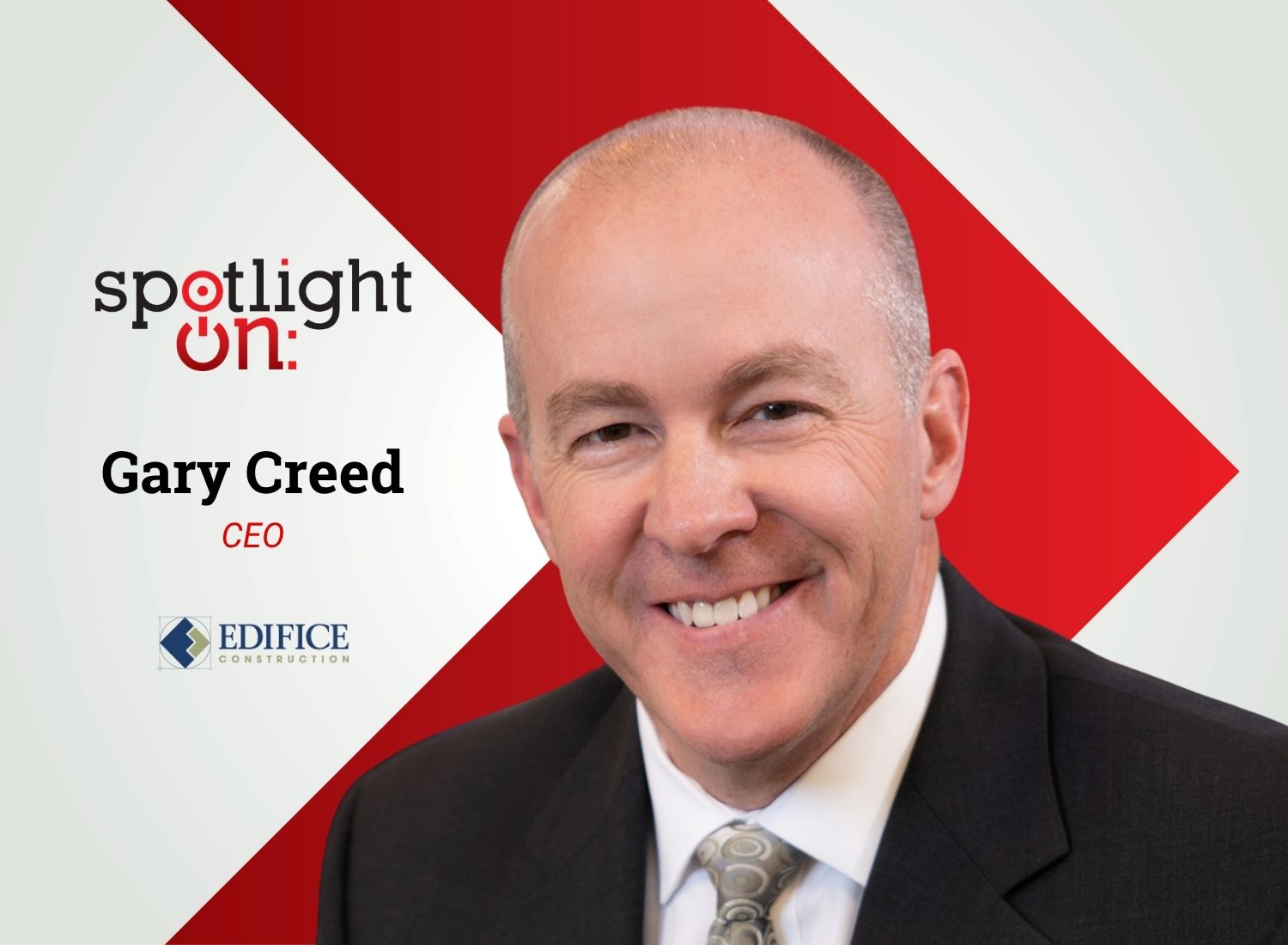 August 2026 — Invest: spoke with Gary Creed, CEO of Edifice Construction, about the firm’s expansion into a new South End headquarters, its diversified growth strategy across the Carolinas, and the evolving role of collaboration and technology in construction. “If the people keep moving to the Carolinas, then I think we’re going to continue to see robust work opportunities in our market,” Creed said.
Join us at the Invest: Charlotte 6th Edition Leadership Summit! This premier event brings together hundreds of Charlotte’s business and regional leaders to discuss the challenges and opportunities for businesses and investors. Buy your ticket now!
What are the most important themes shaping Edifice’s strategy as you plan for the year ahead?
One focus that really has not changed for us is continuing to find some of the best-skilled professionals in the market. I do not just mean craftsmen in the traditional sense, but project managers and superintendents who truly set themselves apart. We rely on our people, so being an employer of choice and attracting top talent is constant.
We are also closely watching how markets ebb and flow. We work with clients across several industries, specializing in several types of buildings. A few years ago, every one of our markets was hitting on all cylinders, which is not typical. Corporate office slowed significantly, though we are beginning to see some resurgence. Industrial stepped back and shifted in product type, but we have maintained a steady pipeline. The key has been making sure that we have the right amount of resources to serve the interesting projects and collaborative clients that are coming without getting too top-heavy or overloaded.
We have also entered newer markets and are seeing strong growth in our healthcare group, which is taking on larger and more complex projects. Our assisted living and multifamily group continues to grow as well. There is more opportunity there than we are currently taking on, but as we continue to build those teams, we will scale accordingly.
Why was South End the right location for your new headquarters, and how does that move reflect your future vision for Edifice in Charlotte?
Most moves start out of necessity, and that was true for us. About two years ago, we realized we were filling up our office and overflowing our parking lot. As we added personnel to support future growth, we simply needed more space.
Our previous building was unique; an adaptive reuse project that we rebuilt. It is beautiful and has character you cannot duplicate. But after 10 years, it was the right time to find a larger space with more parking, upgraded technology, and improved amenities for our employees.
The new headquarters includes a large café, outdoor seating areas, nine conference rooms, and a full training center. We also created a space for entertaining employees, guests, and customers. We have a fitness center, and we have a trainer who comes in twice a week to work out with people. We truly believe in taking care of our employees, and we wanted to provide an atmosphere that fits with our culture.
We are also consolidating what had effectively been two buildings into one, which strengthens collaboration. In addition, our training space is designed to function as a community resource. Many nonprofits and organizations need meeting space, and this allows us to give back and lend our space to those who might need it for a day or for a series of meetings. We were doing that before, but this is going to be even better with stronger amenities and more flexibility.
This project has been a labor of love for me. It has felt like returning to my project manager days, and I am excited about what this facility represents for Edifice over the next 20 years.
What makes the Charlotte market, and the broader Carolinas, an ideal place to be positioned, and how is it supporting your growth strategy?
The Carolinas are hot markets. Charlotte is growing tremendously. Raleigh is growing. Charleston is seeing phenomenal growth. The Upstate in Greenville and Spartanburg is seeing a lot of momentum, too. All those communities are experiencing population growth, and that growth drives not just housing but everything that comes with it, including schools, emergency services, parks, healthcare, churches, and assisted living facilities. People’s families are moving closer together, and the region is building the infrastructure to support it.
We are approaching our 50th anniversary in 2028, and we have grown alongside this region. We have watched the market expand over decades, and our growth has been built here. Now, as we continue to move into South Carolina and other areas, our offices must be positioned to serve each of these growing markets effectively. I believe that is where Edifice’s growth will continue to come from.
Talent remains a key focus for Edifice. What partnerships or internal efforts are you using to strengthen the pipeline and retain professionals?
Compensation is important. It may not motivate people on its own, but it can discourage them if it is not competitive. We make sure we stay aligned with market conditions so we can continue to attract and retain great people.
Beyond that, it is about the quality of the environment we provide and the investment we make in people’s development. About 10 years ago, we launched a formal training program that has grown significantly. It is now led by our chief operating officer, Josiah Goins, and Kyle Hanrahan, the executive vice president. It covers technical skills and professional development.
We teach our teams how to use the technology and the tools that support building, including software platforms and scheduling practices, and we also spend time on soft skills and leadership development. We host book clubs where we use those sessions as roundtable conversations about how to lead, collaborate, and improve. I enjoy sitting in on those discussions and hearing younger employees reflect on how the lessons apply in both their professional and personal lives.
We are investing in the future growth of our people at every level, from administrative staff to superintendents to leadership, so they can be the best they can be.
How are you using technology, data, or forecasting tools to manage operations, create efficiencies, and better serve clients?
We have done a strong job keeping pace with the technology that supports our preconstruction and construction work, and we are disciplined about training our teams to use those tools consistently. We often hear from people who join us from larger organizations that we tend to use these systems more effectively because we are consistent and intentional in how we deploy them.
A lot of the core construction software platforms are now baseline requirements. You have to have them, and you have to use them. Where we are pushing harder is in virtual design and construction, BIM technologies, laser scanning, drone deployment, and other advanced tools that help teams build more efficiently.
We are also exploring how artificial intelligence can support our operations. The construction industry is still learning how to use AI in a meaningful way, but we have formed a committee to evaluate how it can strengthen daily workflows and decision-making. We have been working on this for a couple of years now, and it is starting to take shape.
The biggest difference I continue to see is communication and information exchange. Teams can access drawings and details in real time through mobile devices, and subcontractors are doing the same. Documents get updated quickly, and everyone stays current. I cannot say it automatically makes every project faster, but it is absolutely making teams more efficient and better coordinated.
What kinds of collaboration are you seeing between contractors, developers, designers, and local governments as the region grows?
In my nearly 40 years in the industry, I have seen construction become far more collaborative. Early in my career, people often felt like they were on opposite sides of the table. Now, there is much more of an open-book approach, with everyone working together to deliver the best project.
That collaboration starts with producing the best documents up front, continues with resolving issues quickly and transparently, and shows up in how teams interact through delivery. When people embrace that approach, the process is more enjoyable, and outcomes improve.
Recently, I attended two ribbon cuttings, and everyone involved — owners, designers, contractors, and partners — was celebrating together. That is what construction should be. When projects are delivered as a true team effort, there is pride in the result, and it creates momentum for the next opportunity.
What trends are you seeing in construction models and delivery, including sustainability and technology adoption?
One of the biggest trends I see is the way technology is improving how teams coordinate and share information. Scanning and virtual design tools are becoming more common in the field, and BIM-related workflows are increasingly practical on active job sites.
Even on day-to-day execution, teams are relying less on printed drawings and more on real-time digital access. People are pulling details on their phones, sharing updates instantly, and keeping the entire project team aligned. Subcontractors are doing the same. That information exchange is faster, and it reduces friction and confusion.
I expect that to keep getting better. The industry will continue to push the envelope on how we use these tools to improve planning, coordination, and execution.
What are your top priorities for the next two to three years, and what is your general outlook?
I feel optimistic. There was uncertainty at the start of the current administration around tariff threats, and that stunned the market for a moment. It has calmed down, and I sense that tariffs will remain a topic that moves up and down. From what I can see, the overall impact on our market will be limited if inflation stays manageable.
If the people keep moving to the Carolinas, then I think we’re going to continue to see robust work opportunities in our market. I believe Edifice is well positioned to capture a strong share of that work because we have a diversified portfolio, experienced teams, and the ability to deliver across multiple product types.
My priorities remain consistent. I want us to keep looking ahead, make sure we have the right people in the right places, and stay proactive. I am optimistic about the Carolinas in general, and I am equally optimistic about Edifice’s future here.
The new headquarters has also been a major focus for me, and I am excited about what it represents. It has been a labor of love, and I think it will be a true testament to what Edifice can do in the market and a strong foundation for the next 20 years.
I am looking forward to the move and to seeing our teams fully settled in that space.
Want more? Read the Invest: Charlotte report.