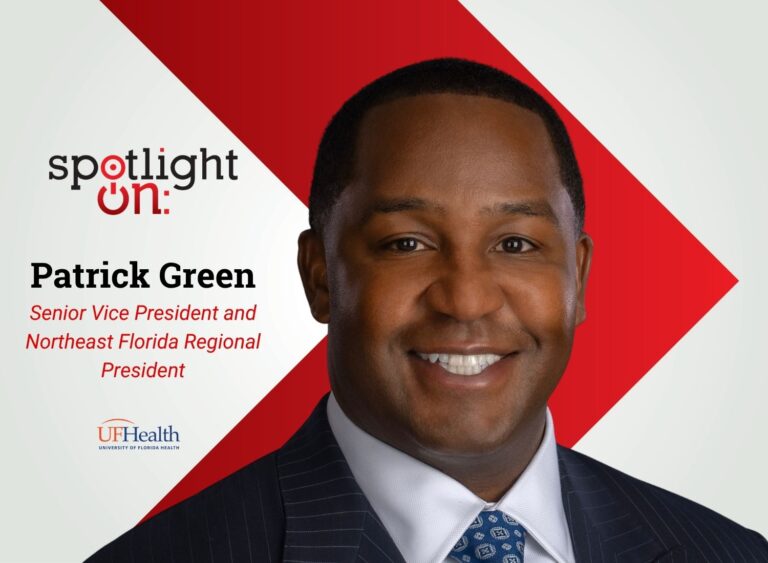




Spotlight On: Patrick Green, Senior Vice President and Northeast Florida Regional President, UF Health
Key points:
- • UF Health is expanding access across Northeast Florida.
- • New facilities are strengthening emergency, specialty, and hospital care.
- • Technology and partnerships are improving efficiency and patient outcomes.
 September 2026 — Invest: spoke with Patrick Green, senior vice president and Northeast Florida regional president of UF Health, about the system’s recent growth, expanding access points across Northeast Florida, and the priorities shaping its next phase of development. “If you look at the investments we are making in our community, from the renovation and expansion of our trauma center to our Durbin Park medical campus, and our plans to expand freestanding emergency and urgent care centers, the future is bright for UF Health,” Green said.
Join us at caa’s upcoming leadership summits! These premier events bring together hundreds of public and private sector leaders to discuss the challenges and opportunities for businesses and investors. Find the next summit in a city near you!
How has UF Health Jacksonville performed over the past year, and how does that reflect broader trends in healthcare?
For UF Health in the Northeast Florida region, we are proud of the work of our teams and how we carry out our mission. We have increased our reach across the region through continued growth, but most importantly, our performance is measured by our quality and safety scores, as well as team member engagement.
To that end, we continue to be recognized for improvements in our quality scores, and we are proud of those results. In addition, our operating performance has been strong, which aligns with trends seen across the country in health care organizations today.
That said, there are significant challenges across health care. Many institutions are facing headwinds that are impacting financial performance for a variety of reasons, including the high cost of care, workforce uncertainty, and reimbursement pressures. We experience those challenges as well, but being part of the University of Florida Health System allows us to be nimble and efficient, while also benefiting from strong institutional support that helps drive our growth.
Our success would not be possible without our strong relationship with the University of Florida College of Medicine – Jacksonville. Overall, our performance remains strong, and we continue to demonstrate value to the communities we serve in Jacksonville and throughout Northeast Florida.
As Jacksonville continues to grow and UF Health expands its specialty care offerings, what recent milestones or services have had the greatest impact?
I would point to a couple of key strategies and initiatives. About 18 months ago, we opened a second hospital tower on our North Campus, adding 124 new inpatient beds, including an inpatient rehabilitation facility. This was a much-needed expansion to improve access to services for our community. It is a beautiful, state-of-the-art facility, and growing demand for services such as orthopedics, heart and vascular care, neurosurgery, and colorectal surgery has helped us continue to expand and support the organization.
In addition, we have expanded a concept we call our freestanding emergency and urgent care centers. This hybrid model allows patients to be triaged upon arrival, either to a full emergency visit with board-certified emergency medicine physicians or to urgent care within the same facility, depending on their symptoms. This approach improves cost-effectiveness and benefits both patients and the broader health care system by ensuring care is delivered at the right time, by the right provider, and at the right cost. These centers are open 24/7, significantly improving access to care.
We recently broke ground on a fourth freestanding emergency and urgent care center near the Intracoastal Waterway, on Atlantic Boulevard, to serve the area’s Beaches communities. This center is expected to open in February 2027.
We have also made significant investments in our heart and vascular and neurosciences programs, including stroke and spine care. One standout initiative is our Mobile Stroke Treatment Unit (MSTU), essentially a rolling stroke center equipped with a state-of-the-art CT scanner and staffed by paramedics and UF Health neurologists. This allows us to deliver advanced stroke care in the field. We partnered with our health system and Jacksonville Fire and Rescue to bring this vision to life.
How do partnerships enhance both patient care and community engagement?
No single health care organization can serve a community alone. Strong partnerships are essential to delivering on our mission.
By working with the City of Jacksonville, the College of Medicine, the University of Florida, and other community organizations, we can demonstrate our expertise, open our doors, and collaborate in creative and innovative ways to better serve our community.
How are technology and digital tools reshaping the way UF Health delivers care and improves outcomes?
Being part of UF Health gives us access to incredible innovation in technology. We collaborate with students and researchers who are actively working to create a better future through the discovery of life-saving treatments. These breakthroughs allow us to leverage technology to improve the care we provide.
The University of Florida has one of the most advanced digital environments in the world. This benefits our caregivers by enabling greater efficiency and allowing them to focus more on patients. Leveraging AI and other digital tools, particularly in areas like clinical documentation, helps create more efficient care models.
Technology also supports work-life balance for our most important asset: our people. By reducing administrative burdens and eliminating repetitive tasks, we enable our teams to focus on more meaningful aspects of care.
Looking ahead, the impact of technology will only continue to grow. From artificial intelligence and digital health to telemedicine, these tools allow us to reach more patients, including those in rural or underserved communities. Telehealth, in particular, ensures that more Floridians have access to UF Health’s physicians and specialists.
As we continue to develop integrated systems of care, we are adding value not just as individual sites, but as one unified UF Health system. This creates a significant opportunity to bring the full depth and breadth of UF Health and the University of Florida to the region.
What will be your top priorities in the near and midterm, and how do you see them shaping the healthcare landscape in Northeast Florida?
We have several key strategic growth initiatives underway, and we are excited to see them come to fruition this year.
First and foremost, our people remain our top priority. We are a people-first organization, and we are focused on supporting our team members, both in retaining current staff and recruiting new talent. We want UF Health to be a place where individuals can build long and fulfilling careers.
In September 2026, we will open a new hospital in Durbin Park in St. Johns County. This 99-bed facility will include a 172,000-square-foot medical office building and will significantly expand access to care for a rapidly growing community.
At our downtown campus, we are in the midst of renovating and expanding our trauma center and emergency department. This state-of-the-art facility will feature 133 private treatment rooms. We are currently in the first phase of construction, supported by a partnership with the city of Jacksonville, the state of Florida, and UF Health.
We are also expanding access to primary and specialty care by growing our ambulatory footprint. All of these initiatives are guided by the needs of our community. We are intentional about where and how we grow, focusing on recruiting providers and expanding clinical programs based on identified gaps in care, rather than growth for its own sake.
Whether it’s our trauma center expansion, the Durbin Park campus, or our freestanding emergency and urgent care centers, the future is bright for UF Health.
Want more? Read the Invest: Jacksonville report.