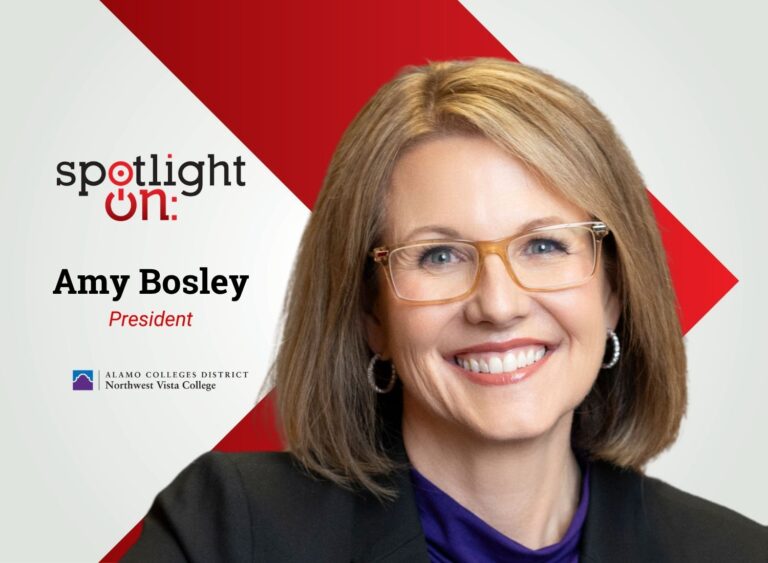
Spotlight On: Amy Bosley, President, Northwest Vista College
Key points:
- • Employer partnerships are aligning programs with evolving workforce needs.
- • AI skills are becoming increasingly integrated across college curricula.
- • Dual credit is expanding access and accelerating degree completion.
 September 2026 — In an interview with Invest:, President Amy Bosley of Northwest Vista College discussed changing policy, student expectations, employer partnerships, artificial intelligence, and the growing importance of dual credit. Bosley explained why accelerating progress matters for community college students: “Time is the enemy of degree completion.”
Join us at caa’s upcoming leadership summits! These premier events bring together hundreds of public and private sector leaders to discuss the challenges and opportunities for businesses and investors. Find the next summit in a city near you!
What changes in higher education are shaping your priorities at Northwest Vista?
Pressures and changes are coming from federal education policy, the state’s outcomes-based funding for community colleges, and local economic development priorities. The opportunities to do this work in a way that truly serves our community are also coming from every level.
We are focused on helping more people in San Antonio get to and through a postsecondary credential because education is a pathway to economic viability. As educational attainment rises, poverty decreases, civic participation grows, and communities are better able to thrive. My priorities at Northwest Vista and across the Alamo Colleges center on moving more families out of poverty, into the middle class, and toward flourishing careers.
What do students expect around affordability and support?
We survey students who have been admitted but have not yet enrolled. Of the students who responded this year, 70% said they were coming here for a better economic future for their family. They see Northwest Vista College and a community college education as a pathway to a better future.
Students are counting on us to remain affordable. AlamoPROMISE allows Bexar County graduates to attend college at no cost, and even without that program, our tuition is very affordable locally and nationally. Students also need support beyond the classroom. The more people we open education to, the more we must build support networks for childcare, an on-campus grocery store, transportation, and other wraparound needs.
Which industries are creating the strongest demand for skilled workers?
In a growing community, especially on the northwest and northeast sides, construction and healthcare are expanding along with the population. Northwest Vista also sees opportunities in information technology and emerging technologies, including biopharmaceutical manufacturing, cybersecurity, and coding.
There may be a short-term correction in some technology jobs. Still, I expect increased growth in IT as AI becomes more widely used and as medical, construction, and other San Antonio industries require more technology. We are also seeing growth in business and finance. Large local companies continue to seek people with a solid education in finance, insurance, and related areas.
How do you work with employers to keep programs aligned with their needs?
Constant conversation with employers is probably my No. 1 priority. We do not want to graduate students into fields where employers will not pay wages that sustain families. I ask employers what they are willing to pay a premium for and where we are not meeting expectations.
We connect through chamber events, one-on-one meetings, campus visits, and visits to employers. Human resources leaders can tell us what they need today, and we also need to understand what skills will be needed in two years and what they project needing in five years. That gives us time to prepare programs so we can be where employers need us to be. My goal is for an employer to hire a Northwest Vista graduate immediately because that graduate is an excellent employee with the needed training.
What are you learning from work-based learning partnerships?
Students need a work-based learning experience while they are in college. It could be an internship, mentorship, or part-time job, but employers want to hire people with experience. We often serve students who do not have the social capital or networks that other groups have long had. We ask employers to help students get those experiences early so students can explore careers and employers can get to know and hire them.
We are also learning how quickly technology changes and how stable employers’ core expectations remain. Employers consistently ask for critical thinking, quantitative and qualitative reasoning, problem-solving, and teamwork. They want those durable skills, along with technical abilities or the capacity to learn new skills quickly because students have a strong learning framework.
How is artificial intelligence changing workforce preparation?
AI feels similar to other technology revolutions I have experienced. There is excitement, fear, and anticipation that it will be disruptive or eliminate jobs. Employers want students to have experience using AI in ways they will encounter at work and to make businesses more efficient, leaving time for work only humans can do.
Northwest Vista is launching a data science and artificial intelligence program this fall. Most students returning for it already have bachelor’s or master’s degrees and are coming back to upskill. We are also helping faculty embed AI skills into their classes. Faculty must learn how students can use AI productively, ethically, and responsibly, so our investments have focused heavily on faculty and program development.
Across the curriculum, students are learning to interact with AI, write effective prompts, and evaluate the information they receive. Employers have made clear that they expect colleges and universities to develop AI skills. Today, this requires specific instruction. In five years, it may be less of a separate curriculum and more fully integrated into learning.
What is the biggest challenge in helping students complete their education?
Community college students often have complicated lives. The so-called nontraditional student is now traditional: an adult, a parent, someone working two jobs, a caregiver, or a person relying on the bus. The biggest challenge is helping students get through as quickly as possible. Time is the enemy of degree completion. The longer students take, the less likely they are to graduate.
A student taking one to five credit hours in a semester has a 7% chance of ever graduating, while a student taking 12 or more credit hours has a 73% chance. Life intervenes, and it can be very difficult to return after stopping out. We have to help students get here, stay here, and finish. We also need to raise their expectations of what is possible for them and their families, then help them make that new reality possible.
How are state and federal policies affecting affordability and student support?
Texas now funds community colleges based on outcomes. We used to be funded largely according to how many students attended. Funding now reflects degrees and certificates completed, with incentives for students who are economically disadvantaged, academically disadvantaged, or older than 25.
The model has changed the whole game and produced more degrees and certificates across the state. The problem is that the Legislature did not appropriate enough money to fully fund all the credentials colleges produced. Outcomes funding generated the result the state wanted, but colleges received less than expected because funding was insufficient across the board. I hope policymakers recognize that community colleges are increasing educational attainment at low cost and high quality and are worth the investment.
At the federal level, the largest changes involve grant opportunities. Community colleges have relied on grants from the U.S. Departments of Education and Labor and on grants for Hispanic-serving institutions. Northwest Vista is proud to be a Hispanic-serving institution, but many of those grants have been removed, closed, or are no longer available. We are rethinking how to fund innovation, student success, and scholarships. Business leaders can help advocate for community college funding because we provide the workforce and talent pipeline for San Antonio.
Where can Northwest Vista expand its impact?
I am optimistic about Northwest Vista’s future and what it can mean for the community. Greater:SATX partners tell us that when companies decide not to come to San Antonio, it is often because the educated workforce they need is not available. If we can provide that workforce, we can help attract more businesses. We also want students to attend school here, stay here, work here, and remain in San Antonio.
Education can change the reality and future of a community. It can help people gain discretionary time and income and lead rich, fulfilling lives.
Dual credit is another major opportunity. Northwest Vista saw 54% growth in dual-credit enrollment in one year and now serves more than 11,000 dual-credit students. Dual credit challenges students with college-level work in high school while saving families and taxpayers money. Our overall dual-credit growth was 54%, but growth in Title I high schools was 151%.
Research shows that providing dual-credit experiences in high-need high schools can increase students’ chances of earning a bachelor’s degree by double digits. These students have not lacked ability or interest; they lacked access. New partnerships are helping us offer dual credit in those schools and put students on a faster path to a baccalaureate degree. It also changes our employer relationships because a college student who needs work-based learning may still be a junior in high school.
Want more? Read the Invest: San Antonio report.