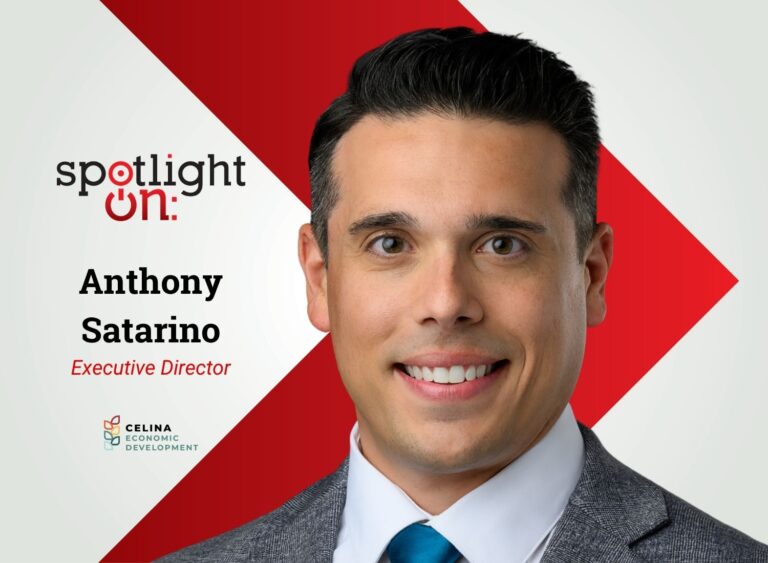

Spotlight On: Anthony Satarino, Executive Director, Celina Economic Development Corporation
Key points:
- • Celina is accelerating commercial development to keep pace with residential growth.
- • Infrastructure investments along major corridors are creating new business opportunities.
- • Downtown revitalization and employment growth are central to Celina’s 2030 vision.
 October 2026 — In an interview with Invest:, Anthony Satarino, president of Celina Economic Development Corporation, discussed commercial growth, development support, infrastructure investment, and the city’s plans for downtown and the Dallas North Tollway. “We know growth is coming,” Satarino said.
Join us at caa’s upcoming leadership summits! These premier events bring together hundreds of public and private sector leaders to discuss the challenges and opportunities for businesses and investors. Find the next summit in a city near you!
How have Celina’s growth and commercial priorities changed over the past year?
Celina’s story for the past several years has been residential growth. As jobs have pushed north in Collin County, so has our residential growth.
The challenge has been that while our rooftops have grown, our commercial development has not. That is typical of fast-growing communities, but we wanted to address it head-on. Over the past two to three years, we have worked on strategies to bring commercial growth, specifically retail growth, into the city.
This year, the fruits of that labor are starting to be recognized along the Preston Road corridor. Costco, Walmart, Home Depot, Lowe’s, and Academy Sports + Outdoors all celebrated grand openings. It has been an intentional strategy by city leadership to make sure commercial growth comes alongside our residential growth.
The Dallas North Tollway is also expected to open through Celina next year, creating a different set of commercial opportunities. We are focused on that corridor and are working with an economic study and master plan consultant to understand how to take advantage of it. We want to determine how to best serve our residents and bring commercial growth through that corridor.
Having options is important for our residents. Costco, Walmart, Lowe’s, and Home Depot improve quality of life by giving residents more convenient places to shop rather than driving to neighboring cities.
What does recent investment indicate about Celina’s position and its next commercial opportunities?
Celina has as much commercial opportunity as any other city. We are fortunate to be in the path of growth with cities that are doing extremely well, and we see those same opportunities coming to Celina.
Celina has 10 miles of frontage along the Dallas North Tollway and 10 miles along Preston Road. The Outer Loop stretches through Celina and will provide a critical east-west connection from U.S. 75 to I-35. The Dallas North Tollway is a generational growth story across the metroplex, and we get to share in it. Preston Road has the same kind of positioning.
We are positioned to take advantage of the growth headed our way. It is important to determine strategically and intentionally where that growth should occur, so it is not haphazard. We know growth is coming.
How does the EDC support developers and differentiate Celina from other growing communities?
Celina has a reputation for working with investors and developers through a hands-on approach. Our Celina Navigator program serves as a liaison through the development process. That process can be complex and cumbersome, so we provide boots-on-the-ground contact for qualified commercial projects and help them move through it as efficiently and effectively as possible. We do not override any code, but having one point of contact is critical.
We customize each economic development program to what a project is seeking. It is not one-size-fits-all. If the City Council identifies a project as important, we work directly with the developer on incentives that address the project’s needs.
Some barriers cannot be changed. Land prices are high and, in some cases, match prices in Frisco and cities to the south. What we can do is use the toolbox to influence the market and help developers.
What barriers and priorities are companies and developers identifying today?
Celina has the geography to make development work because we are growing quickly, have a large city, and are in the path of growth. There are also real barriers. Land is one, and infrastructure is another. We are a new city, and all our infrastructure pieces are not yet in place. Infrastructure becomes critical when we work with developers on larger projects.
Most incentive packages for the retail and commercial projects along Preston Road are focused on infrastructure. They helped create east-west connections, which also serve nearby residents and neighborhoods, while acting as an economic driver for commercial development. We hear about infrastructure and land prices frequently, but Celina’s position in the path of growth remains evident.
How are infrastructure investments supporting Celina’s ability to attract businesses?
Earlier infrastructure investment was designed entirely to serve residential communities. The City Council and city leadership have become intentional about shifting capital improvement dollars toward commercial needs. Building roads opens commercial property and investment opportunities.
We are looking at how to align capital improvement programs worth hundreds of millions of dollars with economic development. That is at the heart of the study underway along the Dallas North Tollway. A new highway does not work without water, sewer, and east-west connections. The tollway is critical, but so is the rest of the infrastructure required to support growth.
We are bringing in consultants to help, and the City Council is prepared to support those needs. Celina spans 78 square miles, so infrastructure is a critical issue we must solve to secure the commercial growth we want.
How is Celina planning for employment centers and a balanced development mix?
Balancing residential and commercial development is a newer effort for us. Every square inch of the city could become residential because that is what is most in demand, with land prices being the main constraint. Planning and intentionality are essential. The City Council has worked to preserve key areas along Preston Road and the Dallas North Tollway for commercial growth, even when that growth may be years away.
We want to wait for the right projects. Mixed-use and employment centers may still be a little way out, and there is considerable office space to absorb in Frisco in a competitive market. Our work now is to put the foundation in place to attract investment.
King Place is an example. The city established a tax increment reinvestment zone on the property, enabling more than $30 million in infrastructure development across over 700 acres. That begins setting the foundation for employment, mixed-use development, and other uses. It also gives the EDC a shovel-ready site to market, which is critical when we compete.
What are the EDC’s priorities, and what should Celina’s economy look like by 2030?
One of our biggest priorities is making sure Celina develops a balanced and diversified economy as the community continues to grow. We don’t want to simply add rooftops and retail. We want to create an economy where people can live, work, shop, dine, gather and build businesses here. By 2030, we want Celina to be recognized not only as one of the fastest-growing communities in the country, but as a community with a strong and increasingly diversified economic base.
Downtown Celina is a big part of that vision. It is the heart and soul of our community, and its traditional square gives Celina a sense of history and authenticity that becomes even more important as the city continues to grow.
We are seeing significant public and private reinvestment Downtown, including the city’s approximately $93 million civic project and more than $20 million in announced private redevelopment. Those investments are bringing new office, retail, restaurant and civic activity into the area while preserving Downtown’s role as a central gathering place.
Looking toward 2030, we see Downtown as both an economic asset and a destination. As new activity centers emerge along Preston Road and the Dallas North Tollway, Downtown provides something different: a place rooted in Celina’s identity that can attract residents, visitors and businesses through a strong mix of dining, shopping, employment, events and experiences.
At the same time, our 2030 vision extends well beyond Downtown. We want to see meaningful employment and commercial development along the Dallas North Tollway, including office and corporate users. Pulling office development this far north will be challenging, and we recognize that it will take time. But we have city leaders, investors, landowners and economic development partners working together to create the conditions for that investment.
We also want to continue building the commercial corridors that are already beginning to establish themselves, while supporting the local businesses and entrepreneurs who give Celina its character. The goal is to create a stronger ecosystem where national investment and locally owned businesses complement one another.
Ultimately, when we think about Celina in 2030, we don’t have a single project or a single development type in mind. We see a community with a stronger employment base, more corporate and office investment, a mature retail and restaurant environment, a vibrant and economically productive Downtown, and more opportunities for residents to work and spend their time here.
Most importantly, we want economic growth to happen without losing what makes Celina unique. Our goal is to build an economy that supports the quality-of-life people who came here while creating the jobs, businesses, amenities and destinations that a growing city needs.
That’s really the opportunity in front of us: not simply to grow Celina, but to intentionally build the economic foundation for the next generation of Celina.
Want more? Read the Invest: Dallas-Fort Worth report.