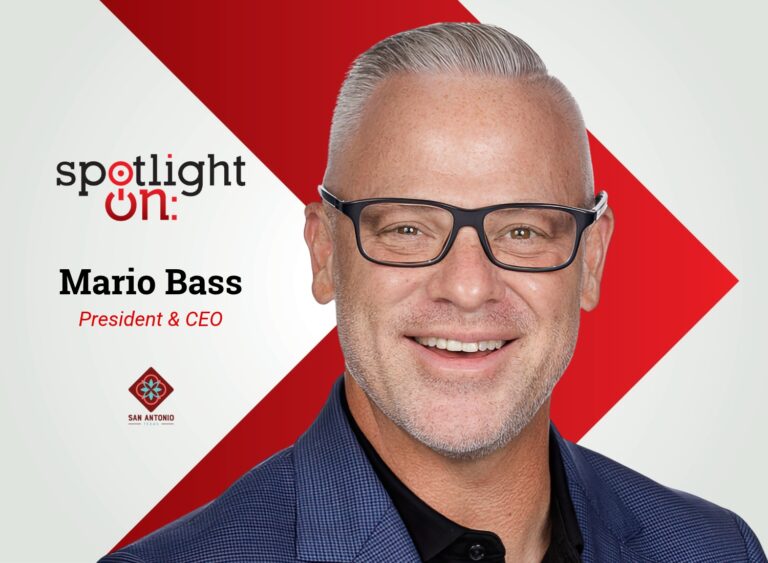

Spotlight On: Mario Bass, President & CEO, Visit San Antonio
Key points:
- • Group business, about 6 million of 39.2 million visitors, anchors Visit San Antonio’s growth strategy.
- • A convention center expansion could unlock 94 groups and about $1 billion in economic impact.
- • Visit San Antonio aims to surpass pre-pandemic visitation of roughly 41 million by 2030.
 November 2026 — In an interview with Invest:, Mario Bass, president and CEO of Visit San Antonio, discussed the city’s resilient tourism sector, the growing importance of group business, and the infrastructure investments needed to keep San Antonio competitive with other Texas markets. “The true differentiator is always the people,” Bass said.
Join us at the Invest: San Antonio 5th Edition Leadership Summit! This premier event brings together hundreds of San Antonio’s business and regional leaders to discuss the challenges and opportunities for businesses and investors. Buy your ticket now!
How has San Antonio’s tourism industry changed over the past year?
The industry continues to be very resilient, and that is very much at play in San Antonio. We continue to see positive momentum in visitation year over year, both nationally and internationally.
Mexico remains our primary international source market. We welcomed 2.51 million international visitors in 2025, with nearly 2.3 million coming from Mexico. International visitation increased 4.4% from 2024 to 2025, and we are forecast to grow another 4.9% in 2026, although international data is generally about a year behind.
San Antonio is doing extremely well. We capitalized during spring break with strong visitation from across Texas. We are fortunate to have about 45 million Texans and touch-states neighbors who consider San Antonio their second home. The city still offered a less expensive vacation option despite higher gas prices. We also benefited from additional visitation connected to the NBA playoffs and Finals and a strong convention calendar.
After your first year as president and CEO, how would you assess the progress made toward your growth strategy?
When I was appointed CEO, we updated the focus to put more group business on the books because it is critical to the sustainable success of the city’s tourism industry.
San Antonio welcomes about 39.2 million visitors, and fewer than 6 million are group travelers. Group business is highly impactful because it does not fluctuate the way leisure travel does. Meetings and events are secured by contract. Whether it is 110 degrees outside or raining, those travelers are still coming to San Antonio for their meetings, educational programs, or product rollouts.
Leisure travel makes up the majority of visitation, but it can be volatile depending on economic conditions. A strong group base gives San Antonio a more balanced and sustained tourism economy.
We wanted more group business on the books entering 2026 and a stronger position in the Texas regional drive market. On dates with stronger group business, we saw improved occupancy and overall revenue. Our focus on regional leisure travel also paid off through a robust spring break compared with the previous year.
We are also promoting new reasons to return, such as portions of the $700 million Alamo redevelopment that have opened downtown. We are starting to see the fruits of the strategies and tactics we implemented promoting those efforts.
How will major investments strengthen San Antonio’s competitiveness?
They are critical. Tourism has a symbiotic relationship with the other industries that make San Antonio what it is, including the military, cybersecurity, bioscience, and the economic development work led by greater:SATX.
When the city thrives and invests in those areas, tourism benefits. The airport expansion, including up to 18 additional gates expected to open by mid-2028, will make San Antonio more accessible to both group and leisure travelers.
The Alamo investment gives Texans and other visitors something new to experience while allowing them to engage with more than 300 years of history.
The planned sports and entertainment district, including the Spurs returning downtown, is also exciting for meeting planners using the convention center.
These investments give meeting planners and visitors new reasons to choose San Antonio.
They are also necessary. Houston, Dallas, Austin, and Fort Worth are investing heavily. If San Antonio does not act, we risk being left behind.
A convention center expansion is especially important. We have identified approximately 94 groups, representing about $1 billion in potential additional economic impact, that we could pursue if the convention center added contiguous exhibit hall space.
Beyond 2030, our current booking pace for meetings and events at the convention center without an approved expansion has fallen by more than 50%, while the rest of our Texas competitive set has increased by roughly that amount. Those cities are already marketing convention center expansions scheduled to open in 2030 and beyond. We do not have a choice. We have to make these investments.
What differentiates San Antonio from other Texas destinations?
The investment gets us onto an even playing field, but San Antonio’s differentiator is twofold: our people and our spirit of collaboration.
Tourism surveys consistently highlight the city’s walkability, convention center, nearby hotel rooms, the River Walk, the Alamo, and the culinary scene. The true differentiator is always the people.
Visitors may not describe it exactly that way, but they often say there is something different about San Antonio. It feels like home. It is friendly and hospitable. When you combine 300 years of history, hospitality, and a spirit to serve, it elevates the entire destination.
The people also make San Antonio highly collaborative. Many of us sit on one another’s boards, and there is a constant understanding that economic development is a team sport, and we’re not going to do it effectively in silos.
How are technology and broader economic trends shaping the way San Antonio markets itself?
San Antonio has a strong focus on technology, including cybersecurity and initiatives centered on Port San Antonio. It is important to tell the story of how robust San Antonio is in those areas.
Theme parks, the Alamo, and the River Walk and the investments being made there are important to tourism, and a diverse economy also benefits tourism because it creates hotel demand.
Houston, with about 20 Fortune 500 companies in its backyard, generates approximately 13,000 room nights from business transient stays, compared with about 3,000 in San Antonio. Tourism benefits from having a more economically diverse destination and simultaneously strengthens the city’s other economic drivers with the quality-of-life amenities, including dining, entertainment, and cultural offerings supported by the tourism economy.
What are the biggest workforce priorities for the hospitality industry?
About 150,000 people in San Antonio are employed in hospitality. That is one in eight San Antonians, who are connected to the city’s $23.4 billion hospitality industry.
Visitation, hotel tax collections, and overall hospitality revenue continue to increase year after year, even following the pandemic.
We collaborate with organizations such as greater:SATX and the San Antonio Hotel & Lodging Association to strengthen the workforce. Through the San Antonio Hospitality Foundation, we have River Walk Royalty, which raises funds to support scholarships for students at St. Philip’s College and The University of Texas at San Antonio who are pursuing careers in tourism.
Additionally, the Culinary Institute of America sits on our board. These are ways our industry collaborates to help us bolster the talent pipeline. When visitation and lodging demand are strong, the need for hospitality workers grows, creating opportunities for further investment.
What are Visit San Antonio’s top priorities through 2030?
Our goal is to continue driving economic development and increase visitation beyond pre-pandemic levels by 2030. Before the pandemic, San Antonio welcomed closer to 41 million visitors, compared with about 39.2 million today.
We want to continue increasing group business, which is why the convention center expansion is so critical. The current convention center operates at about 72% occupancy, which is effectively maximum capacity when accounting for the loading and unloading required for large conventions.
We will remain focused on leisure travel and continue monitoring international markets. Although Mexico represents the majority of international visitation, we also receive visitors from Canada, China, and the United Kingdom. International travelers tend to stay longer and spend more, so we want to be thoughtful about those investments.
How is the growth of short-term rentals affecting San Antonio’s lodging market?
Visit San Antonio has started looking at lodging more broadly rather than focusing only on hotels. Short-term rentals through platforms such as Airbnb and Vrbo have become prominent in a leisure-driven city.
We now look at total lodging demand. Since 2019, about 10% of lodging demand has shifted from hotels to short-term rentals.
A group traveler is much more likely to stay in a hotel, while a leisure traveler may consider a short-term rental. In 2019, San Antonio recorded about 400,000 room nights in short-term rentals. By the end of 2025, that figure had grown to approximately 1.2 million room nights.
We are focused on driving total lodging demand, whether visitors stay in hotels or short-term rentals. We are glad they are coming, but the city needs additional demand to support its full lodging infrastructure.
Want more? Read the Invest: San Antonio report.