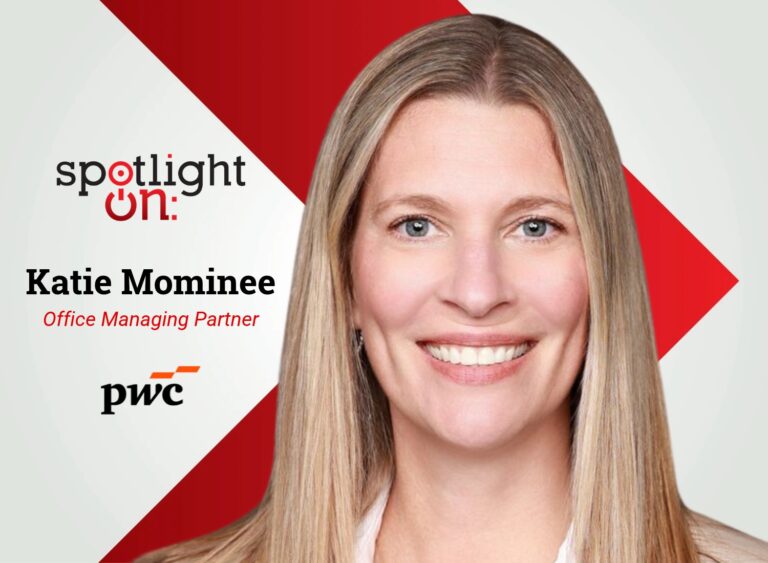


Spotlight On: Katie Mominee, Office Managing Partner, PwC Pittsburgh
Key points:
- • Companies are moving from AI pilots to enterprise-wide adoption heading into 2027.
- • Organizations must modernize governance and cyber resilience as risks evolve.
- • Companies are prioritizing learning and development to build AI and digital skills.
 November 2026 — In an interview with Invest:, Katie Mominee, office managing partner at PwC Pittsburgh, discussed how businesses are navigating rapid technological change, economic uncertainty, evolving risks, and workforce disruption. “Workforce transformation is about culture and leadership more so than it is about the technology,” Mominee said.
Join us at caa’s upcoming leadership summits! These premier events bring together hundreds of public and private sector leaders to discuss the challenges and opportunities for businesses and investors. Find the next summit in a city near you!
How is PwC helping organizations navigate rapid technological, regulatory, workforce, and economic change?
It is certainly a time of change, probably more than I have seen throughout my career. Clients are balancing technology investments, regulatory change, evolving customer expectations, and economic uncertainty, just as PwC is.
We are helping organizations take a more integrated approach by connecting strategy, risk, technology, and workforce considerations. It is more important than ever that decisions are holistic rather than singular, particularly while conditions continue to change.
Clients are increasingly focused on building resilience, improving productivity through artificial intelligence, strengthening governance, and making investments that will deliver long-term value. We are seeing greater demand for support across the entire business life cycle and overall strategy, whereas historically, clients may have approached us with more isolated requests.
What strategies are helping businesses modernize operations and remain competitive?
Rather than making a single change, organizations must continually adapt as the market evolves. When we work with clients, we evaluate where they can create new value and how they can modernize operations while continuing to use what is already working.
Businesses are making significant investments, so they must determine what should change, what should remain in place, and how to manage that transformation effectively. Technology is an important enabler, and we are seeing extensive technology transformation across industries. However, the technology must support the organization’s broader business objectives.
It is also important for the technology and business sides of an organization to work together. Transformation cannot be treated as a stand-alone technology initiative. Companies need alignment around their objectives, operating model, investments, and the value they expect to achieve.
How are companies moving from AI experimentation to enterprise-wide adoption?
Over the past year or two, many companies focused on developing governance processes and building pilots. As we move into 2027, we are seeing organizations go beyond experimentation and consider how AI can be embedded across the enterprise. That may involve adding AI to existing technology, purchasing AI solutions, or creating proprietary tools.
We help clients identify high-value business use cases and determine how AI can be incorporated into their existing technology and workflows. They also need established governance practices that support adoption and protect their data.
One of the biggest challenges is obtaining quality data and ensuring organizations use the right information as they build these tools. Transparency and security are critical because companies do not want sensitive data getting into the wrong hands.
There also must be a human in the loop. AI can only do so much, and organizations need the right people providing oversight and confirming that what has been built is accurate and appropriate. We are helping businesses scale AI across the enterprise and realize value from the technology responsibly.
How should organizations strengthen governance and cybersecurity as risks evolve?
Cyberattacks and emerging technology risks have become significant near-term concerns. As the landscape evolves, we are helping clients strengthen the governance structures they already have in place. Even governance developed one or two years ago may need to be modernized.
Organizations must reconsider their risk management practices, determine what risks they are willing to accept, and improve their cyber resilience. That may involve adopting new tools, working with new providers, and confirming their systems support the organization’s use of data and decision-making.
The quality and security of data remain central to building trust. Companies can develop excellent tools, but their data will remain at risk if they do not have effective governance and security or if employees fail to follow established protocols. The goal is to create an ongoing business capability that supports innovation rather than simply reacting to each new change or threat.
How are automation and emerging technologies reshaping workforce strategies?
Like PwC, many companies are focused on equipping their people with the right skills. Continued investment in learning and development is essential. Organizations are identifying which capabilities they will need in the future and reconsidering the backgrounds they seek when recruiting talent.
Historically, businesses may have focused heavily on computer science skills, while engineering and other disciplines may now become increasingly relevant. Organizations are developing AI and digital capabilities while looking for skill sets that differ from those they traditionally prioritized.
We are also helping companies redesign work around higher-value activities. AI is likely to assume responsibility for some routine and repetitive tasks, so leaders must consider how they will invest in people and deploy talent in areas where employees can create greater value.
The companies making the greatest progress recognize that workforce transformation is about culture and leadership more so than it is about technology. The technology will exist, but organizations need people with the skills to understand it, protect data, and develop new processes around it.
What opportunities and challenges are middle-market and high-growth businesses facing?
Middle-market businesses are being affected from several directions. They are managing rapid growth and change while operating with more limited resources. They may not have the same funding or number of employees as larger organizations.
We help these companies evaluate their operating models, manage evolving risks, and prepare financially for growth. Financing, transactions, and the adoption of new technology and tools all require capital. Businesses must determine how to make those investments while continuing to operate effectively.
Governance is equally important. As change accelerates, middle-market companies need structures that allow them to manage growth and risk without losing agility. We are focused on helping leaders make decisions that position their businesses for long-term success while remaining responsive to changing market conditions.
What makes Pittsburgh well-positioned for innovation and economic growth?
Pittsburgh continues to distinguish itself through a combination of world-class research institutions, established industries, and significant growth within the technology ecosystem.
Organizations across the region are exploring opportunities to modernize existing operations, accelerate AI adoption, strengthen supply chains, and drive innovation. Pittsburgh’s economy spans manufacturing, healthcare, financial services, energy, life sciences, and technology, giving the region a broad base for continued transformation.
PwC is proud to work alongside those organizations as they navigate growth, manage complexity, and position themselves for the future. We are excited to be at what we believe is the epicenter of much of the change occurring across industries.
What will separate companies that thrive from those that struggle over the next five years?
The question is no longer whether or not we need to transform. It’s a question of how we are going to transform. The companies that succeed will be those that get ahead of transformation and approach it strategically.
Transformation cannot be owned only by information technology. Technology leaders and business leaders must work together to establish the organization’s objectives and determine what the future should look like. Companies must bring the right leadership together, seek external resources when necessary, and equip their internal teams with meaningful learning and development opportunities.
Organizations that continue performing the same tasks, using the same processes, and relying on the same resources risk being left behind. AI is not going away, and the economy will continue to evolve. We have not reached a plateau.
The companies that will be most successful are those that remain proactive, use available resources effectively, and promote collaboration across the organization.
What advice would you give leaders balancing innovation, growth, and risk?
We are all facing a significant amount of change, so leaders should have grace for themselves and their people. Employees are continuing to perform their regular responsibilities while also learning AI and adapting to new expectations.
For those of us who are more tenured in our careers, it can feel like re-emerging as a new employee because we are learning something entirely new. Leaders must make time to build those skills alongside their associates and employees.
Ultimately, leadership requires being human. It means demonstrating empathy, recognizing that everyone is being challenged by significant change, and remaining grounded while moving quickly. PwC is working alongside clients throughout this transition, and we learn from our clients while they learn from us. It is more important than ever for organizations and their advisors to understand each other’s perspectives and work together to achieve success.
Want more? Read the Invest: Pittsburgh report.