Charlotte’s growth drives focus on housing and infrastructure

Writer: Eleana Teran

March 2025 — Charlotte’s population is on track to surge from 3 million to 4.6 million by 2050, a transformation that brings both opportunity and pressure. The question on many minds isn’t whether growth will happen — it’s how the city will manage it in a way that sustains the quality of life that draws people here in the first place.
“North Carolina is currently the ninth most populous state, but what’s fascinating is that we’re growing faster than the two states ahead of us. If we stay on this trajectory, we’re on track to become the seventh largest in just a few years,” said Bobbi Jo Lazarus, real estate shareholder at Elliott Davis, during a recent conference. “That gives us a good problem. We need to think about development that meets those demands — housing, infrastructure, commercial growth — and how we do it in a forward-thinking way.”
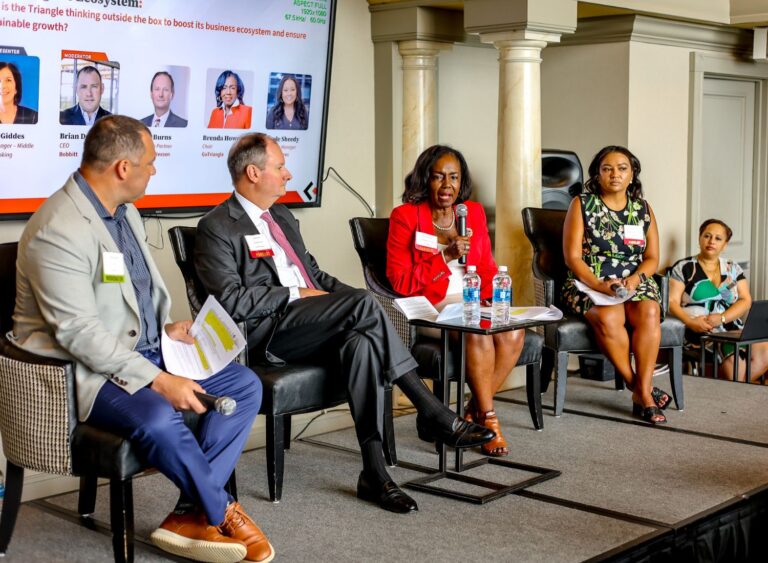
Lazarus moderated the final panel of the Invest: Charlotte Leadership Summit, titled “Charlotte 2030: What’s in store for Charlotte real estate over the second half of the decade, and how industry leaders are taking action.” Panelists included William Haygood III, managing partner at Boundary Street Advisors; Zach Pannier, business unit leader at DPR Construction; and Wade Miller, founder of Copper Builders.
Transportation emerged as a key theme, with panelists emphasizing that mobility will define how well Charlotte manages its rapid growth. Pannier noted that daily in-migration has nearly tripled since he moved to the city in 2018 — from 42 to 117 people a day. “If we’re not serious and we don’t align around some outcomes for Charlotte, that growth is going to be really hard to maintain — or at least maintain in the lifestyle that I certainly love here,” he said.
A newly introduced measure, Senate Bill 145, would authorize a transportation referendum this November to fund major expansions to roads, light rail, and bus infrastructure. Miller underscored that the only way to avoid becoming known for gridlock is to plan far ahead. “If we decided today to start a road project, none of us would be driving on it for five, maybe even 10 years,” he said. “That’s why front-loading these investments is critical.”
Geography and equity were also top of mind. Haygood urged leaders to think beyond the well-developed North and South corridors. “We haven’t spent a lot of time in the East and West,” he said. “There’s opportunity there. And when you go East and West, things are getting less expensive. We need to meet people where they are.” He noted that addressing infrastructure — such as water, sewer, and transit — along with bringing in services like banks, grocery stores, and retail, is key to meeting communities where they are.
As demand for housing grows, build-for-rent models are gaining traction. However financing challenges, labor shortages, and rising costs continue to slow production. “Apartments are hard to finance right now,” said Miller. “Tariffs, labor shortages, new regulations — all of these are putting pressure on the system. We need more solutions and flexibility.”
For Pannier, regional collaboration is critical as Charlotte positions itself as a hub for data centers and advanced manufacturing. “We’ve done a decent job so far, but demand is about to explode,” he said. With energy use growing 3% annually — driven by AI and innovation — he called for smarter planning and new solutions like microgrids, gas turbines, and small-scale nuclear.
Ultimately, the panel agreed: Charlotte’s growth can be an asset if it’s guided by intention. “We talk a lot about bravado in real estate,” Haygood said. “But it’s really about the grind. Doing the research. Planning for developments that are years out. Asking the community what they actually need and delivering it. That’s how you win.”
For more information, visit: