Faceoff: How South Carolina regions turn collaboration into competitiveness
Key points:
- • Charleston’s five-year strategy, developed with Ernst & Young, is shifting the region’s focus from growth for its own sake to deepening innovation across established industries like aerospace, automotive, and life sciences.
- • North Eastern Strategic Alliance’s nine-county coalition is drawing investment interest across energy, data centers, manufacturing, and logistics, anchored by Inland Port Dillon, which set cargo movement records this past year.
- • Both regions credit their success to functioning as single economic units rather than collections of individual counties — Charleston as a federally designated metro of roughly 890,000 people, and NESA as nine counties “pulling the wagon in the same direction.”
 August 2026 — South Carolina‘s economic development story increasingly reads less like a collection of county-by-county wins and more like a case study in regional alignment. Across the state, alliances built to present a unified front to investors, site selectors, and global companies are shaping where — and why — business lands in South Carolina.
Join us at caa’s upcoming leadership summits! These premier events bring together hundreds of public and private sector leaders to discuss the challenges and opportunities for businesses and investors. Find the next summit in a city near you!
In the Lowcountry, the Charleston Regional Development Alliance has spent three decades evolving from crisis response to a five-year innovation strategy built in partnership with Ernst & Young. What began in 1995 with the closure of the Charleston Naval Base and Naval Shipyard, and the loss of more than 22,000 jobs, has grown into a globally competitive economy spanning aerospace, automotive, life sciences, defense, information technology, and tourism. In the Pee Dee region, the North Eastern Strategic Alliance is coordinating nine counties around shared infrastructure, workforce, and industry strengths — from Inland Port Dillon’s record-setting 2025 cargo year to a diverse base of manufacturing, energy, and logistics investment.
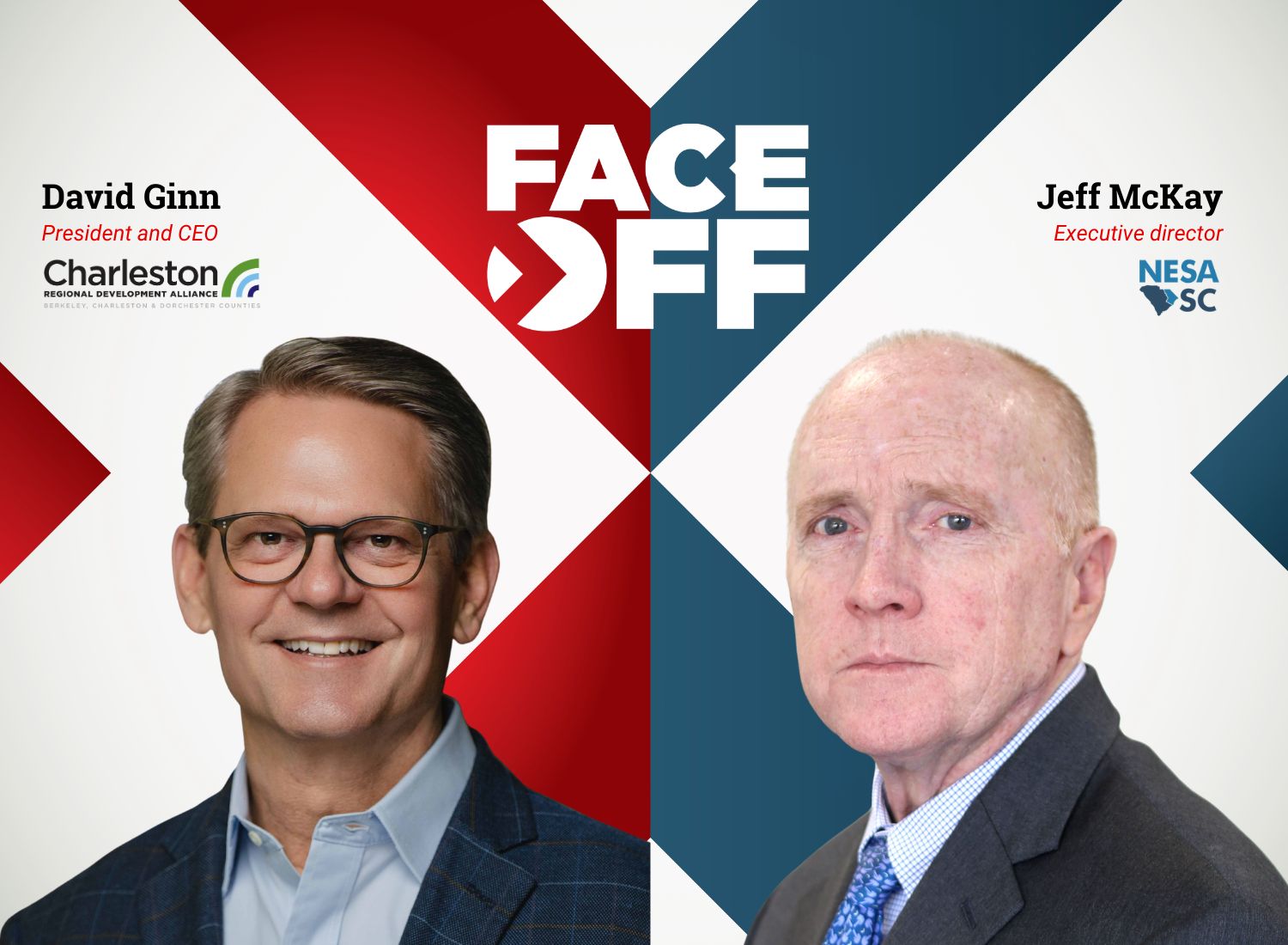
Invest: spoke with David Ginn, president and CEO of the Charleston Regional Development Alliance, and Jeff McKay, executive director of the North Eastern Strategic Alliance, about the milestones behind their regions’ growth, what sets their collaborative models apart, and where they’re steering their organizations next.
What have been the biggest milestones or highlights for your organization and region over the past year?
David Ginn: Throughout the fiscal year, our corporate scorecard has kept us focused on telling the story that the Charleston region is open for business. Our mission is to attract the world’s best companies, talent, and entrepreneurs to the three-county Charleston region of South Carolina. To achieve that, we establish annual goals, and I’m proud to say our team met those objectives. One major milestone this year was the launch of our new website alongside a comprehensive brand refresh… Finally, we now have a five-year strategic roadmap developed in partnership with Ernst & Young (EY), providing a clear vision for the future.
Jeff McKay: There has been a lot of focus on feeling things out with a new federal administration, along with its new policies and new direction, especially around trade and tariffs. There has been uncertainty as everyone tries to figure out where everything is going to land. For us, it has been about identifying where we best fit and where the region’s strengths lie amid all that change.
What differentiates your region’s approach to attracting investment, and how does regional collaboration factor into that?
Ginn: It depends on the industry. We don’t view Charleston as competing with a one-size-fits-all approach. Instead, we begin by understanding each company’s unique needs, what they do, how they plan to grow, the workforce they require, the industries and partners they need to be near, and the assets that will help them succeed. While our region includes three counties and 27 municipalities, it truly functions as one market. By federal designation, the Charleston region is a single metropolitan area with a population of approximately 890,000 people.
McKay: In my view, it is fairly simple: it is all about mass. When we work together, we have the ability to show greater mass to investors and job creators who may be looking at an area. Individually, counties can have success, but regionally, we can have greater success. We work well together across our nine counties to make sure we are putting our best foot forward and showing the strength we have as a cohesive region, rather than only as individual counties. If we’re all pulling the wagon in the same direction, we’re going to have success.
What industries or sectors are generating the strongest investment interest in your region right now?
Ginn: Today, we’ve proven as a community that we can win in aerospace, automotive, life sciences, defense, information technology, and tourism, welcoming nearly 8 million visitors annually in a market that is not quite a million people.
McKay: We have seen a lot of activity in the energy sector from users looking for more available power. We have also seen many inquiries from the data center sector, as much of South Carolina has. Traditional manufacturing remains important. Steel, plastics, chemicals, and similar industries have been the backbone of our region for years, and those projects are still out there looking to create opportunities. Transportation and logistics are also important because of Inland Port Dillon and our location on the East Coast.
What are your priorities for the next two to three years?
Ginn: Our regional economic development strategy, which is centered on innovation, is only about a year old. I posed the question: How long will it take before external audiences perceive Charleston as an innovative place to live, work, and do business — not simply because we say it is, but because they genuinely experience it? Looking ahead, I hope that five years from now, when I bring someone to Charleston, they’ll still say, ‘Wow, it’s a naturally beautiful, historic, vibrant place.’ But I also hope they’ll add, ‘It seems to be a really innovative place.’
McKay: First, we need to continue ensuring that we work well together as a region. We will continue supporting the counties we represent and filling any gaps they may have to make their programs successful. We also need to work with the strong local leadership we have and make sure visions align so that we all win. South Carolina has proven to be, if not the leader in economic development in the United States, certainly one of the top leaders. We want to make sure we stay on board with that.
Want more? Read the Invest: South Carolina report.