


San Antonio investment: Eastside plant, airport grow
Key points:
- • Coca-Cola’s regional bottler unveiled a $42 million, 170,000-square-foot Eastside expansion.
- • The project added 80 workers, bringing the Eastside plant’s workforce to about 900.
- • The FAA awarded San Antonio’s airport $43.2 million, its largest FAA grant ever.
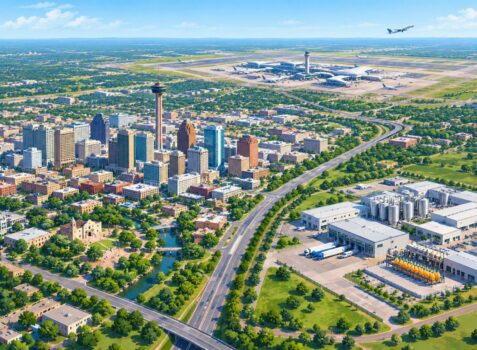 October 2026 — San Antonio landed two major capital commitments within three days in late September, one aimed at the factory floor on the Eastside and the other at the airfield that serves as the city’s front door. San Antonio investment centers on Arca Continental Coca-Cola Southwest Beverages’ $42 million expansion of its Eastside bottling plant, the San Antonio Report reported, a project that adds 170,000 square feet of new space, a second production line and 80 new workers.
Join us at caa’s upcoming leadership summits! These premier events bring together hundreds of public and private sector leaders to discuss the challenges and opportunities for businesses and investors. Find the next summit in a city near you!
The expansion sits at the company’s Eastside facility next to the Frost Bank Center, between Commerce and Houston streets. The new production line uses advanced technology designed for faster production and greater packaging capacity, and the upgrade includes new equipment for forklift operators along with charging stations to power it. That combination reflects how bottling operations are modernizing: output rises not just from more floor space but from faster lines and more efficient movement of product.
The hiring is weighted toward the warehouse. Most of the 80 new positions are warehouse staff roles, and the additions bring the Eastside facility’s workforce to roughly 900 employees.
Company president Susanne Brady-Lusk acknowledged that the new machinery requires a ramp-up period as workers learn new capabilities, a reminder that equipment investments pay off only as quickly as the workforce adapts to them. State Rep. Barbara Gervin-Hawkins and Bexar County Commissioner Tommy Calvert attended the announcement, underscoring the political weight attached to industrial jobs on the city’s Eastside.
San Antonio is also competing for capital within the company’s own network. Arca Continental Coca-Cola Southwest Beverages is making parallel investments at facilities in Fort Worth, Waco, Houston and Oklahoma City. That spread suggests the bottler is scaling capacity across its territory rather than betting on a single market, and it means the San Antonio plant’s performance after this upgrade will factor into how future dollars are allocated among those sites.
SAT gets a financial boost
The second commitment came from Washington, D.C. The Federal Aviation Administration is providing just over $43 million in grants to San Antonio International Airport, the largest FAA award in the airport’s history, the San Antonio Report reported separately. The money comes through the FAA’s Airport Improvement Program, and San Antonio’s award was the largest among four airports in this round, which distributed $84.4 million in total to facilities in San Antonio; Abilene, Texas; Jackson Hole, Wyoming; and Wilmington, North Carolina.
The grant funds improvements to the airfield drainage system as part of the airport’s broader $2.5 billion development program. The work includes a new underground stormwater system that will route rainwater from the airfield and the new terminal development area to Salado Creek. Airport director Jesus Saenz said the project will add stormwater capacity and bring airport infrastructure up to FAA and rainfall-design standards. The benefits are operational as well as regulatory: reducing standing water cuts down on wildlife that increases the risk of bird strikes, and better drainage protects operations during heavy rainfall.
The award extends a steady stream of federal support. Since 2020, the airport has received $217.7 million in federal funding, including $99.2 million for airfield projects and $114.5 million for terminal initiatives such as the new Terminal C and Terminal A expansions. City Manager Erik Walsh said grants like this one help the airport stretch its dollars, since airport development is otherwise funded through revenue sources including carrier fees, parking and concessions. For airlines and concession operators, federal money covering infrastructure work eases pressure on the fees and rents that would otherwise carry more of the cost.
Shaping economic capacity
Taken together, the two projects show the kind of investment that rarely makes splashy headlines but shapes a city’s economic capacity. A modernized bottling plant strengthens San Antonio’s role as a production and distribution hub for consumer goods across South Texas, while airfield upgrades support the terminal expansion that will determine how many flights, routes and visitors the city can handle in the years ahead. Both depend on workers in logistics, construction and skilled trades, and both tie the city’s growth to physical infrastructure rather than office space.
The next markers will come as the projects move from announcement to operation. Executives should watch how quickly the Eastside plant’s second line reaches full output, whether the bottler’s parallel investments elsewhere in its territory draw future capacity away from San Antonio or reinforce it, and whether nearby Eastside businesses see spillover demand from a larger workforce. At the airport, construction contracts for the stormwater system and progress on Terminal C will show whether the $2.5 billion program stays on schedule, and whether San Antonio can keep securing federal dollars that let local revenue go further.
Want more? Read the Invest: San Antonio report.






