Spotlight On: Col. Michael Fossum, Chief Operating Officer, Texas A&M University at Galveston
Key points:
- • Texas A&M University at Galveston is expanding workforce and research programs tied to the blue economy.
- • Demand for mariners and engineers is driving enrollment growth and industry partnerships.
- • The campus supports Houston’s competitiveness through maritime education, port innovation, and coastal resilience research.
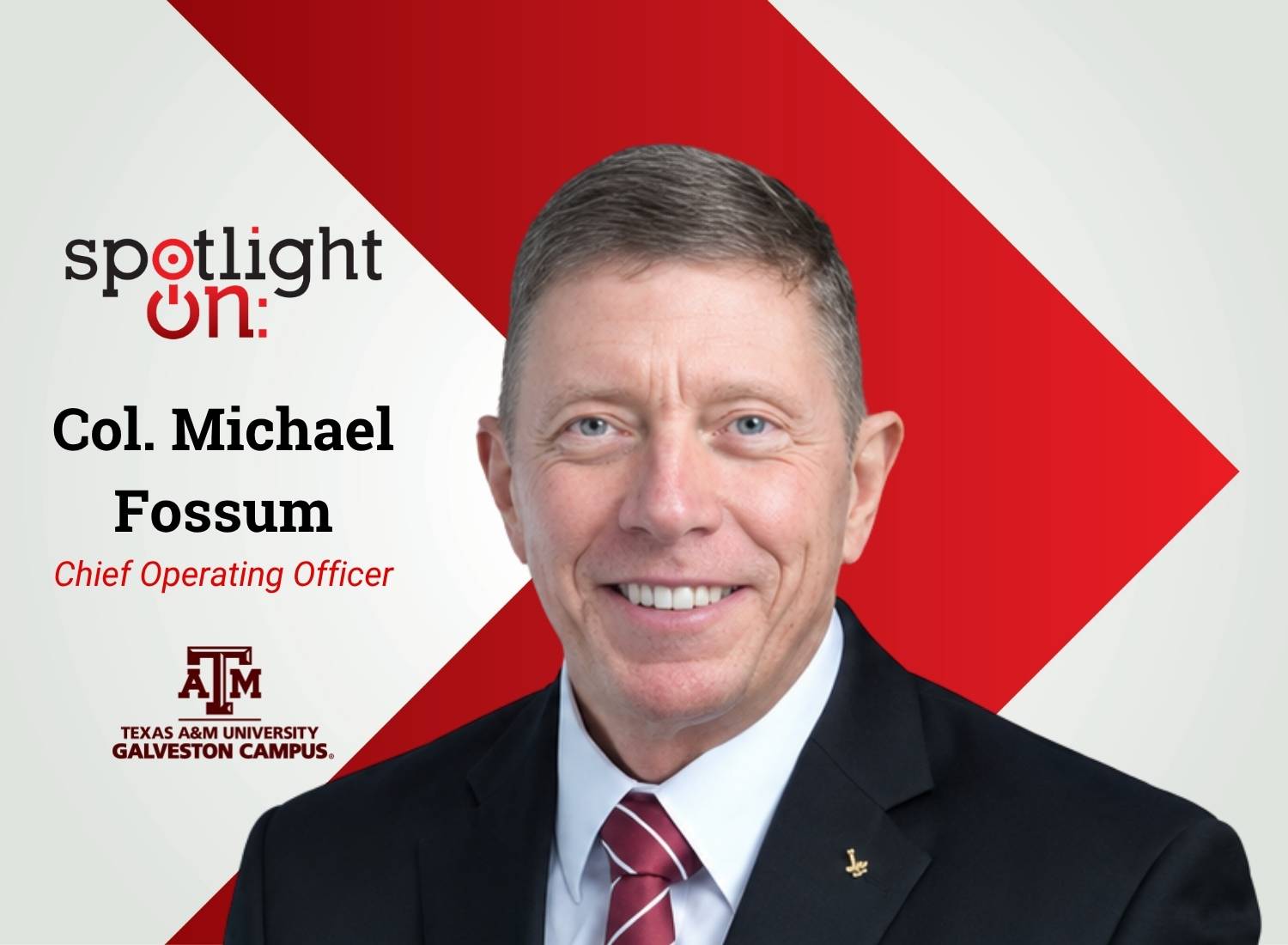 July 2026 — Invest: spoke with Col. Michael Fossum, chief operating officer of Texas A&M University at Galveston, about the campus’ role in the blue economy, workforce pipelines tied to port activity, and the research and engineering capacity needed to strengthen coastal resilience. “Together, we’re a force for good,” Fossum said.
Join us at caa’s upcoming leadership summits! These premier events bring together hundreds of public and private sector leaders to discuss the challenges and opportunities for businesses and investors. Find the next summit in a city near you!
How has the transition to the College of Marine Sciences and Maritime Studies strengthened your position within the Texas A&M system?
Being recognized as one of the colleges and schools within Texas A&M University has significantly elevated our status, helping others understand that we are part of the university. As a remote branch campus, many people still do not realize our connection to Texas A&M, so this clarity is essential.
Now, we have a well-defined identity along with a dean who has taken the initiative to concentrate our academic efforts on what we call the blue economy. Shipping and ports are crucial to Texas, particularly in this region. Although my statistics are over a year old, approximately 28% of Texas’s GDP is linked to this ecosystem, with the Port of Houston alone accounting for nearly 20% of the state’s GDP through the business that flows through it. When you also consider the Port of Galveston and Texas City in our area, as well as the other ports on the Texas Coast, the scale of this maritime network becomes even more apparent.
We combine the Maritime Academy, which trains crews and operators, with scientific and policy work that ensures commerce remains environmentally responsible by protecting bays, oceans, and fisheries. Additionally, we focus on the business and logistics side, connecting ships and ports to rail, trucking, and pipelines that link Texas with global markets. The momentum generated by our founding dean, Dr. Debbie Thomas, has been remarkable.
As Houston continues to grow as a global hub for trade and port activity, and also for energy, where are you seeing the strongest demand for students and industry partners?
There is a strong demand for mariners, and our enrollment in that program increased by about 25% last fall. Students graduate with their degrees and a Coast Guard license, allowing them to serve as officers on commercial ships. These vessels operate around the clock, both in and out of Houston and around the world. The demand for trained professionals in this field is real and immediate, attracting students to pursue degrees that lead directly to credentials and careers.
Applications across our campus are also up for next fall, and the growth we anticipate looking toward the fall of 2026 is prompting us to plan aggressively. Additionally, there is significant demand in the fields of science, business, and engineering. Ocean engineering, which I describe as civil engineering on the water, supports various projects, including port structures and offshore energy systems, such as wind power. Our Maritime Business program produces graduates who are ready to roll up their sleeves to ensure our ports efficiently connect shipping to shore-based transportation on rail, trucks, and pipelines.
We are also focused on enhancing coastal community resilience. The Institute for a Disaster Resilient Texas, led by Dr. Sam Brody, models flooding risks down to the address level. As the region urbanizes and previously grassland areas transform into pavement and roofs, watersheds change, which subsequently alters the probability of flooding.
How will the new engineering building expand your capacity to support workforce needs in coastal infrastructure, offshore systems, and maritime technology?
The new engineering classroom and research building is a dream that is finally becoming a reality. Faculty members have moved in, and we are in the process of outfitting laboratories, makerspaces, workshops, and hands-on learning areas. This new facility will enhance growth in ocean engineering and related research, providing spaces for students and faculty to study wave action, sediment dynamics, and structural performance. This building is essential for our growth.
The demand for engineers in Texas continues to rise, and companies relocating to the area are seeking top-quality talent. Our students receive an R1-level research education and graduate with the values that Texas A&M emphasizes: respect, excellence, leadership, loyalty, integrity, and selfless service. While employers can train new hires in technical skills, they are also looking for character and reliability.
How should regional leaders think about your campus as part of the long-term infrastructure that supports Port Houston and export-driven growth?
This is our world. Ship operations, business, sciences, engineering, and the humanities are interconnected, and our graduates are recognized for their hands-on approach to getting the job done.
In the field of sciences, work extends beyond the laboratory. Graduates actively engage in bays and wetlands, monitoring conditions and tracking changes in the coastal environment. This understanding of the connected ecosystem translates into the workforce. For instance, someone may begin their career in port operations, but when an environmental issue arises, they know exactly who to contact. For business leaders, we serve as a comprehensive resource for much of what the marine and maritime sector requires.
Where do you see the greatest opportunity for growth in research funding, particularly in areas like coastal resilience and risk modeling?
We are exceeding expectations in our research efforts. In the past year, we spent approximately $20 million on research, despite having a relatively small number of research faculty. Much of this funding comes from federal and state sources. A significant advantage of our program is that undergraduates have the opportunity to engage in real research, which enhances their career readiness.
We have a sea turtle rescue hospital here, supported by hundreds of volunteers. During nesting season, teams cover about 150 miles of coastline to locate nests and move eggs to an incubation center, where survival rates are higher. When a cold snap hits, sea turtles can become cold-stunned and fall into a coma-like state, and teams rescue and rehabilitate them. Students get involved in that work, and it brings a sense of responsibility that stays with them.
We also look at large-scale protective infrastructure. In 2008, Hurricane Ike shifted course late, and that shift helped spare the Galveston Bay complex from the worst surge. That risk is one reason the region has pursued major storm-surge protection concepts, including the coastal spine, which has become a major U.S. Army Corps of Engineers effort.
What are your sources of funding, and where do you think you’re going to get the funding next?
The National Science Foundation (NSF) is our primary source of research funding, complemented by company grants and industry partnerships that support student scholarships, internships, and career pathways. Other major funding partners include the Texas General Land Office (TGLO), the Texas Commission on Environmental Quality (TCEQ), Texas Parks & Wildlife, and the National Oceanic and Atmospheric Administration (NOAA). These partnerships are crucial for advancing our research mission and enhancing opportunities for students.
Internships are incredibly valuable. They help students understand the relevance of their coursework while allowing companies to assess future hires. We regularly work with over 100 employers who recruit on campus, and our mariner-focused recruitment can attract up to 75 companies interested in speaking with students. We encourage industry involvement on campus through scholarships, guest lectures, and support for programs like our Blue Economy Institute. This engagement helps students recognize the organizations that are investing in their future success.
Looking toward 2030, what role do you want Texas A&M University at Galveston to play in strengthening Houston’s global competitiveness?
The maritime industry is essential for Houston. The lifeblood of Houston comes through the Houston Ship Channel. Our mission is to be the destination of choice for anyone exploring any aspect of the blue economy. The Maritime Academy is on track to become the best in the nation, and we are not satisfied with anything less than that. The same ambition applies to our engineering, sciences, and business sectors.
Together, we stand as a force for good, supporting the growth of Houston and Texas while contributing to the well-being of the world.
Want more? Read the Invest: Houston report.