Spotlight On: Jason Hyrne, Chief Executive Officer, Chief Investment Officer, Co-Founder, Gryphon Wealth
Key points:
- • Gryphon Wealth’s fee-only model strengthens its fiduciary approach.
- • AI is enhancing personalized advice while preserving client relationships.
- • Clients are reassessing private capital as returns and liquidity shift.
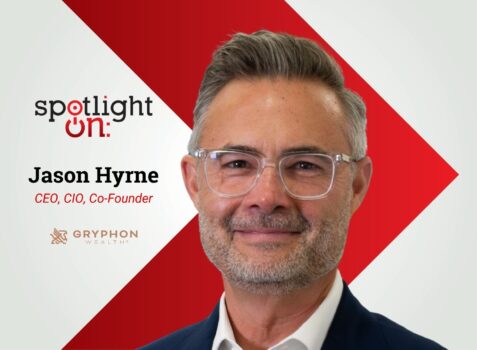 September 2026 — In an interview with Invest:, Jason Hyrne, chief executive officer, chief investment officer, and co-founder of Gryphon Wealth, discussed the firm’s transition to a fee-only fiduciary model, technology’s role in wealth management, and the importance of long-term client relationships. “For much of the last decade, the trend moved toward private capital. Over the last couple of years, we have seen it begin to move in the opposite direction,” Hyrne said.
Join us at caa’s upcoming leadership summits! These premier events bring together hundreds of public and private sector leaders to discuss the challenges and opportunities for businesses and investors. Find the next summit in a city near you!
What role does Gryphon Wealth play in the Jacksonville market, and what milestones have shaped the firm recently?
Gryphon Wealth has 22 employees and just over $3.38 billion in assets under management (AUM) as of August 26, 2026. The families and individuals we serve are primarily based in North Florida, though we also have clients in 30 states across the country.
We were founded in 2005. My partner and co-founder, Jeff Wyatt, who is now chairman of the company, and I started working together at Wachovia, which is now Wells Fargo. In 2023, we went independent while continuing to be supported by Wells Fargo.
This past April, we became a fee-only fiduciary while continuing to clear through Wells Fargo. That has been a really impactful change. Before the transition, we were already 97% fee-based. Completing the transition to a fee-only fiduciary has been meaningful. Our clients appreciate it, and I think it puts us in a leadership position in the community.
What drove the decision to become independent while maintaining a relationship with Wells Fargo?
We’re appreciative of Wells Fargo. They supported us for two decades, and it was a great experience.
The move to independence was driven by opportunity. Wells Fargo opened a program that allowed us to go independent and become a fee-only fiduciary. That opportunity lined up with a broader shift already underway in financial services: technology, including AI, has been reshaping the tools and resources available to advisors over the last decade. We wanted the flexibility to move faster on that.
Wells Fargo remains our custodian, which gives clients real stability and security; their assets are held and safeguarded by a global bank. This gives Gryphon Wealth, as a smaller and more nimble firm, the ability to adopt new technology in planning and investment management quickly. That combination is the best of both worlds: the ability to move quickly while maintaining the safety and stability of a large global bank.
How are technology and AI changing the way Gryphon Wealth serves clients?
We place a strong emphasis on making intelligent decisions, and AI and technology help us do that. We believe clients expect us to use every tool available to manage their wealth well.
Another core value is investing in personal relationships. When it comes to people’s wealth and their families, trust is paramount. While the rapid pace of technological change and AI is bringing opportunities to the forefront, it is also reinforcing how important trusting, personal relationships are.
We want AI and technology to support what our people do, not to replace them. If anything, we expect more focus on personal relationships because technology allows us to spend less time on some of the planning work. That allows us to spend more time with clients.
How are wealth transfer and estate planning changing client priorities?
Our clients are focused on how their assets will pass to the next generation and how that next generation is involved today. We have a full-time estate planning attorney on our team who works on planning and estate strategy to ensure plans are structured and executed the way clients want.
In many cases, we function as a mini family office. There is a much bigger focus on estate planning today than there was 10 or 15 years ago. We are also adding technology, including AI tools, to help us track some of our clients’ more complicated estate plans.
A lot of what drove our decision to become a fee-only fiduciary was building Gryphon Wealth into a forever firm. We do not want something that is here today and sold tomorrow. We want a lifelong firm where clients, their families, and their children work with us for multiple generations.
We currently have four younger advisors learning wealth management, with another joining us soon. Building that next generation creates continuity for our clients and the firm over the next 15 or 20 years.
How does multigenerational planning affect investment strategies?
It becomes even more important to separate what the current generation needs from what future generations may need. We spend a lot of time asking what the current generation needs to live comfortably and enjoy life.
It is not just about the minimum amount someone can spend. The question is what they can spend on themselves, travel, family, or charitable giving. We have had clients make significant gifts to hospitals and a variety of causes that benefit communities in North Florida and nationally.
Then we look at what is intended for the next generation. Investments for the matriarch or patriarch of a family may have a different purpose from investments meant for children, grandchildren, and future generations. Those portfolios can be structured around different purposes.
What trends are you seeing in private capital and other alternative investments?
There has been a major move toward private capital, including private equity, private real estate, and private credit. We have seen that trend and participated in it.
More recently, particularly among some of the larger players, we are seeing investors become a little disappointed. Significant capital has moved into the space, and returns have diminished as a result.
Some of our wealthier clients are asking whether it still makes sense to have significant exposure there. Those investments can involve lockups, tax complications, and other issues. If returns are diminished, clients are reconsidering whether those trade-offs are worthwhile.
We are beginning to see movement away from large allocations to private capital. Clients may still make individual investments where they see specific opportunities, but we are seeing fewer clients allocate large portions of their portfolios there. For much of the last decade, the trend moved toward private capital. Over the last couple of years, we have seen it begin to move in the opposite direction.
How are digital tools helping Gryphon Wealth personalize its advice?
AI and technology let us become more granular and detailed with each client. We can tailor investment decisions and planning more closely to their specific needs. For example, we’ve partnered with a company that can pull tax data for individual clients. That lets us dive much deeper into their tax situation than we could before, rather than working from a general picture. Now we can go further on income tax and estate tax considerations, examine what’s happening with a client, and find ways to improve their situation.
How has the regulatory environment affected the firm and its investment approach?
Our move from a larger wirehouse firm to being independent and a fee-only fiduciary has brought a positive regulatory change. We are now regulated by the U.S. Securities and Exchange Commission, instead of two regulators, which allows us to communicate with clients more directly and transparently.
We have to consider the regulatory environment with every investment. Regulation can sometimes protect established companies by making it harder for new competitors to enter the market. In those situations, an established company can become a more attractive investment, because regulation itself helps create a competitive moat.
How is Jacksonville’s growth affecting wealth management, and what is your outlook for the region?
Jacksonville, North Florida, and Florida generally are fast-growing markets. There has been a movement from higher-tax states and more heavily regulated environments into states such as Florida, Texas, and Tennessee.
We are seeing a real benefit from wealthier families moving to North Florida and Florida overall. That benefits our business, but I think it also benefits the community. Wealth coming into North Florida supports charities and businesses, and business relocations create jobs. It’s a broad economic and community benefit, not just a benefit for Gryphon Wealth.
Looking ahead three to five years, we are optimistic. I think the trends we are seeing now will likely continue, and we don’t currently see signs of them slowing. Our outlook is that the community and economic environment should remain favorable for Gryphon Wealth and other businesses in the region.
We also expect AI to drive productivity gains and economic growth more broadly. We believe we’re at the early stages of a favorable environment, both nationally and globally, and that Florida and North Florida in particular are well positioned to capture more than their fair share of that growth.
Want more? Read the Invest: Jacksonville report.