Spotlight On: Mark Lamping, President, Jacksonville Jaguars
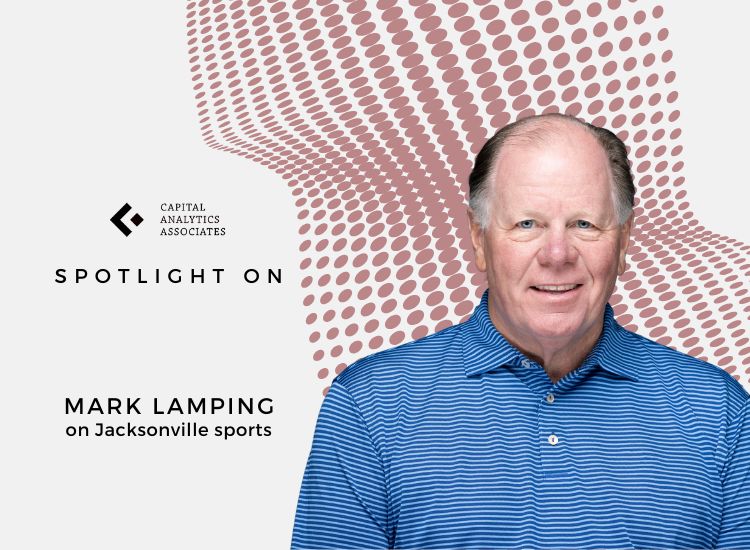 January 2025 — Mark Lamping, president of the Jacksonville Jaguars, talked to Invest: about the NFL team’s new stadium, their burgeoning relationship with the University of Florida, and the economic implications these will have on the surrounding region.
What do you think will be the economic impact of the new stadium project, not just for the Jaguars but for the city of Jacksonville as a whole?
We expect the impact to be significant. The reason we have such lofty expectations is because it’s not just a new stadium. The impact of the stadium should be felt in all corners of Jacksonville. It will prove to be a catalyst for downtown development, helping downtown realize its full potential as an economic engine that can generate revenue for the benefit of the entire community.
We’re already seeing that impact. If you view the stadium as simply the home for an NFL team, and if the end result is just a new stadium, then as a community, we missed a huge opportunity. During the construction phase alone, you’re creating thousands of jobs for residents to work and using local companies. The economic benefits are being felt and things are being allowed to grow and prosper.
And when you get through the construction period, permanent jobs are created both directly through the stadium and the surrounding development. You are already seeing that development happening outside the stadium location. In fact, the single largest private investment in downtown Jacksonville, besides the stadium, is happening right across the street. It’s the development of a new Four Seasons Hotel and Private Residences, office building, and a publicly owned marina and support building.
We’re seeing the impact as it relates to other activities. The community-owned stadium is not designed just for NFL games, it’s designed to bring other events to Jacksonville along with the economic impact that those events represent.
To what extent have the Jaguars benefited from all the growth that has been taking place in Jacksonville, from population to new corporate expansions?
As Jacksonville grows, so will the Jaguars. There’s no question that while Jacksonville is one of the smallest communities with an NFL team, it’s also one of the fastest growing. That growth in Jacksonville is pretty much across the board; not just people moving here but people staying here, companies relocating, and existing companies adding jobs. It’s a much more economically vibrant community than it has been in the past, and since most of our customers are sourced locally, it certainly benefits the Jaguars.
How does the stadium leverage design to improve the overall fan experience?
It’s really a few things. The story is more than what the stadium is going to end up looking like and how it’s going to work with our customers. It’s the process of delivering that. Because this is a renovation, it’s a much more environmentally responsible way to deliver an up-to-date stadium. We’re reusing a lot of materials. From that perspective, it’s a much more sustainable approach. What’s driving the design of this stadium is making sure our fans have the best possible experience. We spent quite a bit of time not only talking to our fans, but also talking to other stakeholders about what would be important to them as it relates to this new stadium experience. We received tremendous feedback in terms of design. This is reflected in, for example, providing comfort in what is a hot part of the country. There will be a significant increase in the amount of vertical transportation, meaning elevators and escalators that transport our customers from one level to the next. And there is the architectural statement that the stadium makes on behalf of the community. All of those things were an important part of the design and will be a joy for our fans to experience firsthand when the facility is complete.
What are the implications of the announced partnership with the University of Florida?
We’ve entered into a new agreement with the University of Florida, principally through their UF Health organization. The University of Florida is one of the highest-rated public universities in the United States. Their primary campus is in Gainesville, which is about 75 miles from Jacksonville, but they have made a huge commitment to Jacksonville historically, and even more so in terms of their commitment to the future. It is one of the largest employers in Jacksonville, and they are committed to bringing in a graduate campus to the city. They have a significant presence in Jacksonville, they are a world leader in what they do, and, if you are known by the company you keep, we are proud to be known through our acquaintance with the University of Florida.
What other partnerships – perhaps with public institutions or private companies – do you have?
We have a healthy roster of community partners. Many of them have been with us for a number of years. They’ve shown their commitment to Jacksonville, and we wouldn’t be able to have a stable NFL franchise here in Northeast Florida if it weren’t for the support we’ve seen from many local corporations.
From a more holistic point of view, what sets the sports industry of Jacksonville apart from that of other regions?
The Jacksonville market is one of the smaller markets in the National Football League. We’re also one of the few NFL markets where the team is the only major league sports franchise located in that city. There’s no basketball team, there’s no baseball team, no hockey team. The only major sports franchise located in Jacksonville is the Jacksonville Jaguars. That in and of itself makes the relationship between the team and the community unique.
The city of Jacksonville is incredibly important to the Jacksonville Jaguars and, likewise, the Jaguars are incredibly important to the city of Jacksonville; more so even than most cities and their relationship to their local sports teams.
What are the main challenges the team and the NFL are facing at the moment?
The biggest challenge we are facing is determining what the future of our stadium is going to be. The existing stadium was not going to be able to support the needs of our fan base and our team going into the future. We had to come up with a stadium solution. We’ve done that with our recent agreement with the city of Jacksonville. Now we have to secure final approval from the NFL. Once that happens, the Jaguars will be executing a 30-year lease to play in this reimagined city-owned stadium, thus assuring NFL football here and in Northeast Florida for generations to come.
For more information, please visit: