

Spotlight On: Michael Shannon, President, University of North Georgia (UNG)
Key points:
- • UNG is experiencing record enrollment across its five campuses.
- • STEM investment is strengthening workforce and industry connections.
- • Adaptability, leadership, and purpose are central to workforce preparation.
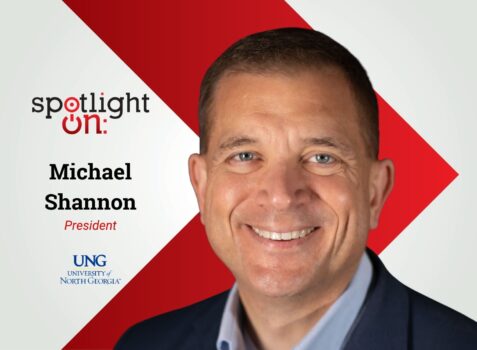 September 2026 — In an interview with Focus:, Michael Shannon, president of the University of North Georgia (UNG), discussed changing expectations around higher education, enrollment growth, workforce preparation, STEM investment, and purpose. “Nobody’s born to be average,” Shannon said.
Join us at caa’s upcoming leadership summits! These premier events bring together hundreds of public and private sector leaders to discuss the challenges and opportunities for businesses and investors. Find the next summit in a city near you!
How do you describe higher education in Georgia today?
Higher education in Georgia is incredibly strong because the state is committed to it. Our private institutions are strong, and the 25 institutions in the University System of Georgia are well integrated and working to connect with the state’s direction. UNG is proud to be part of that family.
That connection is especially important during an era when people are asking, “Why college?” Students and families are considering the time, money, commitments, and sacrifices involved. Universities need to connect students to why they are here, why college matters, and why the investment is worthwhile.
The answer changes as technology and society change. Skills become obsolete, and new ones emerge. Historically, universities have not been comfortable with change, but our lasting responsibility is to prepare people who can learn, adapt, lead, and act with purpose. UNG is serving more students than at any point in its 153-year history because that message is resonating. It should remain an evolving conversation rather than a fixed answer.
What is driving UNG’s enrollment growth?
We serve students across a broad continuum, not only the traditional ages of 18 to 23. UNG has the second-largest dual enrollment program in the University System of Georgia and serves thousands of high-school students earning college credit in the core curriculum. We then extend through associate, bachelor’s, master’s, and doctoral degrees.
Some students are already college-bound because of family expectations and will attend one of Georgia’s public institutions. The HOPE Scholarship is an extraordinary resource that can allow students who do their part to attend at a very low cost.
Our particular opportunity is reaching people who would not otherwise attend college. We have worked to explain why college matters in 2026 and why there is a path for anyone with interest and desire. UNG now serves more than 20,000 students across five campuses. Technology, analytics, data, and artificial intelligence are changing traditional education-to-work pathways, but humans are more important than ever. The right question is how people can interact with technology, leverage it, and make the world better.
Where are you seeing the strongest academic demand?
Healthcare remains exceptionally strong. Nursing is our flagship program, and this fall we expect nearly 900 students across bachelor’s and graduate nursing programs. Business is also booming across administration, marketing, finance, and accounting. Accounting now depends on data, analytics, analysis, and AI in ways that might once have been associated primarily with computer science.
Our College of Education is the fifth largest in the system by output, and Georgia school districts continue to ask for more teachers. The arts are also strong, particularly where they intersect with other disciplines. Art therapy, music therapy, and drama therapy connect creative work with healthcare. The arts also intersect with science, AI, and business. Georgia’s film industry provides another growing avenue.
A degree provides an area of deep study, but it does not define the whole person. Graduates should be people of purpose who are ready to learn and take on what the world puts in front of them.
How are changing industries reshaping workforce preparation?
Industries are changing constantly, which creates opportunity. A powerful regional example is the King’s Hawaiian facility near our Gainesville campus. It may appear to be a bakery, but inside it is a highly technical laboratory and engineering environment. The company is continually redefining how it operates.
That example helps students see that modern workplaces do not fit old categories. The same transformation is occurring in hospitals, medical offices, schools, and classrooms. COVID, online education, and AI have upended established approaches, but those changes can be viewed as opportunities to reinvent a product, service, organization, or how people are taught and supported.
The regional economy gives students a window into those possibilities. North Georgia has an inland port that is important to logistics, a strong manufacturing base, and substantial healthcare activity. Students need to understand that opportunity will not simply arrive at the door. They must be people of action who move toward it. Our job is to tell them to go get it and to become better than the generation before them.
What impact are you expecting from the new STEM Excellence Center?
UNG has been strong in biology, chemistry, physics, mathematics, and the traditional sciences for generations. The STEM Excellence Center allows us to bring education, industry, technology, economic needs, and national security together rather than keeping them separate. When those areas meet, important connections and discoveries can happen.
The $50 million investment creates an environment for those collisions. Our vision is to become Georgia’s go-to university for STEM leaders. Other institutions in the system also do science very well, but our role is to build leaders with scientific breadth, experience, and knowledge.
We want regular people to emerge as STEM leaders who are ready on day one to accomplish extraordinary things. They should be able to solve complex problems, identify the next step, and continue even when a problem is difficult. The center also expands the possibilities for industry partnerships by providing a place where education, technology, the economy, and national security can work together.
How does UNG define its national security role?
UNG is the Military College of Georgia and one of six senior military colleges, giving us a unique place in the national security enterprise. However, national security is broader than the students in our military programs. It can include local, regional, state, and national service; community development and planning; international affairs; science; mathematics; technology; and healthcare.
The central question is what students will encounter five or 10 years from now in their workplaces and communities and what we must do today to prepare them not simply to enter that future, but to lead it.
National security is about maintaining an advantage, having a decisive edge, and remaining ready for what comes next. AI, autonomous systems, and emerging technologies are transforming industries, classrooms, and security. Employers are continually redefining the capabilities they need, and many future jobs and challenges do not yet exist.
Cybersecurity is a clear example. We will teach content through courses and areas of focus, but the larger responsibility is to develop leaders who can solve problems, influence others, define emerging challenges, and lead through change.
Why is purpose central to the university experience?
Purpose is the reason I get out of bed every day. I believe every person is created for purpose and greatness. Nobody’s born to be average. The challenge is that many people do not believe greatness is available to them.
Universities should not expect students to arrive having found their purpose or leave four years later with every answer. I am still working to understand my own purpose. A university’s role is to help develop it. Purpose is not a fixed personality trait or a luxury for a fortunate few. It can be influenced, grown, and intentionally cultivated over time.
A college degree still opens rooms and seats at tables that may otherwise remain inaccessible. The degree creates entry, and then the individual has to take the next step and deliver. I want every UNG student to leave believing they can accomplish the impossible and pursue the greatness they were created for.
Failure belongs in that process. Every failure can be an investment in improvement. Winners often lose more because they take action and are not afraid to lose. We want students to invest in their purpose, act with courage, learn from failure, and keep moving toward the life they are capable of building.
Want more? Read the Focus: Atlanta report.