
Spotlight On: Todd Brockwell, CEO, 1900 Wealth
Key points:
- • Economic uncertainty continues to shape investor concerns and portfolio decisions.
- • Family-office services are growing alongside generational wealth transfers.
- • AI and alternative investments are expanding wealth management capabilities.
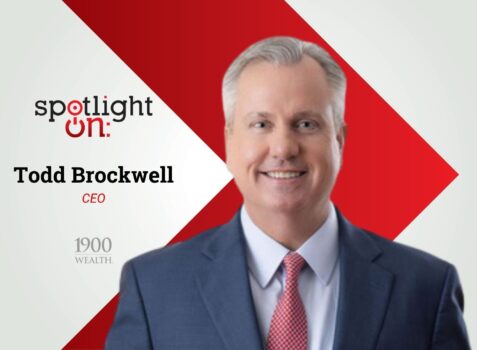 September 2026 — In an interview with Invest:, Todd Brockwell, CEO of 1900 Wealth, discussed economic uncertainty, generational wealth transfers, and technology’s growing role in wealth management. The conversation also highlighted the firm’s family office capabilities, alternative investment platform, and commitment to remaining locally owned. “Our priorities have remained the same since the first day. We want transparency, alignment with clients, and to do the right thing for them,” Brockwell said.
Join us at caa’s upcoming leadership summits! These premier events bring together hundreds of public and private sector leaders to discuss the challenges and opportunities for businesses and investors. Find the next summit in a city near you!
What changes have you observed in the investment environment and in your clients’ concerns?
Developments in the Middle East, interest rates, and inflation have been three of the largest concerns this year. They affected the markets tremendously during the first quarter, and those concerns remain as we move through 2026, even though they may ebb and flow.
Investors like certainty. When moving parts create uncertainty in fixed income or equities, investors become uncomfortable. The markets have performed well, and fixed income has been relatively stable, so people feel better than they did when those concerns first emerged. However, news about military action, potential rate hikes, inflation, or higher gasoline prices continues to create unease.
Overall, I think clients remain comfortable with the U.S. economy and our markets. It is the uncertainty surrounding geopolitical issues they cannot control that remains a concern.
How has being part of Jefferson Bank strengthened the way 1900 Wealth serves its clients?
Jefferson Bank is celebrating 80 years in business, and while 1900 Wealth was only established about 10 years ago, we have had the advantage of building our platform on the foundation of a strong, locally owned and operated stable community bank serving South Texas.
We started with approximately $175 million to $200 million in assets under management and have grown to $3.5 billion over the past 10 years. We have leaned into the bank’s stability and created a smooth client experience between 1900 Wealth and the private bank. It is designed to make things as seamless as possible because we collaborate closely to meet each family’s needs.
That may involve transferring money, coordinating with the bank’s trust department, or maintaining seamless communication. We create a positive experience for our clients and ultimately do the right thing for each family.
What has driven the firm’s growth, and what are your priorities moving forward?
Our priorities have remained the same since day one. We want transparency, alignment with clients, and to do the right thing for them. We are not commission-based or sales-based. If we can continue growing without compromising those principles, we will have done our job.
Approximately 80% of our new business this year has come from existing clients or their referrals. Ten years ago, most of our growth came from bank referrals and our network. Today, the opposite is true. Clients are referring family members and friends because they trust us and our expertise.
Which client groups are driving demand for your services?
Approximately one-third of our clients are ranching families or are connected to the energy industry. That has always been an important driver for our firm.
We have also launched family-office and consulting services that help families manage their overall wealth, not simply their investments. Demand has grown because families often need guidance beyond selecting investments.
Another important area is families experiencing liquidity events. We have an investment banker, a trust and estate attorney, and several CPAs with tax expertise on our team. We coordinate the right professionals throughout the process.
Whether a family is selling a multigenerational business, a ranch, or mineral interests, we help quarterback what can otherwise be an overwhelming process.
How is the generational transfer of wealth changing the services families expect?
AI and robo-advisers are important tools, but sophisticated clients with larger balance sheets and investment portfolios generally still want face-to-face interaction with an adviser. I do not believe advisers serving these families will be replaced by robo-advisers during my career.
Some families manage everything internally and may not need an outside adviser. The families we serve value guidance and an experienced sounding board.
We may manage portfolios for partnerships or trusts and provide reporting to the broader family. I have been doing this for almost 30 years, and several members of our team have comparable experience.
How do you maintain a high-touch, personalized approach?
There are five people on our family-office team, and three of us have run family offices. Every family is different, and there is no cookie-cutter approach. We customize our services for each family and their needs. Our team has the in-house expertise to provide high-touch service and recognizes when outside expertise is required.
If a family needs a specialized tax attorney or is preparing for a complex transaction, we bring in the appropriate advisers. Knowing when outside expertise is needed is just as important as having expertise in-house.
How are alternative investments incorporated into client portfolios?
Alternative investments are important for sophisticated families that understand the potential returns associated with illiquid investments. About seven years ago, we began developing our alternative platform and launched a legal entity that allows us to add multiple investments to the same platform.
Through our alternative investment platform, we focus on private equity, venture capital, real estate, and private credit. Scale and diversification are especially important in private credit. In the other categories, we rely heavily on relationships with family offices across Texas, particularly in Dallas, Houston, Austin, and San Antonio.
Those networks can provide access to managers and funds that are closed to new investors or too small for major wirehouse platforms. Our commitments typically range from about $7 million to $40 million. A fund may require a $10 million individual commitment, but through our platform, qualified clients can participate with a much smaller amount.
How are technology and AI affecting the wealth management industry?
During the past year, we added four new software platforms, all of which include AI components. For example, one uses AI to aggregate data, particularly for alternative investments. As technology continues to improve efficiency, I believe firms must embrace it.
We are very careful about how we use AI, primarily because of client confidentiality. We must protect the data lake we have created, so we are hesitant about placing client information into AI tools. Accuracy is another concern. Large language models are not perfect, and human review remains necessary to ensure the information is accurate.
How has Central Texas’ growth benefited the firm?
Technology, fintech, and venture capital activity between Austin and San Antonio has created another layer of wealth in Central Texas. We have invested with several managers in that corridor that we know and trust.
Historically, much of that activity was focused on software-as-a-service, business-to-business technology, and fintech. Today, AI has become the primary venture capital theme. That shift has created investment opportunities for existing clients and liquidity events for founders and investors.
What is your outlook for San Antonio and the firm?
I believe San Antonio must continue pushing for growth outside the government sector. Government and the military are critically important, but the city has lost several major corporations or headquarters over the past couple of decades, and those losses have not always been backfilled.
In my opinion, continuing to recruit privately held and public companies is imperative. That is a heavy lift, but it is critical. Airport connectivity is also a major factor. San Antonio needs more direct flights to strengthen its ability to attract larger corporations.
I am thankful for companies such as H-E-B and USAA that remain committed to San Antonio. I am personally involved with the San Antonio Stock Show & Rodeo, where projects are underway that can support economic development on the East Side.
Almost everyone on our team is from San Antonio or South Texas. This is home, and we want to contribute to the continued growth of Central and South Texas through our community involvement and professional work. Jefferson Bank and 1900 Wealth are locally owned; decisions are made locally, and neither organization is for sale. We intend to remain locally owned because we love our community.
Want more? Read the Invest: San Antonio report.