
Why turnover is costing your business more — and how to fix it
 Writer: Mirella Franzese

July 2025 — As the U.S. labor market shows signs of slowing, the cost of employee turnover is rising, highlighting one of the biggest challenges facing employers in 2025: managing retention.
The voluntary turnover rate, also known as the quit rate, reach a recent critical point in 2024, averaging 3.3 million workers quitting each month, according to a new report by Work Institute, a Tennessee research organization focused on reducing employee turnover.
A recent survey by Express Employment Professionals-Harris Poll found that nearly two in five U.S. hiring managers expect their company turnover to rise this year, a jump from 33% in 2024.
“Employee turnover isn’t just a staffing issue, it’s a financial one,”said Express CEO Bob Funk Jr., in a company release. “Companies that want to stay competitive must be intentional about retention. Which means building a workplace where people see long-term value — not just in compensation, but in leadership, clarity of direction and the opportunity to contribute meaningfully.”
Turnover costs U.S. businesses an average of $36,723 annually in rehiring expenses and lost productivity.
While the total number of voluntary turnover separations in 2025 is projected to fall between 35 to 40 million, this number is lower than the 2024 rate, the cost per employee is still expected to rise due to wage inflation and tight labor conditions, further pressuring employers to address retention.
“Replacing employees is costly,” Stephanie Mahnke, executive director of the Tennessee Pride Chamber, told Invest:. “(It costs) up to approximately $8,000 per employee, with even higher costs for executive-level positions – so retaining talent really matters.”
On average, turnover costs equal 33% of an employee’s base pay. For a worker earning $50,000, that could exceed $16,500 in 2025, accounting for rising wages, labor shortages, and growing competition for talent.
Larger organizations bear the brunt of costs, as 34% of companies with 500 employees or more report turnover-related losses above $100,000. In contrast, only 5% of companies with fewer than 50 employees face similar expenses.
Early exit
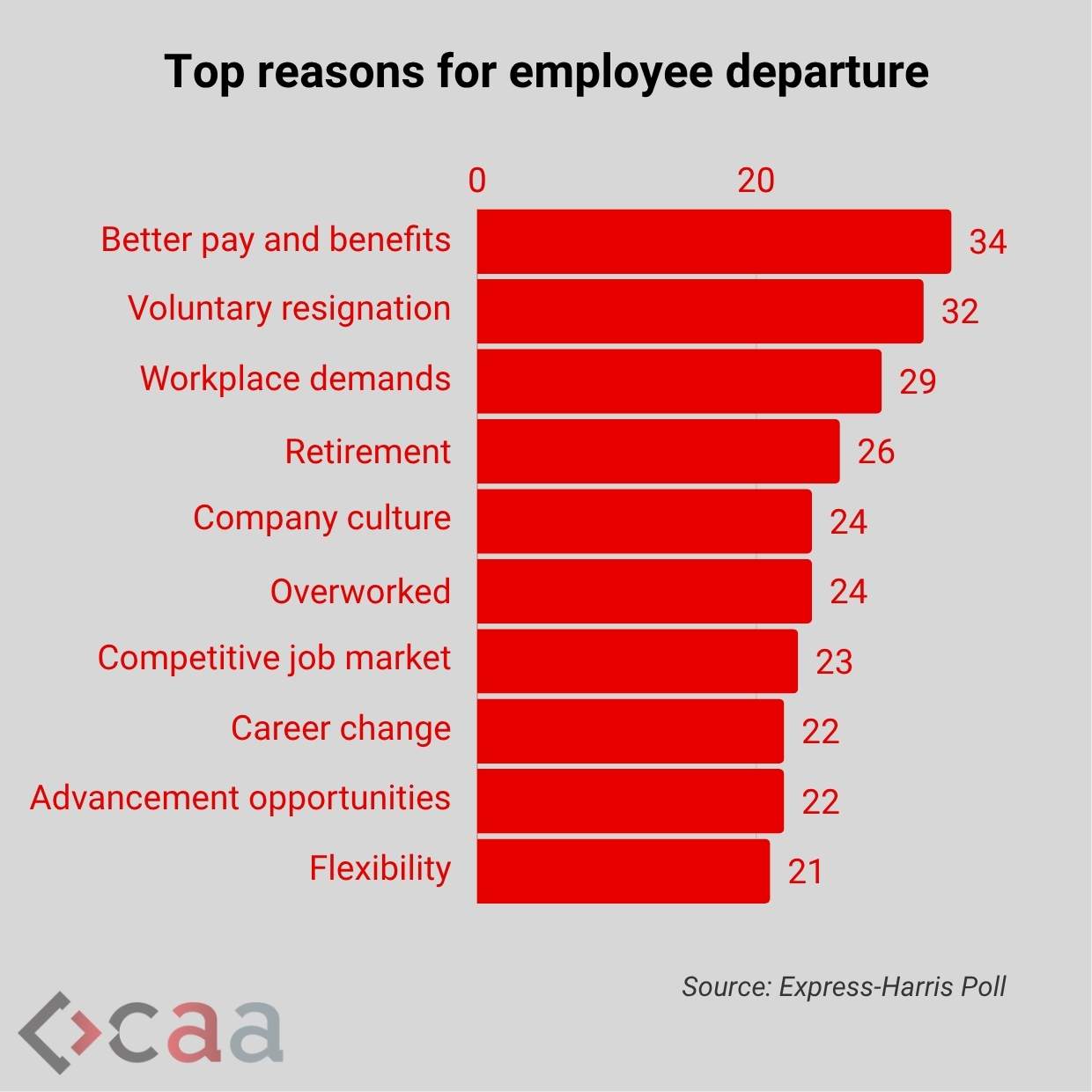
A Yahoo Finance analysis of the Express-Harris Poll found the top reasons for employee departure include better pay and benefits offered elsewhere (34%), employees voluntarily resigning (32%), increased workplace demands (29%), employee retirements (26%), more appealing company cultures elsewhere (24%), feelings of being overworked (24%), a competitive job market (23%), career changes (22%), better perks or advancement opportunities elsewhere (22%), lack of flexible schedules (21%), and lack of remote work options (19%).
Work Institute’s report attributed 63% of all 2024 employee exits to poor work-life balance and management issues.
Creating inclusive work environments remains key to employee satisfaction and stability, said Mahnke.
“In September 2024, during the peak of corporate DEI backlash, I reached out to major corporations such as Nissan, Bridgestone, Amazon, and Asurion to gauge their stance on inclusivity,” explained Mahnke. “Each affirmed their commitment to these values, recognizing that failing to foster inclusive environments leads to employee attrition.”
Sector-specific solutions
The challenge is especially acute in industries with chronic labor shortages, such as accounting and construction.
“For every 150,000 new accounting jobs opening every year, there are only 75,000 accountants coming out of school to replace them,” KraftCPA’s Chief Manager Chris Hight told Invest:. “That is a major challenge that has been developing over the last couple of decades, and this is now coming to a head.”
Given the ongoing staffing challenges in the accounting profession, Hight maintains that developing strong culture in the workplace and training employees is integral to building morale. “Culture is very important to us as a firm … We want to create a workplace where people want to come every day, where they feel appreciated, accepted, and heard.”
In the construction industry, on the other hand, there are two potential solutions to the broader labor market decline — both of which go beyond turnover.
“One involves reopening construction jobs to immigrant workers through work visas, a politically sensitive topic,” said Sean Williams, founder of Carbon Design & Architecture, to Invest:. “The other is leveraging technology, which also faces resistance but is less controversial.”
Both hiring and skilling remain a top priority for U.S. decision-makers.
Hiring appetite
According to J.P Morgan, the U.S. employment-to-population ratio declined by 0.3% in the past year, while the labor force participation rate slipped 0.2%, suggesting more Americans are exiting the labor market or struggling to re-enter it.
Hiring remains a focus, as revealed in the latest Invest: Business Sentiment Survey (I:BSS). In the second quarter, 73% of Northern U.S. executives said they plan to increase staffing in the next six months, marking a 12% rise from the previous quarter. Interestingly, hiring sentiment in Southern markets declined last quarter, with only 59% bullish on hiring in the next six months, down 13% quarter over quarter and 10% year over year, possibly due to fears over tariffs, immigration policy, and political uncertainty.
However, in general, the large majority of hiring managers (88%) say their companies still plan to hire in 2025, according to Yahoo Finance. But 43% of them say hiring plans are motivated by the need to replace employees lost to turnover, further reinforcing the cost of attrition.
“Retention is not an accident. It is the result of deliberate choices. High-retention organizations embrace accountability, listen to their workforce, and act decisively to address systemic challenges,” as cited in the Work Institute report. “As turnover costs rise and workforce mobility persists, employers have a critical choice to either invest in their people or risk falling behind in a competitive labor market.”
READ MORE: Economic sentiment slips slightly in Q2, Invest: Biz Survey finds
For more information, please visit: