


Spotlight On: Paul Edwards, Managing Partner, Stengel Hill
Key points:
- • Outpatient growth is reshaping how healthcare facilities are designed.
- • Flexible spaces help health systems adapt to changing care needs.
- • Technology and AI are accelerating innovation in healthcare architecture.
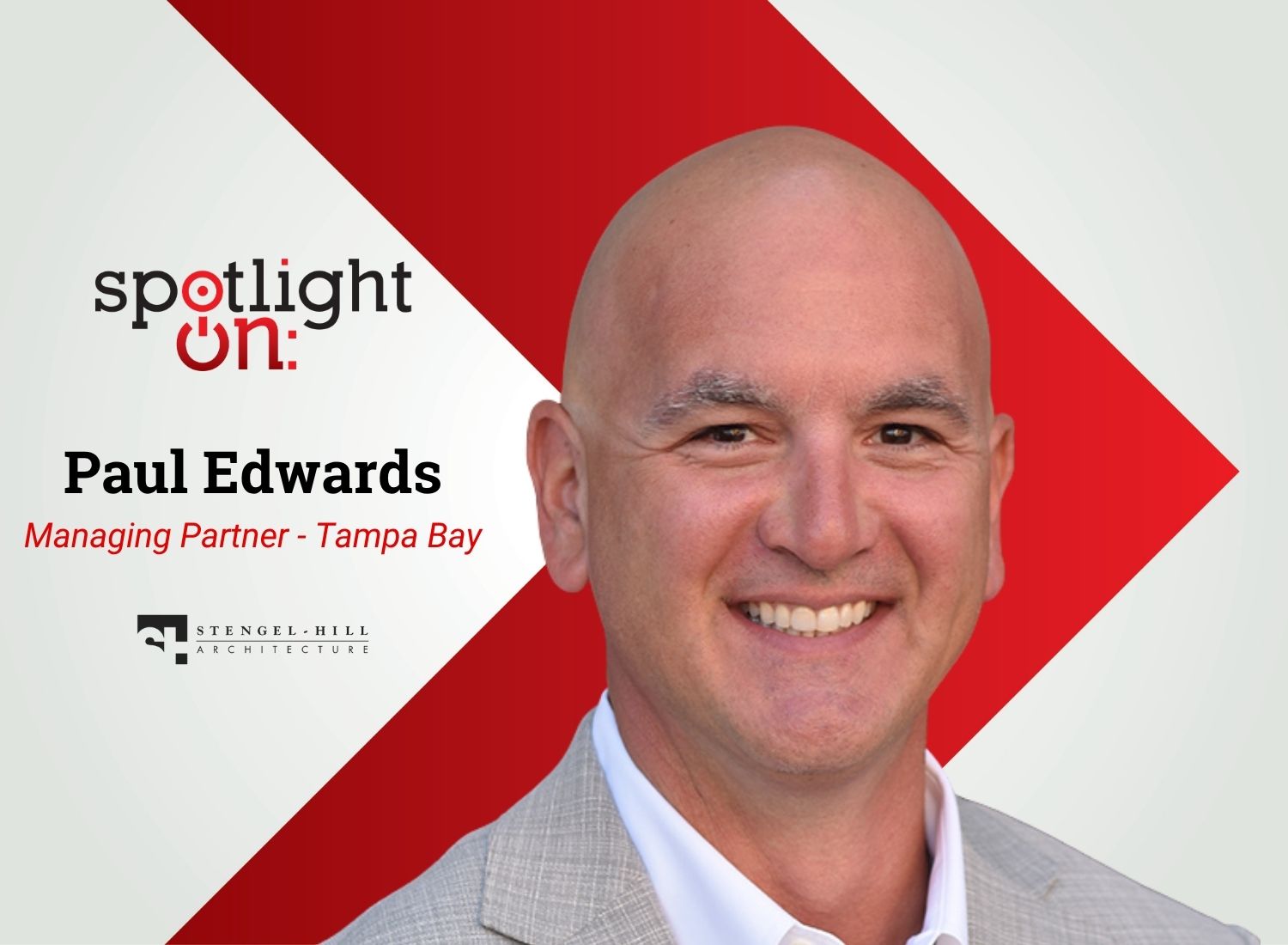 August 2026 — In an interview with Invest:, Paul Edwards, managing partner of Stengel Hill, discussed shifts in healthcare architecture, including outpatient growth, behavioral health design, flexible facilities, national expansion, technology, and access to care. “The more flexible we can design these spaces and keep our eye on budget and speed to market, the more successful these facilities are,” Edwards said.
Join us at the Invest: Tampa Bay 7th Edition Leadership Summit! This premier event brings together hundreds of Tampa Bay’s business and regional leaders to discuss the challenges and opportunities for businesses and investors. Buy your ticket now!
What shifts are you seeing in how hospitals and healthcare systems think about facility design today compared to five or 10 years ago?
One of the big shifts we see is a particular focus on outpatient healthcare development. We are seeing a big push in ambulatory care design, including surgery centers, freestanding emergency departments, medical office space, and targeted medical office space for higher-acuity care in the off-campus healthcare environment.
That is not to say there is not still a tremendous amount of growth in the inpatient setting. There is a lot of focus on bed towers, emergency services, surgical services, and core inpatient hospital services. However, that is now coupled with a trend toward the outpatient environment and how that outpatient environment can also drive patients back to inpatient hospitals.
What design principles are proving most effective in creating environments that improve patient outcomes while supporting staff safety and well-being?
Behavioral health has been a significant portion of our portfolio for about 15 to 20 years at Stengel Hill. What we find is that our behavioral health clients are searching for very safe environments and therapeutic environments.
No one wants to design or have designs for the psychiatric hospitals of the 1970s and 1980s. Instead, everybody wants highly therapeutic environments that are safe for patients, safe for staff, and also help move patients in and out of the behavioral health space and back to healthy lifestyles as soon as possible. Thoughtful access to natural light, outdoor spaces, clear wayfinding, and calming, trauma-informed design strategies all contribute to environments that improve patient outcomes while reducing stress and burnout for caregivers, the goal is to balance safety with dignity.
How is Stengel Hill helping clients design facilities that remain flexible for future healthcare models?
There is always downward pressure in terms of cost, budgets, and speed to market. We find that a model of success is highly flexible spaces. On day one, a space might be used for primary care. In the future, it might be used for higher-acuity care, perhaps cardiology in an outpatient setting, or even imaging and a surgical center.
The more flexible we can design these spaces, and keep our eye on budget, and keep our eye on speed to market, the more successful these facilities are, not only for today’s use but for the future as well.
What opportunities are driving the firm’s growth, and how do you maintain a consistent design culture as the firm scales nationally?
We have a team that keeps a close eye on culture, and we take our culture with us to each new market that we enter. That is really part of the growth strategy. We look at whether there are opportunities for us to do mergers and acquisitions.
We intentionally share expertise across offices, leveraging firmwide healthcare specialists, design reviews, and collaborative project teams to ensure every client benefits from the collective experience of the entire Stengel Hill organization—not just one office. If there is an opportunity, like we had in Florida, we look at how that existing culture aligns with ours and what we need to bring to that office or organization to bolster that culture and infuse some of what is a core Stengel Hill quality.
Sometimes that is the deal, and sometimes it is starting from scratch. In our Nashville market, for example, we made a strategic hire and then built up around that hire very quickly to a staff of around 14 or 15 today.
Culture is central to that. We identify the markets we want to be in, and that generally has to do with the health systems in a particular market, our analysis of those health systems, and whether we feel our service line will be a benefit to those organizations. When the answer is yes, we are immediately interested in the market.
Then we are also looking at population growth, local healthcare trends, and legislation in those particular environments, and whether they are pro-growth. It is a matrix of decision-making that goes into whether we want to enter a new market. Ultimately, culture is very important, and it is important that we are forward-facing as Stengel Hill collectively, and that in all of our offices everyone understands the service line that defines Stengel Hill.
How has the partnership with Godspeed Capital changed the company’s strategic priorities and capabilities?
We could not have asked for a better partner than Godspeed. There is a wide range of partner types in that space, and we feel like we hit a home run with Godspeed. We love the relationship, and they could not be more supportive.
They help us with our growth strategy. They help us evaluate the markets we are interested in moving into, and they help us evaluate our M&A opportunities. They could not be more helpful in terms of growth.
You need a partner like that when you are looking to grow. There is a certain amount of organic expansion that a firm like ours can do over time, but you reach a tipping point where you need extra help. You need a partner who knows how to inject themselves into a new market, how to evaluate opportunities, and who ultimately has the capital to help us make the growth moves we want to make. For our clients, that partnership means greater access to specialized expertise, expanded geographic reach, and the resources to deliver larger and more complex healthcare projects while maintaining the personalized service and healthcare-focused culture that have always defined Stengel Hill.
How is Stengel Hill incorporating emerging technologies into the design process and into healthcare facilities themselves?
Technology has been one of the biggest growth portions of our industry, whether in healthcare itself or in architecture. The confluence of those coming together has helped us with our internal speed to market. It has helped us with collaboration, quality control, our internal processes, and ultimately getting our product out to the market quicker as years go on.
Within hospitals themselves, it seems like there is a limitless amount of possibility with AI and technology, particularly for healthcare providers. Two of the books I am reading right now are on AI in healthcare, and it is amazing what it is going to be able to do.
Particularly in the outpatient setting and in more rural areas, technology is going to help quite a bit. Think about the ability for X-rays and other imagery to be read remotely, which allows providers to get a jump start on those readings. In years past, you might have had to wait days before a radiologist was available to read those images.
Hybrid operating rooms are another environment where technology has had a big impact. Having imagery available in the surgical space in real time drives the size of the room, so it has had an architectural and engineering impact as well. The thumbprint of AI and technology is all over healthcare, and it is in architecture as well.
Want more? Read the Invest: Tampa Bay report.