
Spotlight On: Susie Shannon, President & CEO, South Carolina Council on Competitiveness
Key points:
- • Population growth and collaboration are strengthening competitiveness.
- • Workforce and rural development remain key priorities.
- • AI and defense are emerging growth opportunities.
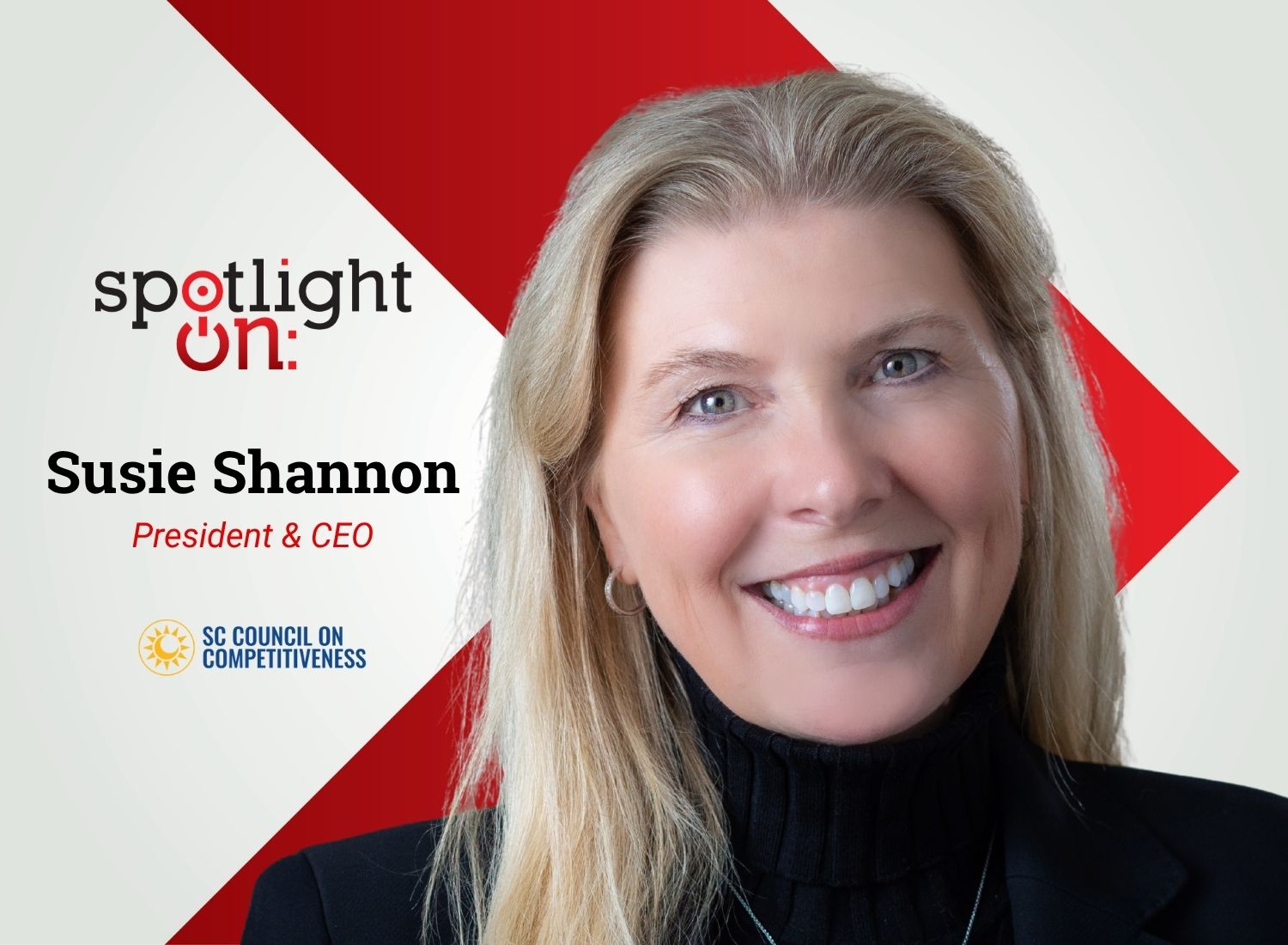 August 2026 — In an interview with Invest:, Susie Shannon, president and CEO of the South Carolina Council on Competitiveness (SC Competes), discussed the state’s economic resilience, collaborative approach to workforce and industry development, and opportunities in rural communities, artificial intelligence, and defense. “The population of South Carolina, and in fact the entire Southeast, is exploding; access to people is access to suppliers, it’s access to markets, it’s access to customers,” Shannon said.
Join us at caa’s upcoming leadership summits! These premier events bring together hundreds of public and private sector leaders to discuss the challenges and opportunities for businesses and investors. Find the next summit in a city near you!
What will determine whether South Carolina can sustain its growth and remain competitive?
South Carolina is experiencing exploding growth and even a healthy resilience during economic fluctuations. Historically, we were sometimes slower to emerge from recessionary periods, but following the impacts of COVID-19, South Carolina has come out faster, farther, stronger, and more resilient. We have done a good job of generating significant growth and diversifying our economic portfolio even out of challenging conditions.
Aerospace is a good example. At the height of COVID-19, the global aerospace and aviation economy took a major hit across a broad range of activities. Relative to our peer aerospace states, South Carolina grew faster and stronger, particularly in aerospace manufacturing. We continue to see growth through new manufacturing orders and industry activity.
South Carolina has also been resilient in responding and adapting to inflationary pressures and broader global economic conditions. In many cases, the state has emerged from those pressures in a stronger competitive position.
Population growth is another important factor. We conducted a study in 2023 that looked beyond how many people were moving into the state and examined population “centroids” – sitting in Columbia, South Carolina, we are one of the top states in accessing the largest concentration of people in the U.S. The population of South Carolina, and in fact the entire Southeast, is exploding; access to people is access to suppliers, it’s access to markets, it’s access to customers. This positioning strengthens our economy and creates more opportunities for companies considering South Carolina.
How has South Carolina’s cluster-based economic development model evolved?
That question goes to the core of our mission. SC Competes has been in existence for nearly 23 years. The organization was created by industry leaders and policymakers who wanted to focus on South Carolina’s longer-term economic growth rather than short bursts tied to, for example, election cycles or shorter-lived markets. They also wanted the state to be better prepared to look around the corner and respond to potential economic downturns while also seeking out emerging opportunities.
We introduced the concept of clustering into the state’s economic development vocabulary decades ago. The model is about bringing together the public sector, private industry, academic institutions, trade associations, and other partners within a unified ecosystem to address shared challenges.
Some of those organizations or companies may compete with one another, but they often rely on the same supplier networks, workforce, and global economic conditions. There is significant overlap in both their challenges and opportunities. The cluster model brings those constituencies into a collaborative framework where they can work on common priorities.
Shared supplier networks, workforce needs, and global conditions can become direct and competitive tools for advancing South Carolina’s long-term strength. Collaboration allows the state to address challenges more effectively and position industries for sustained growth.
What differentiates South Carolina’s approach to talent development?
South Carolina reoriented the Coordinating Council for Workforce Development several years ago. The goal was to create a unified plan for talent development, but just as importantly, it was designed to create a framework of alliances among industry, educational institutions, and government.
The state does not think about talent development in isolation. It is paired with economic development and infrastructure growth. There is a unified plan, framework, and strategy, and talent development does not exist on its own.
South Carolina’s geographic size may help support that approach, but the real differentiator is the people. South Carolina is often described as a “handshake” state. Our organizations work together, communicate with one another, and try to make sure people know what is happening across the state.
When we do not know where a particular resource is, we usually know someone with direct knowledge. That interconnectedness is present across SC Competes, public agencies, local organizations, and other statewide partners. Combining that human-centered network with talent, economic, and infrastructure development has been critical to differentiating South Carolina.
How can economic growth reach rural communities as well as metropolitan areas?
South Carolina remains a largely rural state under many technical definitions. Having been born and raised here, and from a rural community, I believe one of the state’s greatest assets is its people and their sense of connection to South Carolina, whether they were born here or moved here.
Rural and community development has always been intertwined with the state’s broader economic development strategies. South Carolina cannot compete and thrive without rural communities being part of the equation and having the resources they need. The South Carolina Department of Commerce has rural and place-based strategies specifically designed to support those communities.
Population growth is creating new possibilities. People are looking for a sense of place, and many are finding rural communities to be inviting places to live, work, and play. Although much of the state’s population growth has been centered in metropolitan areas, we are beginning to see spillover into rural communities.
That growth creates challenges related to infrastructure, traffic, and other conditions that accompany rapid population increases, but it also creates opportunities. South Carolina is increasingly viewed as a strong place to locate a business and a desirable place to live and, in part, due to the access to talent and innovation arriving here and thriving here. That gives the state an opportunity to include rural communities more intentionally and be more selective about the types of economic development projects it targets.
How is artificial intelligence reshaping South Carolina’s economy?
Artificial intelligence has already begun to reshape and reorient South Carolina’s economy, as well as the national and global economies. At SC Competes, we try to look around the corner at emerging technologies. We established a dedicated artificial intelligence cluster initiative, the Palmetto AI Corridor, in late 2021 – before most even knew how to spell “AI.”
Like logistics and technology more broadly, artificial intelligence is embedded across industries rather than confined to one sector. It affects nearly every part of the economy.
South Carolina is in a strong position because we have research and development assets, talent, and companies that are using and deploying artificial intelligence in their operations. We also have companies that specialize in developing emerging technologies, including artificial intelligence and even quantum technologies.
That combination gives South Carolina a unique opportunity. The state is not simply adopting new tools. It has the talent and business base to participate in developing the technologies that will shape the next generation of economic activity.
What are SC Competes’ key priorities for the coming years?
Our lens is the longer-term competitiveness of South Carolina and how we can contribute to the collaborative effort to strengthen the state’s economic and education base. We also work closely with companies and industries whose strategic planning horizons may be one year or three years, so we have to connect long-term goals with near-term priorities.
One focus is continuing to showcase South Carolina companies and industries that are unique, differentiated, and competitive within their respective fields. The state has significant assets that deserve greater recognition.
For example, all F-16 fighter jet production currently takes place in South Carolina. Despite the state’s relatively small geographic size, it has eight major military installations that often transition highly-talented and ready-to-work Veterans who may choose to remain in South Carolina. That creates a strong foundation for applying emerging technologies specifically within the defense sector.
We are focused not only on defense and national security applications, but also on dual-use commercialization. Companies developing technologies for military applications may also have opportunities to bring those products or capabilities into civilian markets, and vice versa.
South Carolina already has many of those assets. Our goal is to identify them, connect them, and strengthen the statewide defense ecosystem. That can expand the state’s economic opportunities in defense and dual-use commercialization while also supporting national security.
Emerging technologies and defense applications will remain major priorities. Across technology and artificial intelligence, logistics, aerospace, and defense, we also have dedicated team members with subject-matter expertise. Their work is focused every day on advancing those industries and supporting South Carolina’s long-term competitiveness.
Ultimately, competitiveness is about connecting South Carolina’s strengths and being intentional about where we can lead. We have tremendous assets in our people, our industries, our educational and research institutions, and our communities. SC Competes’ role is to help connect those assets, look around the corner at what is coming next, and bring the right partners together to turn opportunity into action. South Carolina does not have to be the largest state to compete at the highest level, but we do have to continue doing what we do particularly well: collaborate, adapt, and think long-term.
Want more? Read the Invest: South Carolina report.