Spotlight On: Steve Williams, City Manager, City of Schertz
Key points:
- • Location, infrastructure, and long-term planning are fueling Schertz’s growth.
- • Retail, housing, manufacturing, and industrial development are expanding rapidly.
- • Transportation and wastewater investments are preparing the city for future growth.
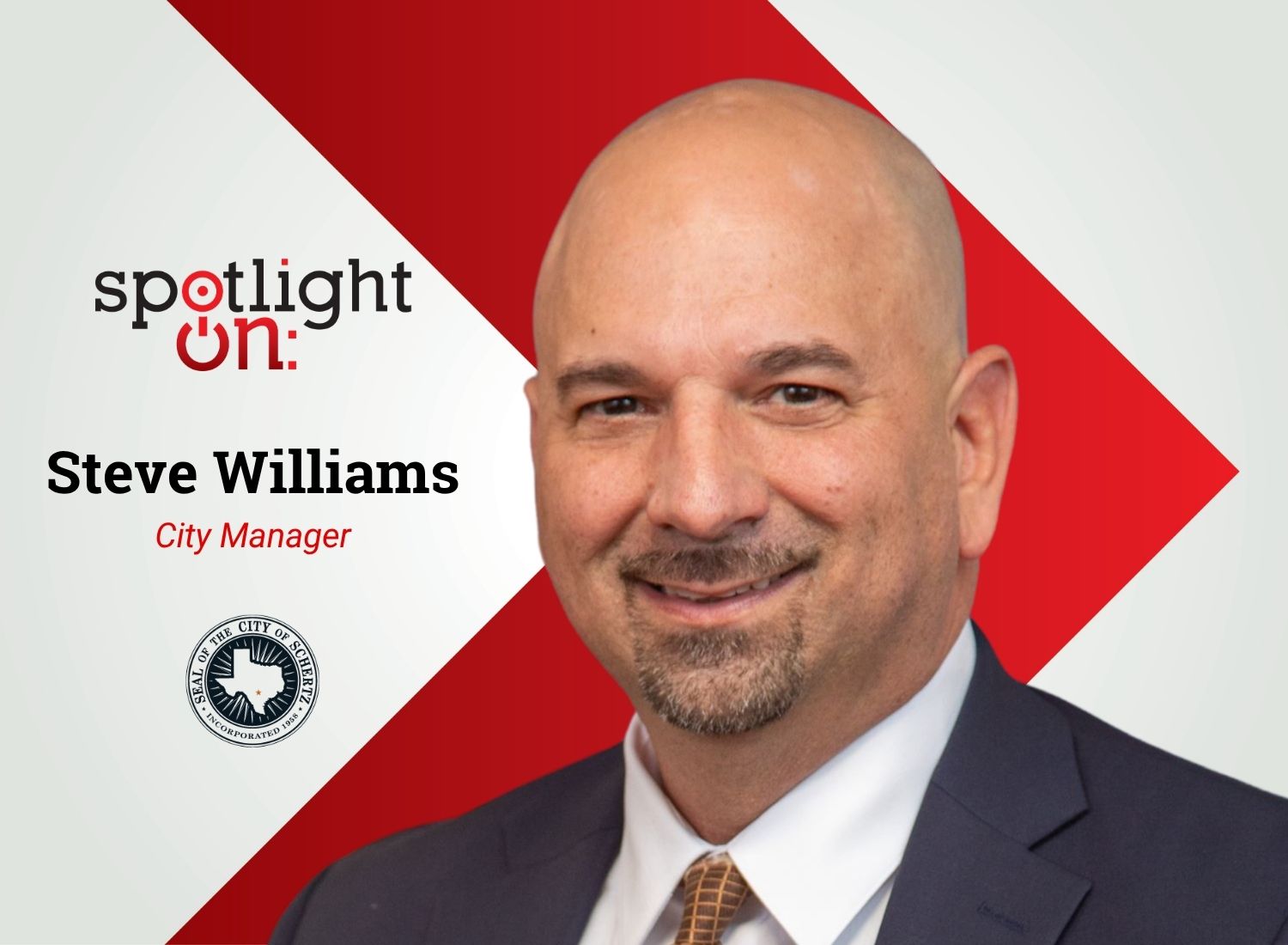 August 2026 — Invest: spoke with Steve Williams, city manager of Schertz, about the forces driving the city’s growth, its expanding industrial and retail base, infrastructure priorities, and regional collaboration. Williams pointed to Schertz’s location along I-35 and I-10, its proximity to Randolph Air Force Base, and decades of planning as key advantages. Looking ahead, Williams said, “The momentum is what excites me most. We are seeing retail development, housing growth, and stronger infrastructure come together.”
Join us at caa’s upcoming leadership summits! These premier events bring together hundreds of public and private sector leaders to discuss the challenges and opportunities for businesses and investors. Find the next summit in a city near you!
What are the main drivers behind Schertz’s growth, and how is the city’s role within the San Antonio-Austin corridor evolving?
Proximity is always going to be a major driver for a city like ours. We are on the northeast side of San Antonio, with part of the city along I-35, just south of New Braunfels, while another part stretches down to I-10. Being located on two interstate corridors is a major advantage, especially as development continues moving toward New Braunfels and along the broader corridor.
Our proximity to Randolph Air Force Base is another consistent driver. We are adjacent to the base, which has an active training mission, and a large segment of our community is active-duty military, retired military, or otherwise associated with the military.
The people who came before me also did a fantastic job over the past 20 to 25 years of laying out the community, establishing development standards, and planning infrastructure. That includes making sure we have water and sewer capacity. One example is the Schertz-Seguin Local Government Corporation, which we formed with the city of Seguin about 25 years ago to produce water for both communities. That foresight has positioned us well in a region where water is a critical resource.
Which business sectors are showing the most interest in Schertz?
We are seeing development across several sectors. Retail has experienced a strong upswing, driven by pent-up demand and population growth. Once retail begins to build, it tends to attract even more activity as the community becomes a destination.
Schertz Station is a good example. It is about 257,000 square feet and includes concepts such as Panera Bread, Dave’s Hot Chicken, Chipotle, Cava, and Portillo’s, along with retailers such as James Avery. The development opened a little over a year ago, and the multitenant development is already about 71% leased, and Portillo’s occupies one of four pads. Home Depot will serve as the anchor and is expected to open next spring.
Residential growth is supporting that momentum. We have 2,255 homes that are available, under development, or planned across communities such as Homestead, Parklands, Saddlebrook, Carmel Ranch, and Crossvine. We are also seeing demand for build-to-rent housing. The Collection at Schertz Station includes 318 two-story townhome-style units and was about 85% leased within a year.
On the manufacturing side, Caterpillar is undertaking two expansions, including roughly $94 million in capital investment and 194 associated jobs. We are also recruiting in aerospace, automotive, and high-tech, and we have seen increased international interest. Existing companies across our manufacturing base are expanding as well.
Warehousing, distribution, and speculative industrial development also remain strong. We have about 8.2 million square feet in various stages of development, with roughly 6 million square feet occupied or available, and additional sites shovel-ready.
How is the city addressing workforce needs?
Our recent economic development master plan identified some job-matching challenges. Certain jobs coming into Schertz may not necessarily be filled by Schertz residents because of the nature of the positions. Even so, those companies add taxable value and potentially sales tax revenue that supports the city.
We maintain relationships with Alamo Colleges and other area universities, and we make efforts to connect businesses with prospective employees through educational institutions and community outreach. There is room to continue strengthening those connections as our employment base grows.
What is Schertz doing to make permitting and development processes more efficient?
We are focused on streamlining the process. We recently upgraded to CityView, a software platform that manages permitting and development workflows. It may sound basic, but it has been a major enhancement in organizing our processes, keeping projects on schedule, and ensuring nothing slips through the cracks.
We also have a development review committee that brings together economic development, planning, and other relevant staff every week. That coordination helps us identify potential issues early and avoid the disconnect that can sometimes occur between economic development and planning teams.
In addition, we have been updating our Unified Development Code to make sure it is modern, business-friendly, and positioned to support development as effectively as possible.
How important is regional collaboration in attracting investment?
Regional collaboration benefits everyone. Cities will naturally compete, but we also recognize that a win for Cibolo or another neighboring community can be a win for Schertz.
We participate in organizations such as Greater:SATX and other statewide and regional collaborations that promote Texas and the San Antonio area. Locally, we have strong administrative relationships with surrounding cities and elected officials.
The Northeast Partnership is particularly valuable. It brings together mayors and council members from communities in the northeastern part of the San Antonio region. The group provides a regular opportunity to discuss shared issues, strengthen relationships, and work together on regional priorities.
What are the city’s top infrastructure priorities?
Transportation is in a category of its own. Several state-owned roads run through Schertz, and the reconstruction of I-35 and I-10 will provide major improvements for the city. I-10 is being expanded through Guadalupe County, while the double-decking of I-35 represents another significant regional investment.
FM 1518 is also a major project. The state is converting it from a two-lane asphalt road into a four-lane divided roadway with a raised median, a 10-foot concrete hike-and-bike trail, and a 6-foot sidewalk. The roughly $75 million project will significantly improve north-south mobility and is expected to be completed in early 2028.
We are also investing in local collectors that were originally built as narrow rural roads. Lower Seguin Road, on the southern side of Randolph Air Force Base, is one priority. We are working with the base to pursue federal funding because the road serves as an important access corridor.
Wastewater capacity is another major focus, particularly in southern Schertz. In 2024, the city annexed 5.5 square miles, and that area has since generated considerable development interest. We are investing in an additional 1.6 million gallons per day of capacity at the Clear Creek Municipal Authority treatment plant, which should accommodate several years of growth.
We are also advancing major sewer trunk lines, including the Cibolo West and Woman Hollering Creek lines, to open southern Schertz for development. On the north side, another trunk line will support undeveloped portions of the industrial area.
What are your priorities and outlook for the next three to five years?
The momentum is what excites me most. We are seeing retail development, housing growth, and stronger infrastructure come together. We are also investing in amenities because bringing in companies and jobs is only part of the equation. People also need to want to live here.
One example is Community Circle Park, a planned $12 million park project. Investments like that will help make Schertz a more desirable community as transportation projects are completed and new development comes online.
I am bullish on Schertz. I believe we’re going to be a destination community that people really want to live in and locate their business in. We will become a destination suburb within the San Antonio region.
Want more? Read the Invest: San Antonio report.