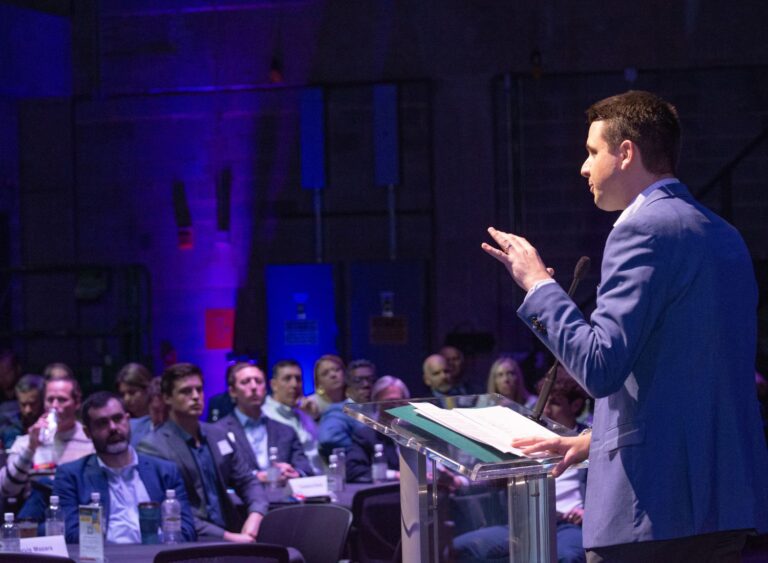




Scott Brandman, Managing Partner, Baker McKenzie
 Invest: spoke with Scott Brandman, managing partner of Baker McKenzie, about AI’s impact on the legal industry, leadership during transformation, and Miami’s growing role in global business. “The real differentiator will still be building true and honest trust with our clients,” Brandman said.
What habits turn major clients into career-long relationships?
There is nothing magical about it. The difference maker is executing on the right habits every day. Even while writing the book, I realized there were things I could still improve.
The biggest takeaway from the habits of top rainmakers is trust. AI is exciting, and everyone will have access to the same tools, but tools are still tools. The real differentiator will still be building true and honest trust with our clients. That is what separates the best lawyers and firms. There are no tricks to it. It is honest, real trust.
What technology will most transform the legal industry over the next few years?
It is AI, without question. It is changing how we deliver work and how we become more efficient. It is also going to change the business model for law firms because the billable hour has never promoted efficiency.
AI will create better efficiencies, which means the business model we were built on probably will not remain the predominant model. I do not think the billable hour disappears completely, but I also do not think it will continue to dominate the industry.
I see that as an opportunity. When AI handles repetitive and commoditized work, it frees lawyers to add more value and become stronger partners to clients. It also frees clients from lower-level tasks so they can focus on higher-level thinking.
What has leadership taught you during this period of transformation?
The biggest lesson has been the importance of listening. That means listening to partners, listening to clients, and understanding what others are thinking.
You cannot lead change without understanding the organization, the clients, and where things are headed. Leadership may have its own views, but it is important to take in different perspectives and think about the future carefully.
It is exciting to lead during this period because the industry is changing quickly, especially with AI. The business is different from the one many of us entered, and that creates opportunity.
Where do you see the firm making its biggest impact in the next decade?
There is growth everywhere, and that is one of the strengths of our firm. We are positioned well globally, and we continue to look at new markets where there could be opportunities.
We continue expanding our Latin American presence, and we are excited about Miami. People used to think about Miami primarily as a gateway to Latin America. That is no longer how we see it. Miami stands on its own and has incredible industry coming into the market. It is still in the early stages, so there is a lot of opportunity there.
Across Europe, Asia, and Latin America, we see strong growth opportunities. What makes Baker McKenzie different is that we are truly global while operating locally in every market. Our attorneys are local attorneys, and we combine global reach with local expertise.
What do people misunderstand about global legal practice?
People sometimes misunderstand how local the business really is. Some firms place U.S. attorneys into foreign markets, but we are truly local in those markets because clients need expertise on the ground.
We work with multinational companies around the world, but we also help regional companies grow within their markets and eventually expand beyond them. That combination of global capability and local depth is important.
What advice are executives seeking as they navigate global business?
It is hard not to focus on geopolitical events right now, and I do not see that changing. Political risk is one of the main topics clients want to discuss when entering or exiting markets.
Companies are thinking about logistics, product flow, market risk, and opportunity. Some markets offer tremendous growth potential, but companies need to understand the risks involved. Clients want to know how to diversify and minimize geopolitical risk while still pursuing growth.
How do you ensure leadership transitions create real evolution?
Diversity is critical. One of the strengths of our firm is diversity, both because of our size and our global reach, but diversity in leadership is especially important.
The future of big law is changing quickly. A leadership team that is stuck in the past would have a real problem. The best way to avoid that is by making sure leadership includes diverse perspectives and ideas.
What makes a legal partnership successful over the long term?
Culture is a major driver of success. Our culture is built around people truly knowing each other. We spend a great deal of time making sure our people build relationships across the firm.
Even as large as we are, we know each other well, and that allows us to bring the entire firm to the table for clients. We know our strengths, and we know where we may not be the best fit. If another firm is the better choice for a client in a certain area, we will say so.
You can only do that if you understand the strengths and weaknesses of the firm and know your people well. That has been a major differentiator for us: being global and large while still maintaining strong relationships across the firm.