Jacksonville business news: Bigger ships ahead
Key points:
- • JEA is raising St. Johns River power lines from 185 to 225 feet for bigger ships at JAXPORT.
- • Container trade tied to the project supports about 15,000 regional jobs, JAXPORT says.
- • JAXPORT cargo volume hit 1,388,841 TEUs in FY2025, up from 1,340,412 TEUs in FY2024.
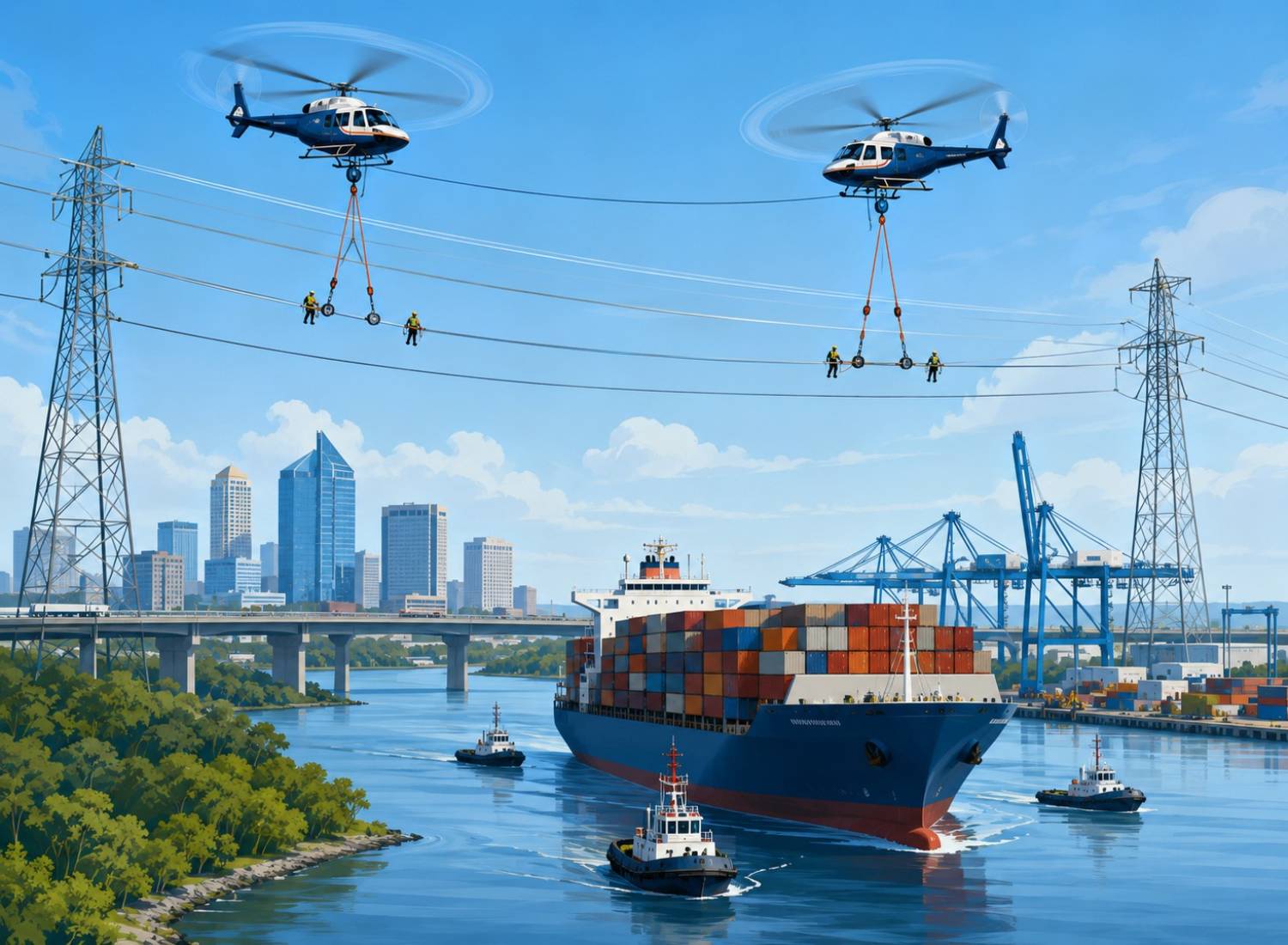 August 2026 — Jacksonville‘s cargo capacity just took a major step forward, and it matters to anyone following Jacksonville business news this summer. In late July, helicopter crews began the next phase of a project to raise electric transmission lines spanning the St. Johns River at Fulton Cut, clearing the way for larger container ships to reach JAXPORT’s Blount Island Marine Terminal. The upgrade is a quiet but pivotal piece of infrastructure behind the region’s trade growth.
Join us at caa’s upcoming leadership summits! These premier events bring together hundreds of public and private sector leaders to discuss the challenges and opportunities for businesses and investors. Find the next summit in a city near you!
Raising the wires
The numbers behind the project explain why it counts as one of the year’s more consequential pieces of Jacksonville business news. JEA, working with the city of Jacksonville, JAXPORT, and the Florida Department of Transportation, is lifting the transmission lines from their current height of 185 feet to 225 feet, creating 205 feet of operational clearance above the water.
That extra headroom is not a cosmetic upgrade, it is the difference between JAXPORT welcoming today’s larger container ships and turning them away toward rival ports up and down the Eastern Seaboard. Crews are using helicopters, ropes, and pulleys to string new conductors across the river between Blount Island and Reed Island, work that will continue over the next several months according to JAXPORT’s announcement of the project.
The timing lines up with a broader trend playing out at ports nationwide. Ocean carriers have spent the past several years deploying ever-larger vessels to cut per-container costs, and East Coast and Gulf ports have been racing to widen channels, raise bridges and reinforce cranes so they are not locked out of those bigger ships’ rotations. Charleston, Savannah, and Norfolk have all invested heavily in similar clearance and depth projects in recent years. Jacksonville’s move to lift its own overhead lines puts it in the same conversation, reinforcing why so much of the region’s Jacksonville business news cycle now centers on port infrastructure rather than any single tenant or shipper.
The stakes are not abstract. International container trade tied to this stretch of the port supports roughly 15,000 jobs across the region, and JAXPORT’s overall cargo operations underpin more than 258,800 jobs and close to $44 billion in annual economic impact for Florida, according to the same JAXPORT release. Those figures cover longshoremen, truckers, warehouse staff, customs brokers and the small businesses that supply them, the kind of employment base that makes a single infrastructure fix a citywide economic story rather than a narrow port matter.
Why capacity matters
JAXPORT already bills itself as Florida’s No. 1 container port by volume and the nation’s third-largest vehicle-handling port, backed by a 47-foot-deep shipping channel, two-way vessel traffic, and same-day trucking access to 98 million U.S. consumers. Its own cargo statistics show container volume climbing to 1,388,841 twenty-foot equivalent units in fiscal year 2025, up from 1,340,412 the year before, a steady gain even as some rival gateways saw volumes plateau. Vessel calls have also risen over the past five fiscal years, from 1,521 in FY2021 to 1,611 in FY2025, evidence that more ships, not just bigger ones, are choosing Jacksonville.
That growth is exactly why the Fulton Cut project matters so much as it affects trade, logistics, and site selection. Every additional foot of vertical clearance widens the pool of vessels that carriers can deploy to Blount Island without rerouting cargo through Savannah or Charleston first.
For third-party logistics firms, warehouse developers, and manufacturers weighing a Northeast Florida distribution footprint, that flexibility is a tangible signal that the port intends to keep pace with vessel sizes rather than fall behind them. It also reinforces the calculus behind the millions of square feet of new warehouse and distribution space that have risen around Blount Island, Cecil Commerce Center, and the I-295 corridor in recent years, much of it built on the bet that Jacksonville’s terminals will keep absorbing bigger ships and heavier volumes rather than losing cargo to neighboring gateways.
Want more? Read the Invest: Jacksonville report.