Jacksonville small business news: The impact of a $60M bet
Key points:
- • JAXPORT’s new $60 million vehicle berth at Blount Island is now 50% complete.
- • JAXPORT’s auto processors moved more than 506,000 vehicles in 2025.
- • Port cargo activity supports over 228,000 Florida jobs and nearly $44B in impact.
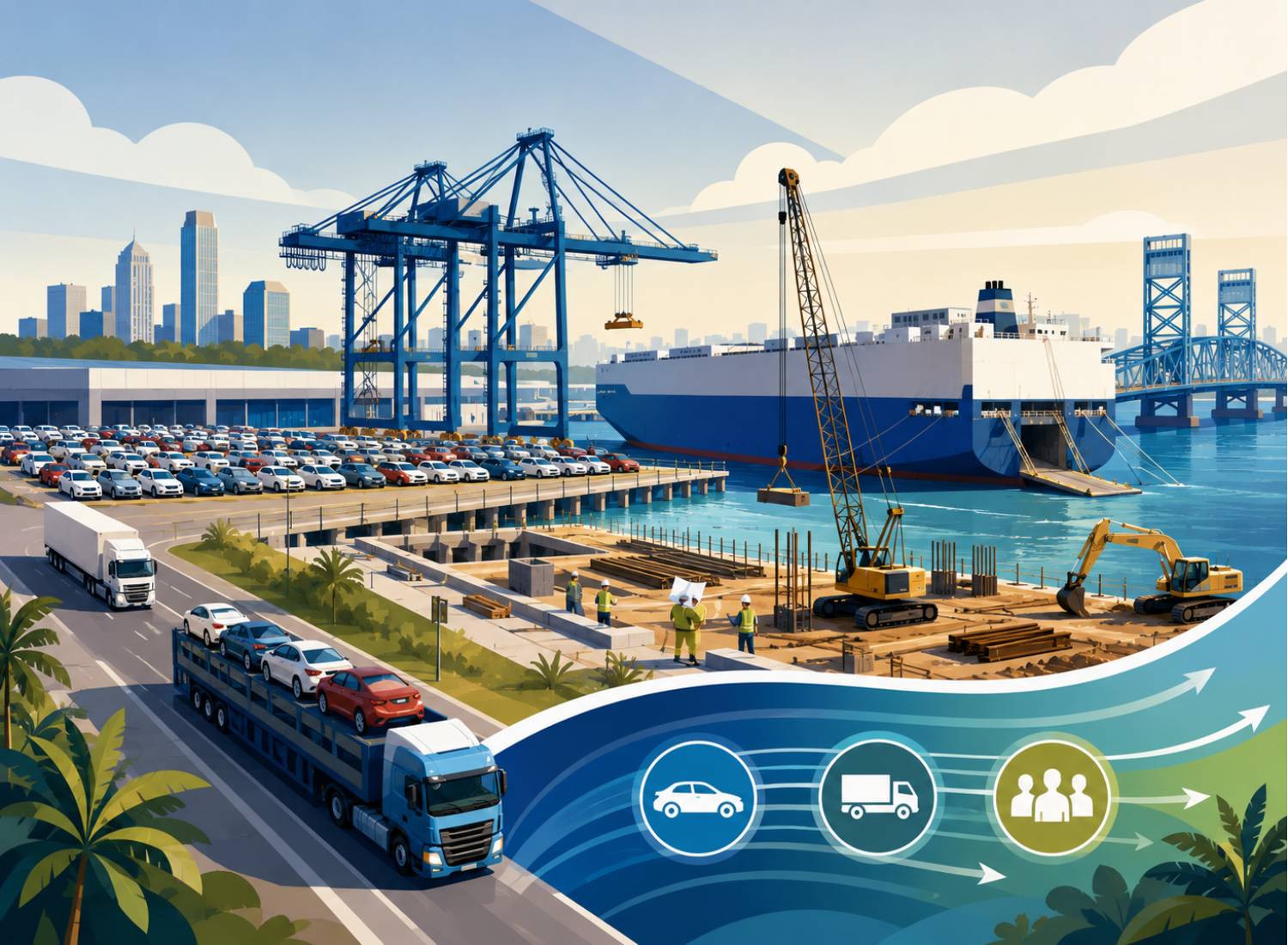 July 2026 — For anyone following Jacksonville small business news this month, the clearest signal of where the local economy is headed sits at Blount Island Marine Terminal, where JAXPORT has reached the halfway mark on a new $60 million vehicle berth built to keep pace with rising auto-import demand.
Join us at caa’s upcoming leadership summits! These premier events bring together hundreds of public and private sector leaders to discuss the challenges and opportunities for businesses and investors. Find the next summit in a city near you!
Construction of the new Berth 21 has reached 50% completion, with the project on track to finish in early 2027, according to JAXPORT’s official announcement published June 1, 2026. The berth will be Blount Island’s third dedicated vehicle facility once complete. It’s part of a $60 million investment package, with the Florida Department of Transportation covering 75% of the cost and JAXPORT providing the remaining 25% match — a funding split that reflects the state’s own strategic interest in keeping Jacksonville’s port capacity ahead of demand rather than playing catch-up.
A port built for cars
The new berth follows closely on the heels of an expansion to the terminal’s existing Berth 22, which now accommodates auto-carrier vessels up to roughly 750 feet in length overall — a meaningful upgrade given how much larger modern vehicle-carrier ships have become compared to the fleets these terminals were originally designed to handle. Together, the two projects reflect a port betting heavily on continued growth in vehicle logistics rather than diversifying away from it, a strategy that is paying off in the numbers JAXPORT reported for 2025.
JAXPORT’s three auto processors — AMPORTS and Southeast Toyota Distributors at Blount Island, and Enstructure Auto Logistics at the Talleyrand terminal — moved more than 506,000 vehicles through the port in 2025. That volume underlines Jacksonville’s position, as JAXPORT describes it, as the northern gateway of Florida, the nation’s third-largest car market, offering same-day trucking access to more than 98 million U.S. consumers. Few port cities can claim that kind of reach into the country’s population centers within a single day’s drive, and it’s the geographic advantage underpinning nearly every vehicle-logistics investment JAXPORT has made in recent years.
The economic stakes extend well beyond the auto sector narrowly defined. Cargo activity moving through JAXPORT supports more than 228,000 jobs across Florida and generates nearly $44 billion in annual economic impact for the region and state, according to the same JAXPORT release. That figure covers everything from longshoremen and truck drivers to the warehousing, logistics, and vehicle-prep businesses that cluster near Blount Island specifically because of its terminal capacity — the kind of dense, mutually reinforcing business ecosystem that regional economic development officials point to when recruiting additional logistics investment to Jacksonville.
The timing also matters for Jacksonville small business news beyond the port gates. Vehicle-prep companies, customs brokers, and inland trucking firms that depend on Blount Island’s throughput have spent recent years operating near capacity, at times turning down volume during peak import seasons because berth space limited how many vessels could unload simultaneously. A third dedicated vehicle berth directly addresses that bottleneck, giving smaller logistics operators room to bid on additional contracts once the facility opens rather than watching cargo get diverted to competing ports with more available capacity.
What small firms should watch
For the smaller logistics, trucking, and vehicle-service businesses that make up much of the Jacksonville small business news beat, port capacity announcements like this one are leading indicators worth tracking closely. A new berth reaching completion in early 2027 means increased vehicle throughput capacity, which typically translates into new subcontracting and staffing opportunities for the smaller firms that handle vehicle prep, inland trucking, and last-mile logistics once cars clear the port. Those businesses have historically expanded in step with JAXPORT’s own capital investment cycles, and this berth expansion gives them a concrete timeline to plan around.
The broader national context reinforces why this matters beyond Jacksonville. Vehicle import volumes have become an increasingly closely watched indicator of consumer demand and global trade patterns amid ongoing tariff uncertainty, and ports capable of handling larger vessels and higher volumes are positioned to capture share from less-equipped competitors up and down the East Coast. JAXPORT’s willingness to keep investing in dedicated vehicle infrastructure, even as some other cargo categories face uncertain near-term demand, suggests port leadership sees durable, structural growth in vehicle logistics rather than a temporary cyclical bump.
Executives and small-business owners tied to Jacksonville’s logistics sector should watch for JAXPORT’s next construction-progress update and any announcements about additional auto-processor capacity at Blount Island, since both will signal how quickly the port intends to convert this berth investment into actual throughput once it opens in 2027.
Want more? Read the Invest: Jacksonville report.