Miami business news today: Nike returns to UM
Key points:
- • UM’s new Nike deal is worth more than $20 million annually over 10 years.
- • The university receives over $13 million a year in cash, plus apparel.
- • Nike replaces Adidas, whose 12-year, $90M-plus deal expires this June.
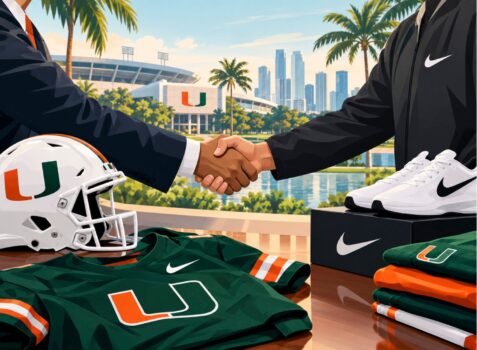 September 2026 —Miami‘s biggest college athletics program just rewrote its economics for the next decade, and the numbers involved put it among the richest apparel deals in college sports history. Miami business news today centers on the University of Miami’s decision to sign a 10-year agreement with Nike worth more than $20 million annually, according to Axios Miami and other outlets.
Join us at caa’s upcoming leadership summits! These premier events bring together hundreds of public and private sector leaders to discuss the challenges and opportunities for businesses and investors. Find the next summit in a city near you!
The deal ends a 12-year run with Adidas and marks the school’s return to a brand it wore for 28 years before switching in 2015.
The structure of the deal matters as much as its size. UM will receive slightly more than $13 million a year in cash — roughly two-thirds of the total value — with the remainder delivered as apparel and footwear for its athletic programs. That cash allocation gives the athletic department flexibility it didn’t have under the outgoing contract: administrators plan to direct the money toward operational costs, name, image and likeness payments to athletes, and a potential on-campus football office building.
Dwarfing the Adidas deal
The new agreement dwarfs UM’s previous arrangement. Adidas had paid the university $6.5 million annually, excluding apparel and footwear, under a 12-year deal signed in 2015 and worth more than $90 million in total. Nike’s per-year value is more than three times that figure. It reflects how aggressively apparel companies are bidding for marquee athletic programs as media rights and conference realignment keep raising the value of college sports brands nationally.
The switch isn’t entirely clean. Adidas maintains a separate name, image and likeness (NIL) arrangement with UM receiver Malachi Toney that will let him wear the brand’s apparel on campus, though not during game competition — a reminder that individual athlete endorsement deals now operate on a separate track from institutional apparel contracts, complicating what used to be a straightforward, all-or-nothing sponsorship relationship.
UM’s deal lands amid a broader wave of apparel spending across college athletics, as Nike, Adidas, and other brands compete for exclusive rights to some of the country’s highest-profile programs.
Miami’s built-in recruiting advantages — South Florida’s talent pipeline, national television exposure and a fan base that spans the Atlantic Coast Conference footprint — make it exactly the kind of program apparel companies are willing to pay a premium for, based on the branding halo it provides nationally, not just the merchandise sales it generates.
Nike’s return to Coral Gables also reflects how much leverage individual athletic departments now hold in apparel negotiations, a shift driven largely by realignment among the major conferences over the past several years. As media-rights payouts diverge more sharply between conferences, schools with strong football and basketball brands, like Miami, have used that leverage to renegotiate apparel contracts on a scale that would have been unusual a decade ago. Multiyear, multisport apparel deals now routinely fold in NIL considerations that didn’t exist when Adidas and UM first signed in 2015, reflecting how thoroughly college sports economics have been rewritten since name, image and likeness compensation became legal.
Built-in advantages
The deal also underscores Miami’s standing as a program apparel brands view as undervalued relative to its market size. South Florida’s roughly 6 million residents, a recruiting pipeline that regularly produces NFL talent, and a campus an hour from two major airports give Miami built-in advantages that programs in smaller media markets can’t match, regardless of recent win-loss records.
Nike’s willingness to pay more than three times what Adidas offered suggests the company is betting that a stronger on-field product, paired with the university’s market position, will pay off in merchandise sales and brand visibility well before the 10-year contract term is up.
The next test comes once boosters, athletes, and rival programs get a full look at how the money is allocated. Athletic department leaders elsewhere should watch whether UM’s NIL earmark becomes the template other programs use to justify their own apparel negotiations, and whether Nike’s return to Miami signals a broader push by the company to reclaim marquee ACC and SEC programs it has lost to competitors over the past decade.
For Miami, the real payoff won’t show up until the first Nike-branded uniforms take the field and the athletics department can show boosters exactly what the extra revenue bought, and until rival Atlantic Coast Conference programs decide whether to respond with apparel negotiations of their own rather than let Miami’s new deal reset the market on its own.
Want more? Read the Invest: Miami report.