
Private investors keep Texas bullet train project on track
Writer: Andrea Teran
April 2025 — The long-embattled high-speed rail project between Dallas and Houston is once again navigating a sharp curve. The federal government has withdrawn a $63.9 million planning grant, but Texas Central’s new lead investor insists the train remains on track — privately funded and “shovel ready.”
Kleinheinz Capital Partners, a Fort Worth-based investment firm, assumed controlling interest in the bullet train project earlier this year. CEO John Kleinheinz told lawmakers the setback from Washington may actually simplify matters. “Amtrak has been trying to get control of our deal,” he said, as cited by the Houston Chronicle. “It would have been terrible for Texas. Government procurement rules make it so expensive to do a project like this.”
The Trump administration’s move to cancel public funding, citing cost overruns and concerns about taxpayer liability, shifts the burden entirely to private developers. U.S. Transportation Secretary Sean Duffy called the rail line “a distraction from Amtrak’s core mission” and a “waste of taxpayer funds,” pointing to ballooning capital costs now estimated to exceed $40 billion.
This marks the first time the administration has revoked funding from an Amtrak-led initiative, a signal of its intensified scrutiny of federal rail expenditures. The administration also announced that the Federal Railroad Administration will now prioritize fixing Amtrak’s existing performance issues, particularly delays in the Northeast Corridor and its ongoing operational deficits.
The Texas Central line, first proposed in 2009, aims to shuttle passengers between Houston and Dallas in 90 minutes, modeled after Japan’s Shinkansen system. While critics label it fiscally unrealistic, supporters say it’s a transformative solution to infrastructure congestion in one of the nation’s fastest-growing corridors.
“The project is the equivalent of five or six lanes of highway,” said Kleinheinz, referring to plans by the Texas Department of Transportation to expand I-45. “This is a huge money saver for taxpayers.”
That optimism is not universal. Lawmakers continue to file bills aimed at curbing the project’s reach and limiting state cooperation. “It’s a big cost hole that is a bottomless pit,” said Sen. Robert Nichols, R-Jacksonville.
While Texas Central awaits final approval from the Surface Transportation Board and continues to seek financing, Kleinheinz remains steadfast. A six-month planning period and a seven-year construction window could bring the vision to life by 2032.
The funding withdrawal also fits within a broader policy shift. The Trump administration has signaled its intent to halt or reassess funding for transit projects that don’t align with newly imposed fiscal or regulatory benchmarks. Similar moves have been made targeting California’s high-speed rail and New York City’s congestion pricing initiative.
Additionally, Elon Musk — who plays an informal advisory role within the Department of Government Efficiency — has echoed calls for privatizing Amtrak, reinforcing the administration’s shift away from public-sector infrastructure models.
Investors are pressing on. Kleinheinz says Texas Central has acquired about 25% of the needed land, with another small fraction expected to require eminent domain. “Seventy percent of this route is underneath high-voltage utility lines,” he said. “People don’t live underneath high-voltage utility lines.”
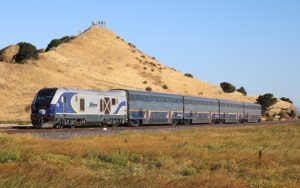
Top image via Geroge Luchs/Wikimedia
For more information, please visit:
https://www.amtrak.com/
https://railroads.dot.gov/