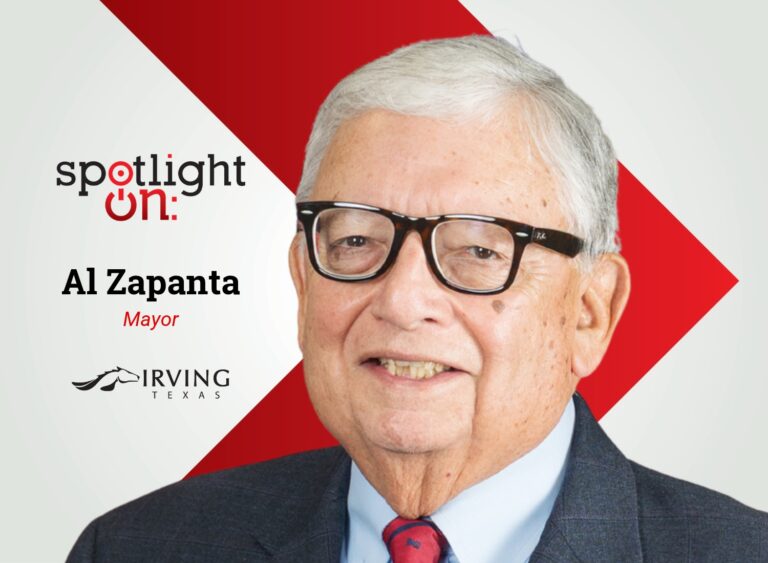

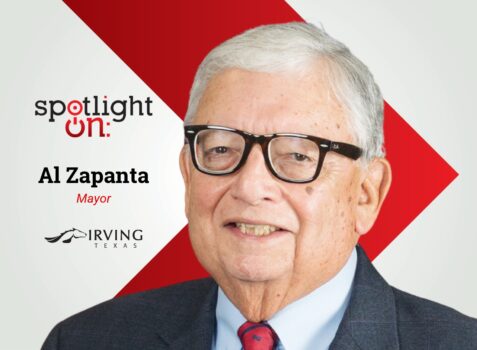
Spotlight On: Al Zapanta, Mayor, City of Irving
Key points:
- • Irving is prioritizing economic development and international investment.
- • The city is seeking a partner to develop the 80-acre former Texas Stadium site.
- • Major corporate employers are attracting supply chain companies to Irving.
 November 2026 — In an interview with Invest:, Irving Mayor Al Zapanta discussed his priorities for economic development, international investment, infrastructure, workforce development, and the future of key sites such as the former Texas Stadium property and Las Colinas. Drawing on his experience in international business, Zapanta highlighted Irving’s central position within North Texas and its connections to markets across North America and beyond. “We’re right in the middle. That’s why I call it the sweet spot,” he said.
Join us at caa’s upcoming leadership summits! These premier events bring together hundreds of public and private sector leaders to discuss the challenges and opportunities for businesses and investors. Find the next summit in a city near you!
What do you see driving Irving’s economy, and where do you see the greatest opportunities for growth?
Now that I’ve been in the mayor’s position for three months, economic development is my No. 1 priority. I served eight years on the City Council and have been involved in the area. I came back here because I really feel that Irving is right in the center — what I call location, location, location. It’s the real sweet spot in North America.
I was so convinced of that that I moved the United States-Mexico Chamber of Commerce, where I am also president and CEO, from Washington, D.C., to Irving so we could develop our international reach. We focus on Canada, the United States, and Mexico, but we’re also looking toward Europe, particularly Spain, and the Asia-Pacific region, including Taiwan, the Philippines, South Korea, and Japan.
We have diversity in our business community, and we are also one of the most diverse cities in Texas. My focus as mayor is economic development, and development and infrastructure go hand in hand. We recently held a two-day summit on infrastructure, economic development, and international partnerships, with representatives from Mexico, Canada, Panama, India, Ukraine, and Taiwan.
Irving is not only in a key location in North Texas but also in the hemisphere. We have two major airports and major highways, and we’re part of the Dallas-Fort Worth Metroplex. There are more than 20 Fortune 500 companies across the area, and nine of them are here in Irving. Companies are coming because of the workforce, logistics, and their ability to connect with the North American trade market.
My priority is economic development not only locally, but regionally and internationally.
What is your vision for the former Texas Stadium site, and what needs to happen to move the project forward?
We have been in discussions with potential partners, mainly professional athletic teams, including the Dallas Stars and the Dallas Mavericks. We’re looking for the right partner that can develop this 80-acre site.
The goal is not just development but to make it a destination. That’s also why the international component is important. When professional teams are playing, you have people coming from throughout the hemisphere and from around North Texas.
Irving is in a key location to develop not just business opportunities but also add to the supply chain of the major corporations in the region. We also have to work with federal and state legislators because much of what we can do as a municipality is based on state law, as well as federal involvement with roads, airports, and transportation.
I enjoy working with the other mayors around Irving. We see ourselves as a hand-in-glove operation. We’re not competing. We want to develop the amenities — parks, recreation, swimming pools, and libraries — as well as the highways, streets, and airports that help businesses operate and get their products where they need to go.
What are companies looking for from Irving today, and which industries offer the greatest potential for further investment and growth?
When you have major corporations such as Boeing in aerospace, McKesson in healthcare, Citibank, and Fluor Corp., they’re looking for many things, but one of the most important is workforce. They need a labor pool that can support their operations.
The second major piece is the supply chain. These companies depend on Tier 1, Tier 2, and midsized companies that can provide products and services.
Three months ago, I welcomed a French company that manufactures interiors for executive aircraft and major airliners, including seating and luggage compartments. Why are they here in Irving? They want to be next to Boeing. They want to be next to American Airlines. That’s their client base.
That is why the international component of my economic development focus is real. We want those midsized companies here to provide the supply chain. That creates a robust economic development environment at the local level.
How is Irving differentiating itself to continue attracting and retaining investment?
When you look at our base of major corporations, and then at our infrastructure, you see the ability for these companies to do what they need to do, including moving their products and services globally. One of our largest employers is Citibank, and it is a global company. You see that opportunity across manufacturing, services, and financial services.
Why Irving? We have six major highways, two major airports, and road connections between Canada and Mexico. You can move goods by major trucking routes as well as railroads. We’re right in the middle. That’s why I call it the sweet spot, and that’s one of the reasons I decided to move the headquarters of the United States-Mexico Chamber of Commerce here.
As companies rethink their workplace needs, what is the next phase of growth for Las Colinas?
Las Colinas started with a vision. Back in the 1970s, Ben Carpenter had a vision to use his family’s property here to build a corporate and business center.
It wasn’t all about the corporate setting. The vision also included condominiums, apartments, residential communities, and homeowners associations that could be close to airports and highways. That’s what Las Colinas did.
There was also something special about the design of the area we call the Urban Center. Because we’re next to the Trinity River, there had to be collaboration with the state of Texas and Dallas County to provide flood control, which ultimately became the lake and canals.
It brought together all the pieces of an economic ecosystem — the people, labor, amenities, and the infrastructure provided by the city of Irving. That’s what we have here.
With limited undeveloped land remaining, how is Irving approaching redevelopment and housing while maintaining quality of life?
We’re running out of land, although we’re not out of it yet. Many surrounding cities have already developed 85% to 90% or more of their available land.
In Irving, more than 30% of our living structures are apartments or multifamily properties. We now have a population of more than 267,000 people, so we have to think about where and how people live and where they work.
What’s interesting about Las Colinas is that more than 200,000 people come here every day to work Monday through Friday, but 80% leave afterward to go north, east, west, and south. Housing outside the Metroplex can be more economical, and people have the infrastructure to make that possible, including roads and the Dallas Area Rapid Transit system.
Again, you have what I call that economic development ecosystem that brings all the pieces together, and we’re sitting right in the middle of it here in Irving.
How is the city working with school systems and other partners to strengthen the local workforce pipeline?
One of the first things major corporations ask us is, what is your education system like here? We have a solid independent school district. Irving Independent School District is the major one, with five high schools, but you also have Carrollton-Farmers Branch and Coppell around us. That makes this an attractive area because families with young children have options for where to live and where to have them educated.
Irving Independent School District is moving forward with a more than $900 million bond package to help build new schools and remodel older schools. The district is about 65 years old, so some of the buildings are getting older. Two have already had to come down and be rebuilt.
That’s another part of development when we talk about Irving. It’s not just business — it’s education. The city of Irving and the independent school district are starting to work more closely together. We have a responsibility to help provide housing, education, amenities, highways, and the infrastructure people need to get to work and take their children to school.
We’re right smack in the middle, and right now is our time to really push forward on development.
What trends are you seeing in U.S.-Mexico business and supply chains, and how can Irving benefit from those ties?
What’s interesting is the history of Texas, which at one time was part of Mexico and, before that, New Spain. When I speak to audiences, I like to say that my great-great-grandparents never crossed the border — the border crossed us. Texas, Arizona, New Mexico, Colorado, and California were all part of that history.
Then you look at the makeup of the people and young people here. In our school district, more than 50% of the population is of Mexican, South American, or Hispanic backgrounds. About 20% of the city is made up of people from India and Pakistan.
This is really a microcosm of the world. We want companies to come here because there’s a familiarity with many of the individuals who are living here and who have come here for a better life.
Want more? Read the Invest: Dallas-Fort Worth report.