


Spotlight On: John Beckham, Managing Director, North American Development Bank
Key points:
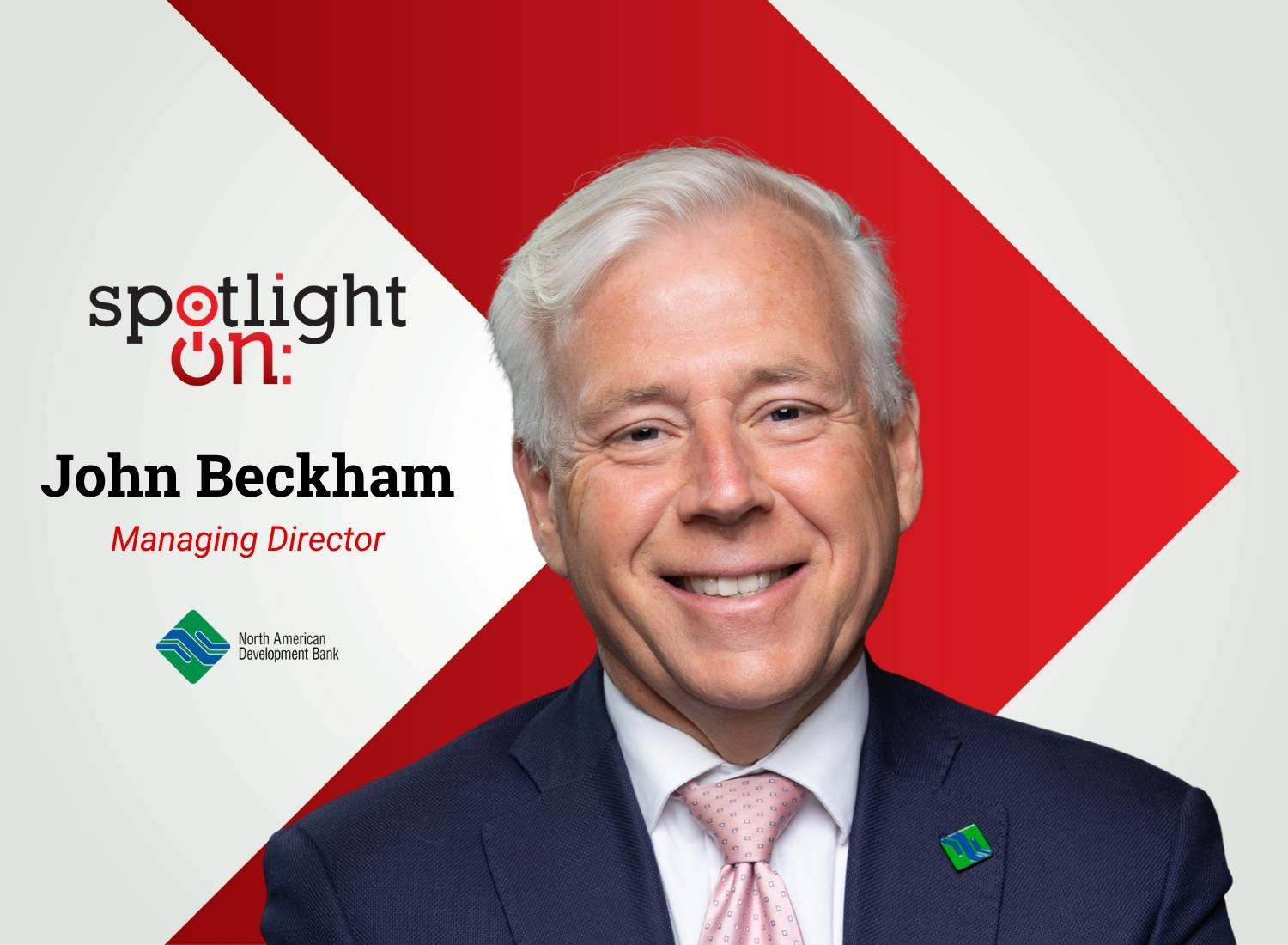 June 2026 — In an interview with Invest:, John Beckham, managing director of North American Development Bank, discussed infrastructure priorities across the U.S.-Mexico border region, San Antonio’s role in binational trade, and the need for more efficient use of water, energy, and land. “San Antonio has a lot more to take advantage of in terms of the overall U.S.-Mexico relationship,” Beckham said.
Join us at caa’s upcoming leadership summits! These premier events bring together hundreds of public and private sector leaders to discuss the challenges and opportunities for businesses and investors. Find the next summit in a city near you!
How would you describe the economic outlook for the U.S.-Mexico border region, and what trends are shaping your priorities?
The review of the USMCA is clearly on the agenda, and private investors are watching it closely because it provides certainty around the trade relationship. We are optimistic, but until it is resolved, it remains an issue on the minds of investors and businesses as they make decisions.
At the same time, the geopolitical value of North America as a manufacturing and market hub is stronger than ever. That ties directly into nearshoring. We are seeing strong interest in areas such as information technology, critical minerals, data, and energy. The question is what the rules for that engagement will be. Hopefully, the answer is the USMCA or an improved version of it.
How is nearshoring changing infrastructure investment demand across Texas and northern Mexico?
Energy is one of the biggest areas. Mexico has not invested much in its energy generation capacity over the last seven years, so there is a lag that is receiving more attention because of future demand expectations. You have delayed investment combined with increased expectations for future demand, and that makes energy a critical issue.
We have heard compelling arguments from clients that North American energy integration always makes sense, and it makes even more sense now. The uncertainty of the Middle East as an energy supplier has reinforced that. North America has experienced disruptions, but relative to other parts of the world, less so. That creates strong interest and demand in energy.
Water is the other major trend. In the best of circumstances, the U.S.-Mexico border region and San Antonio are vulnerable to hydrological and water risks. With chronic drought, that continues to be the case. We are investing significantly in water delivery and clean water, and in August 2025, we launched a water resiliency fund focused on diversification and conservation. The goal is to increase or optimize supply so water is used more effectively.
What other infrastructure trends are you watching?
We need more private investment to support infrastructure broadly. That means not only energy and water, but also efficient buildings, industrial parks, and housing. By efficiently built infrastructure, we mean systems and buildings that use less energy, use less water, and produce less waste. Those gains can reduce the amount of infrastructure needed for water treatment, potable water, landfills, and energy generation.
Transportation is another challenge. Truck crossings between the United States and Mexico have increased from about 3 million to nearly 13 million last year since the North American Free Trade Agreement was signed in 1994. Also, roughly 75% of the infrastructure supporting those crossings predates 1994. The physical infrastructure has not kept pace with traffic volumes, while more people, cars, and trucks also increase air quality issues and the time tax on people who live in San Antonio and the border region.
What opportunities do you see for San Antonio as companies and investors focus more heavily on the Texas-Mexico corridor?
San Antonio sits at the top of a triangle formed by San Antonio, Houston, and Monterrey, which is a major hub of energy and manufacturing capacity. That is a strong advantage for the city.
We see this through the infrastructure needs in Laredo, which connects San Antonio to Monterrey. Several projects are underway or in planning and permitting phases to expand transportation connectivity through that port.
There is also an increased need to diversify water resources. San Antonio is ahead of the game in that regard, but some communities south of San Antonio, including business and trade partners in South Texas and northern Mexico, are not as far along in investing in better utilization of their water resources. We are doing a great deal of work in that area.
San Antonio relies on those relationships with South Texas and northern Mexico for its well-being, including in auto manufacturing, technology, energy, and cultural dynamism. San Antonio is where Mexico and the United States come together to do business and engage socially. That ecosystem needs to be taken care of.
How important is coordination between U.S. and Mexican agencies when advancing large-scale infrastructure projects?
There is active coordination and engagement between the United States and Mexico at the federal level, though these projects do not move as quickly as anyone would want.
These are expensive, capital-intensive projects, so it is important to ensure they are budgeted properly and that the expected benefits are technically feasible and realistic.
There are also differences between the Mexican and U.S. approaches to infrastructure investment and regulation. In Mexico, decision-making is more centralized, so once a decision is made, implementation can move more quickly. In the United States, many ports are locally owned, especially in Texas. Laredo and McAllen are examples, and even Port San Antonio is locally controlled.
That means federal priorities must reconcile with local ownership and local priorities. The United States has more capital but a more fragmented system, while Mexico has a more unified system but often less capital to deploy. That dynamic always requires attention.
How are higher costs and financing costs affecting infrastructure development and investment decisions?
Our clients have been working through inflationary pressures on raw materials and finished goods since the pandemic. Those higher costs are now integrated into planning and budgeting processes. The focus is on how quickly those higher costs can be reflected in expected revenue.
On financing costs, it is still too soon to tell what will happen in our portfolio. These are not short-term projects that move based on small swings in interest rates. Once you move beyond that, it may have an effect, but it is still too early to know how that will play out.
Where we focus is on bringing a long-term financing structure that helps enable a project. We are not trying to do projects simply because we are the cheapest financing option. If the private market can do it, we would prefer that.
What are NADBank’s top priorities, and what is your overall outlook?
By way of background, the bank and I, for 35 years, have given people money and hoped they would pay us back. That requires optimism, with some skepticism. At the end of the day, if you are a pessimist, you never lend anybody a dime.
These are long-term investments that are less sensitive to short-term volatility, and that anchor our optimism.
Our core mission is infrastructure that benefits long-term growth, community well-being, and the health of the U.S.-Mexico relationship. The fundamental value of San Antonio and the broader U.S.-Mexico relationship has not changed. World events have only strengthened the logic and value of that relationship. That also gives us optimism.
What final message would you like to share with San Antonio’s business community?
The bank is proud to be in San Antonio. We believe San Antonio has a lot more to take advantage of in terms of the overall U.S.-Mexico relationship and the trade and investment opportunities created by our proximity to each other.
We want to engage more with the private sector in developing projects that use water and energy more efficiently and generate less waste, regardless of the business sector. That is both a challenge and an aspiration for us, and we want to achieve it with businesses in San Antonio that see the same opportunity.
Want more? Read the Invest: San Antonio report.






