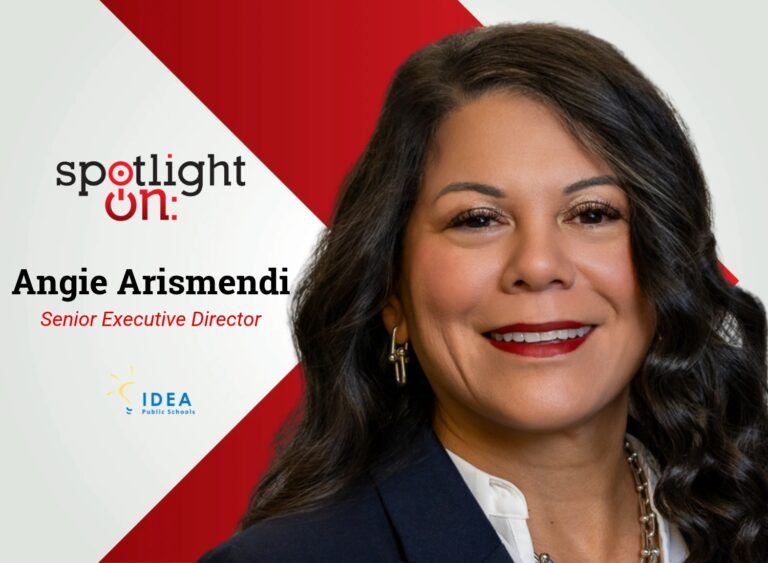

Spotlight On: Angie Arismendi, Senior Executive Director, IDEA Public Schools in San Antonio
Key points:
- • IDEA San Antonio prioritizes academic achievement, leader development, and school culture.
- • Teachers can earn up to $10,000 annually; retention is nearing 85%.
- • IDEA plans to expand career and technical education tracks across San Antonio.
 November 2026 — In an interview with Invest:, Angie Arismendi, executive director for San Antonio at IDEA Public Schools, discussed academic achievement, teacher development, and preparing students for college and the workforce. “There’s no substitute for the connection between a teacher and a student,” Arismendi said.
Join us at the Invest: San Antonio 5th Edition Leadership Summit! This premier event brings together hundreds of San Antonio’s business and regional leaders to discuss the challenges and opportunities for businesses and investors. Buy your ticket now!
What are IDEA Public Schools’ main priorities in San Antonio for the end of 2026?
Our focus is always on setting students up for success in college and beyond. In San Antonio, we’re concentrating on three pillars. The first is academic achievement across all grade levels. For younger students, that means reading on grade level. For students taking state assessments, we want them to achieve their personal best and prepare for AP courses that can help them gain access to highly selective colleges.
The second pillar is developing leaders and staff to support teachers. Teachers work directly with students every day, so we need principals and regional team members to develop the skills to support teachers’ growth and, ultimately, student achievement.
The third is culture: creating an environment where children thrive and see the community around them supporting their development. College preparation involves more than grade-level reading and math. Students need to engage with the world, advocate for themselves, choose classes, and ask professors for help when they need it. We want to prepare them for those decisions and experiences.
How are you adapting to demographic changes and the range of education options available to families?
We’re experiencing the effects of several years of low birth rates. In San Antonio, that means fewer children to serve. We’re working to ensure that the children entering our schools receive a high-quality education, grow in reading and math, and develop the social skills they’ll need as they prepare for college.
Families have many choices, and we appreciate the opportunity to serve those who choose us. I also recognize the work of educators across the community who are trying to ensure every child receives a good education. We’re all working to support children and their futures.
Which services are becoming more important as student and family needs change?
Our school counseling teams work directly with children. To learn, students need to be ready for that experience, and challenges in their own lives or their families’ lives can affect their readiness. Our counselors and teachers have a responsibility to help address those challenges. Sometimes that means connecting students and families with community resources beyond what we provide ourselves. There are local programs supporting needs such as food and housing security. We work hard to make those connections so families can access available services and children are prepared to thrive at school.
How are you developing and retaining teachers and school leaders?
We’ve been in San Antonio since 2012, and staff and leader retention has improved over the past five to six years, including the last couple of years. We’re approaching 85%, but we haven’t reached it yet. We’re working toward that goal.
When teachers and leaders have the right resources, training, and development, they’re more likely to stay because they can grow stronger in their roles. They can build students’ skills and help them achieve their personal best. Seeing that progress helps our adults feel successful. We’re doubling down on those efforts this year to support both children and staff.
How are you preparing students for technical careers alongside college pathways?
I’ve seen the organization evolve over time. Several years ago, we made a major push for AP for All, giving students access to 11 or more AP courses.
As the world has changed, we’ve increased our emphasis on career and technical education, or CTE. Schools have specific tracks that give students experience in those areas. We’ve implemented that approach and are excited to expand it across IDEA San Antonio and the broader organization in the coming months and years.
How do business and community partnerships influence your curriculum?
IDEA San Antonio is part of a larger organization with a broad team. In preparing our 2035 plan, that team coordinates outreach and engagement with businesses, the private sector, and families. It conducts market research to understand what communities need.
The team then brings that information back to help shape our curriculum and educational tracks. We learn through those partnerships and through the work of our national team, then make adjustments locally. That process helped us introduce career and technical education tracks in our schools.
How are you approaching AI while preserving the human side of education?
Many organizations are exploring AI, and I’m interested in what they’re learning. Technology and the resources available to us are important, but nothing compares to the care and connection between teachers and students.
We first want teachers to develop the skills to judge whether AI-generated material is rational and reasonable. There’s no substitute for the connection between a teacher and a student. That relationship helps children achieve their personal best and prepares them for the future.
We’ll probably see more AI use as the world changes, but it won’t replace that connection. When a child is struggling, there’s nothing like a teacher offering encouragement, staying beside that student, and providing guidance. That is a particular strength of the teacher-student relationship.
How are you balancing financial sustainability with investment in teaching quality?
Like other school systems, we use state and federal funding. We also work to provide additional support for teachers. They have access to the Teacher Incentive Allotment through their ability to help students grow and meet their growth goals.
Separately, IDEA Public Schools has invested time and funding in our teacher career pathway for years. It uses a rubric and multiple measures to evaluate teachers’ effectiveness with the children they serve. Teachers can earn up to $10,000 annually in performance bonuses based on their impact on students.
We intend to continue that support for teachers and staff. As we evaluate our resources, we’ll consider what we can live without, but this is something we need to preserve. We want to continue honoring the work our teachers do for many years to come.
What role does K-12 education play in San Antonio’s workforce and economic future?
Communities move forward when adults can support one another. Children need cognitive and relationship skills so they can communicate their perspectives, disagree respectfully, and collaborate on initiatives. They also need to read, write, and do math on grade level.
Those abilities prepare them to enter the workforce and contribute to the community. Some of our students go away to college, while others study locally. After earning their degrees, they can return to their communities and make an impact. I’m grateful we can contribute to San Antonio in that way and look forward to seeing our students continue to help it grow.
Where do you see the biggest opportunities for IDEA in San Antonio?
Our biggest opportunity is to graduate more students each year. We’re adding two graduating classes this year: IDEA Converse and IDEA Hidden Meadow will both graduate their first seniors. Their campuses are excited to see more students preparing for college.
I’m even more excited to see those students eventually return to the community. Once they earn their degrees, they can join the workforce and lead in many different roles. Helping them do that allows us to give back and support our community.
Want more? Read the Invest: San Antonio report.