Spotlight On: Brett Finley, President & CEO, Metro SA Chamber
Key points:
- • San Antonio’s diversified economy continues to drive resilient growth.
- • Workforce, infrastructure, and affordability remain top priorities.
- • The Metro SA Chamber is focused on responsible growth and business advocacy.
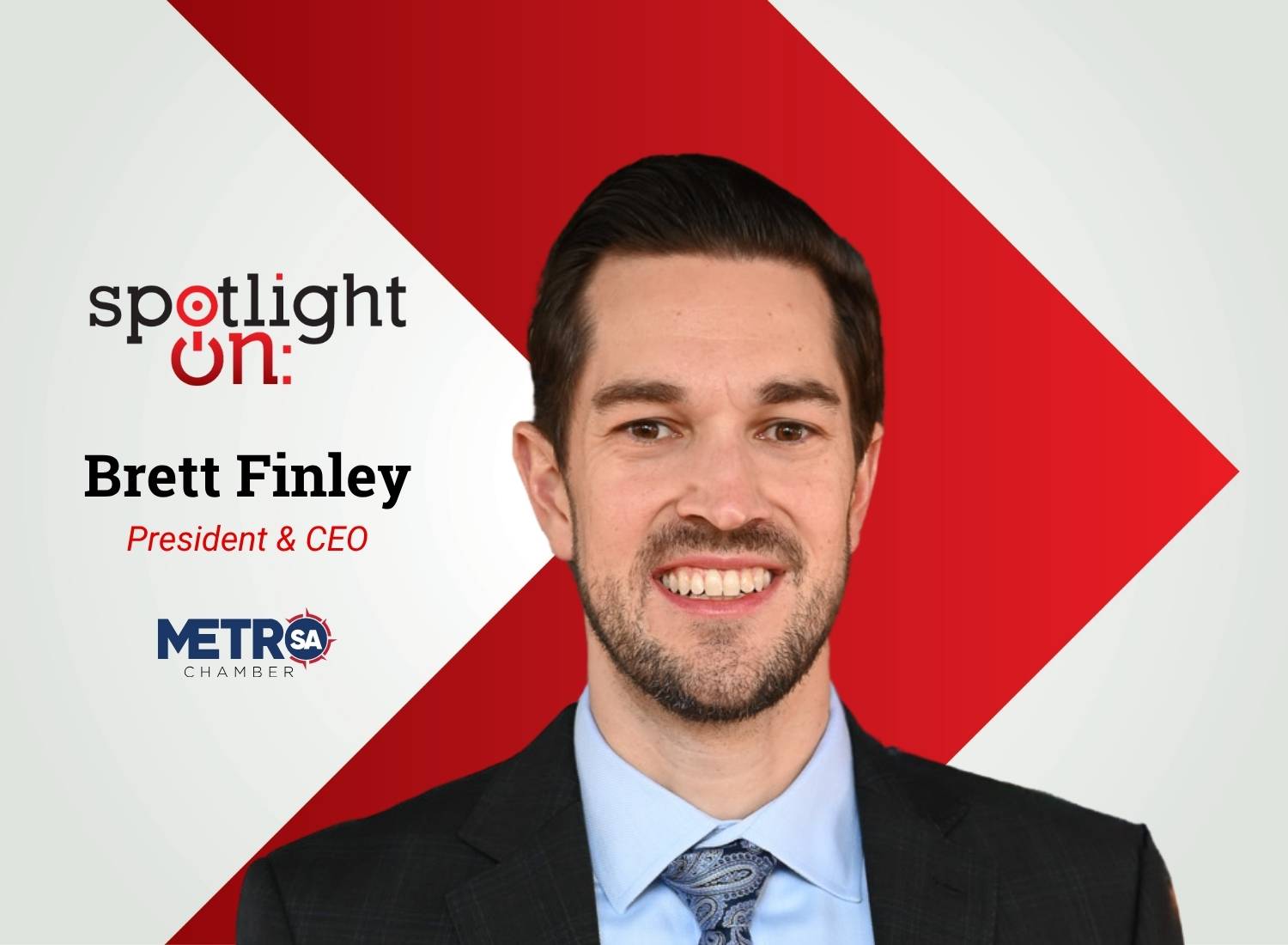 July 2026 — In an interview with Invest:, Brett Finley, president and CEO of the Metro SA Chamber, discussed San Antonio’s growth, workforce needs, infrastructure priorities, and economic momentum. “I wouldn’t say San Antonio is necessarily recession-proof, but we are resistant,” Finley said.
Join us at caa’s upcoming leadership summits! These premier events bring together hundreds of public and private sector leaders to discuss the challenges and opportunities for businesses and investors. Find the next summit in a city near you!
How has the role of the Metro SA Chamber evolved since the rebrand, and what are you hearing from members about San Antonio’s business climate?
The rebrand, which was launched about a year and a half ago, has exceeded everyone’s expectations. It has placed us at the forefront of more conversations across the city and county. As our membership has evolved over the last 50-plus years, so have the issues we follow. Whether those are issues at the local, state, or federal levels, we are trying to advocate for all of our membership base and the issues we care about as an advocacy-first organization across the region.
How do you see San Antonio positioning itself as the regional economy continues to expand?
Population growth has certainly benefited San Antonio. The city and county have put together intentional and responsible growth policies. San Antonio is open for business, but growth must happen in a way that does not place strain on existing utilities and infrastructure.
That includes roadway infrastructure and publicly owned utilities on the water and electric side. Transmission, energy generation, and the sustainability of our water system are all topics of conversation.
As people continue to see San Antonio as a destination for corporate relocation and as a place to bring their families, they are not bringing roads, water, or electricity with them. We have to balance those efforts. San Antonio and its local leaders have a good grasp on that. We are still open for business, but we are doing it in a clear and responsible manner.
What industries are creating the most momentum, and where do you see room for growth?
Given the focal point of our downtown entertainment, we are a hospitality and tourism-driven city first and foremost. We have also seen advancements in the biomedical space and in cybersecurity. We continue to be the second-largest cybersecurity hub in the country behind Washington, D.C. From a quality-of-profession standpoint, that helps raise median income and salary pay scales. Advanced manufacturing is another industry that continues to make strides.
We have been able to navigate downturns better and remain more insulated because our economy is diversified across industries. Even during the housing recession in 2008, we were not hit as hard as the rest of the country because of that diversification. I think you are seeing the same thing with the downturn in the economy over the last couple of years. I wouldn’t say San Antonio is necessarily recession-proof, but we are resistant.
What are you hearing from your members about strengths and challenges across key sectors?
The challenges continue. San Antonio is a city where, unfortunately, it can sometimes be the haves versus the have-nots. We are one of the most economically segregated communities in the country, with close to 20% of individuals living at or below the federal poverty line.
That creates limitations for our workforce. Employers are here, and we want to keep them here from a corporate retention perspective. For larger-scale companies whose headquarters we want to relocate to San Antonio, one of the first things they look for is a qualified, educated workforce.
If we want to remain competitive with peer cities across the state and country, our workforce development partners across the region have to continue working together. They need to hear from employers and understand their needs rather than creating a square-peg, round-hole situation. We have to listen to one another, adjust, and put solutions in place efficiently.
How important are trends like nearshoring and U.S.-Mexico trade opportunities to San Antonio’s economic outlook?
San Antonio’s geographic proximity to Mexico has always been an advantage. Given the current federal administration, however, there have been challenges because of added federal regulation and the conversations around those issues in national media narratives.
That has placed limitations on our workforce. We have seen that on the construction, trade, and engineering side. If there is a setback, those are some of the first industries to feel it.
We want to make sure there is a reasonable path to full citizenship within the means of the law. There has to be a balancing act between what is going to hurt our economy and what can strengthen it.
How are San Antonio’s quality-of-life and affordability advantages becoming harder to maintain as the city grows?
San Antonio’s affordability has always been one of the feathers in our cap as a local economy. The average dollar goes further here compared with markets like Phoenix, San Diego, Austin, Houston, and Dallas.
That has to stay at the top of our frame of mind. Any policy local governments kick-start has to consider its impact on neighborhoods and residents. If a policy is going to add undue costs to households already affected by a downturn in the economy, rising prices, higher gas costs, and higher utility bills, that has to be part of the conversation. We have to make sure we are not continuing to place strain on average-income households, lower-income households, and seniors on fixed incomes.
What workforce challenges are employers reporting, and how can the region improve alignment?
It is both a blessing and a challenge that our workforce development ecosystem is decentralized. At any given time, we could have 15 to 20 publicly owned, quasi-governmental, and private-sector organizations doing something in that space.
The challenge locally is alignment, redundancies in efforts, and communication gaps. We need to make sure employers are getting the qualified workers they need.
It is a benefit that we have so many programs, but San Antonio has at times taken a siloed approach unintentionally over the last five to 10 years. Workforce and those challenges over the next 10 to 15 years will be among the biggest issues we continue to deal with.
How are local businesses approaching technology, innovation, AI, and automation?
The frequency and speed of AI, optimization, and cloud storage are driving a workforce dynamic where companies are able to streamline many processes.
AI is making companies more efficient, more productive, and helping more work get done. Hopefully, it will also make them more profitable. The struggle for the next generation, though, is going to be more pronounced than ever before. Some degrees that individuals are coming out of college with may not be as beneficial because AI has impacted certain industries more than others.
People are leaning into it. With Claude, Microsoft Copilot, Google, and others making advancements constantly, companies cannot keep up fast enough. In this AI revolution, you either have to adapt or you are going to be left behind.
Looking ahead, where do you see San Antonio evolving, and what are the chamber’s priorities?
The San Antonio International Airport has done a tremendous job of using the airport as an economic catalyst for growth in the local economy over the last couple of years. We have a record number of direct flights, with more than 50 destinations domestically and internationally.
Another major priority is the transformational aspect of downtown San Antonio, including the Downtown Sports and Entertainment District, the expansion of the Convention Center, and the new Spurs arena. Over the next five to seven years, downtown could be transformed into an economic generator and a source of civic pride.
The Alamo is also undergoing a major revitalization, and the River Walk continues to be of value for the city.
What additional priorities is the chamber focused on as San Antonio continues to grow?
Our organization prioritizes having the appropriate infrastructure in place. If the infrastructure is there, that helps alleviate potential hidden costs, whether related to water, roadways, utilities, or housing.
With median incomes not necessarily keeping pace with the cost of living in San Antonio, that will continue to be something we prioritize. It impacts employers, employees, and their quality of life here.
Making sure that is taken care of, and that we continue advocating for businesses of all sizes across industries, will remain at the forefront of our organization now and in the years to come.
Want more? Read the Invest: San Antonio report.