


Spotlight On: Heather Kesner, Head of Small Business Banking, US Bank
Key points:
- • U.S. Bank is expanding its focus on midsized small businesses with more specialized and personalized support.
- • The bank is combining digital tools with relationship banking to help business owners grow more efficiently.
- • Nationwide expansion and new advisory services are positioning U.S. Bank to reach more small businesses.
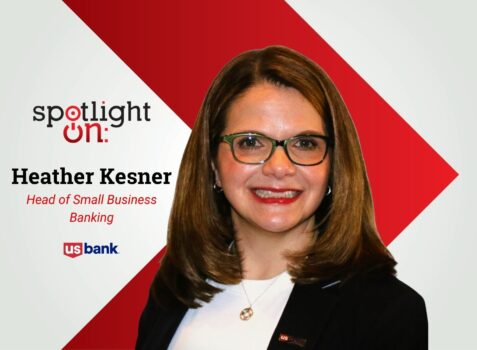 July 2026 — Invest: sat down with Heather Kesner, head of small business banking at U.S. Bank, to discuss how the bank is sharpening its focus on small businesses nationwide, particularly in the midmarket segment. “We want to make sure that we balance the digital and the human experience to provide the expertise that a small-business owner needs,” Kesner said.
Join us at the Invest: Charlotte 6th Edition Leadership Summit! This premier event brings together hundreds of Charlotte’s business and regional leaders to discuss the challenges and opportunities for businesses and investors. Buy your ticket now!
How has your move into a national leadership role changed your priorities for small-business banking?
Small-business banking is a critical driver of growth for our organization. We take great pride in supporting business clients as they navigate the complexities of ownership, and small businesses are critical to the U.S. economy. There are more than 36 million small businesses in the country, representing 99.9% of all businesses. They account for about 44% of GDP and nearly 46% of U.S. jobs.
For U.S. Bank, that represents a tremendous opportunity. We already support 1.4 million small-business customers, which we define as businesses with up to $50 million in annual sales, and we are looking to grow that number. This new role was created to help us better meet the specialized and evolving needs of customers, particularly in the $500,000 to $2.5 million annual sales segment.
Business owners at this stage often face more complex banking and payment challenges, so personalized service is essential. In our model, the small-business specialist acts like a quarterback, bringing together internal partners in merchant services, credit cards, and other areas to help business owners grow and thrive.
What opportunities do you see in that $500,000 to $2.5 million revenue segment, and how are you targeting businesses in that range?
These are the businesses rooted in local communities. They are creating jobs and providing the goods and services people rely on every day. They are also facing real challenges.
Staffing is a major one. Turnover can be high, and specialty roles are difficult to fill. Access to the supply chain is another issue. Some of the businesses that owners relied on in the past may no longer be available, and that affects their ability to get what they need to run their companies. Rising costs are also a challenge. Everything is going up faster than it has in the past, and managing cash flow while trying to grow is difficult, especially with higher employee and supply costs.
So even as owners report strong success and growth, they are also experiencing stress related to the broader economic environment.
According to our 2026 small business survey, there are also encouraging developments. 75% of owners are already using generative AI and reporting measurable gains. Additionally, the majority of business owners are still experiencing growth, while 83% of owners say they feel optimistic about the next 12 months.
Where do you see the biggest growth opportunities for the business right now?
There is a tremendous amount of growth opportunity today, and that is why focusing on midsized small businesses is so important. At U.S. Bank, our small-business and business banking teams work hand in hand up to the $50 million revenue mark.
We are growing our team and adding positions across the country to better support clients and ensure that every small-business customer has prompt access to dedicated specialists. We are also creating a new team called Small Business Connect, which is essentially a virtual team designed to help us reach more small-business owners in places where we may not have specialists on the ground.
We have been piloting that model for the last six months and are in the process of scaling it, with plans to have the team fully up and running in the second half of 2026. It is going to help us reach more clients in more meaningful ways. We have learned that clients want access to expertise in the way that suits them best, whether that is through a virtual office or in person.
We are also expanding into new geographic areas in business banking, including Houston, Atlanta, and Florida, while continuing to offer small-business services nationwide through our national sales team.
How are client expectations evolving around capital access, speed, and advisory support?
We have a team called Business Access Advisors located across the country, including in Charlotte, and they specialize in supporting small businesses. They connect owners to available resources, advise them on how to raise capital, and help them network with other businesses, providers, and customers.
These advisors do not directly offer products and services, but they work closely with U.S. Bank colleagues, such as our small-business specialists, as well as community partners. Their services are free, and business owners do not have to be U.S. Bank clients to work with them. They are an important part of how we help communities and small businesses thrive.
How do you balance digital capabilities with the relationship-based banking that differentiates your approach?
We continue to understand the importance for business owners who prefer digital solutions for banking, payments, and other administrative tasks. The easier we can make it to run their business, the more time they can spend with clients and on their actual business needs.
This past year, we introduced a number of new tools that support our strategy of bringing together interconnected products from across the bank into a seamless, one-stop shop experience. We introduced Business Essentials, an all-in-one business checking account that combines payment acceptance with checking. We also launched Spend Management, which enables businesses to monitor, track, and control card-based spending.
In addition, we introduced U.S. Bank Bill Pay for Business, an all-in-one cash management platform, and U.S. Bank Payroll, an embedded solution that allows owners to manage payroll within their online banking. We also launched the U.S. Bank Business Shield Visa card, which includes an extended introductory 0% APR on purchases and balance transfers and provides access to our expense management platform.
We know we operate in a competitive environment with other banks and fintechs. People have a lot of options when it comes to financial providers. We want to make sure that we balance the digital and the human experience to provide the expertise that a small-business owner needs.
How are economic conditions affecting the way clients are borrowing, investing, and planning ahead?
Many of the same pressures remain in place, including staffing shortages, inflation, and supply chain issues. Owners are also aware of the realities of starting and growing a business in today’s environment. Despite the ongoing pressure, optimism remains high in 2026 as 87% of owners rate their business as successful. Planning ahead still remains critically important for business owners. With more than half of business owners over 55, many still do not have a clear succession plan in place. Whether someone is looking to buy a business or sell one, now is the time to start having those conversations.
From a leadership perspective, how are you preparing your teams to deliver more advisory-driven support?
Our Small Business Connect team is a big part of that. It is going to help modernize our operating model, further streamline our support, strengthen client relationships, and create more capacity for proactive service across all of our regions.
Whether it is on the ground, through virtual support, or through our call centers, we know clients want faster and more flexible service. We are building the capabilities to provide all the ways our clients want to be served.
Looking ahead, what will define success for the business over the next few years?
We want to continue making sure that we meet our customers where they are. That means continuing to invest in how we serve them and continuing to expand our reach.
At the end of the day, success means serving more customers than we are serving today. We are going to stay focused on growth by reaching more current and future clients through our expansion efforts, our community outreach, and our partnerships across the organization and across different business lines.
Want more? Read the Invest: Charlotte report.






