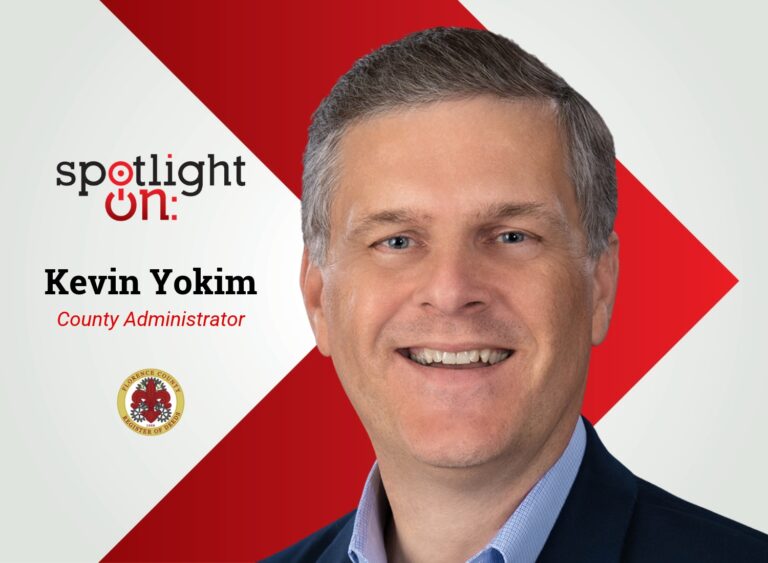

Spotlight On: Kevin Yokim, County Administrator, Florence County
Key points:
- • Florence County has raised its protected land from 1.3% to above 5%.
- • Its I-95 and I-20 location anchors its role as the Pee Dee region’s hub.
- • A $20.6 million museum expansion and a 2027 sales tax vote are planned.
 November 2026 — Kevin Yokim, County Administrator of Florence County, spoke with Invest: about land conservation, quality of life, transportation, regional growth, and the county’s priorities. “Florence is the hub of the Pee Dee region in northeastern South Carolina,” Yokim said.
Join us at caa’s upcoming leadership summits! These premier events bring together hundreds of public and private sector leaders to discuss the challenges and opportunities for businesses and investors. Find the next summit in a city near you!
What have been Florence County’s most significant developments over the past year?
Probably the biggest development has been the county’s recent increased focus on land conservation. Florence County has done a great job in economic development over the past 25 years, and we are not leaving that emphasis. We are also increasing our emphasis on land conservation and recently completed a land conservation plan.
South Carolina has established a long-term goal of protecting roughly one-third of the state’s land by 2050. About three years ago, Florence County was at 1.3%. Through partnerships with organizations across the state, we have increased that percentage to above 5% in just a few years. Our partners include Francis Marion University, the Open Space Institute, the Darla Moore Foundation, the Pee Dee Land Trust, and the South Carolina Conservation Bank.
What conservation projects has the County advanced recently?
Shortly after I became Administrator in February 2023, several of those organizations purchased about 500 acres at Independence Farm in southeastern Florence County and gave the land to the County. We are master planning that site for passive recreation. About 18 months ago, we partnered with the State of South Carolina on the purchase of the 7,600-acre Snow’s Island Assemblage in southeastern Florence County. General Francis Marion was from that area, and Snow’s Island was among his Revolutionary War strongholds.
Within the past few months, the State and Francis Marion University purchased a little more than 8,000 acres in northeastern Florence County along the Great Pee Dee River, and the County was again a partner. Francis Marion University will manage the acreage through its relatively new forestry and environmental sciences programs.
Through a shared partnership with the Darla Moore Foundation, we contracted with Weston & Sampson to prepare a comprehensive conservation plan identifying where the County should increase its efforts. We held three public meetings to learn whether residents wanted to preserve water quality, animal habitat, passive recreation, or forestland. Using complex GIS mapping, the plan identified 10 general areas, rather than specific parcels, where we should focus.
How is growth changing demand for County services and quality-of-life amenities?
Florence punches way above its weight. We are probably the 12th-largest county in the state by population, with about 140,000 people. The City of Florence, the county seat, has about 40,000 people. We are not nearly as large as some other counties.
Healthcare is near the top of the list. McLeod Health is the largest employer in Florence County and the wider region, including the Myrtle Beach area. About five years ago, MUSC bought a for-profit hospital in Florence and has made significant improvements to it. HopeHealth is a federally qualified health center serving communities across the Pee Dee and surrounding regions. We have great healthcare partners.
We also have higher education. Francis Marion University has more than 4,000 students and educates future leaders for this part of the state. The technical college program prepares our workforce for the industrial development taking place here. The County has a significant art and history museum. William Henry Johnson, an important 20th-century African American artist, was from Florence. We have hosted several exhibitions of his work. Across the street is the Francis Marion University Performing Arts Center, and next door is the Florence Little Theatre.
We also have extensive recreation opportunities. Lynches River County Park covers 700 acres in the middle of the county. In southern Florence County, Lake City now has Lions Park, an approximately eight-acre lake with a boardwalk around it, thanks to a partnership with the Drs. Bruce and Lee Foundation.
Florence School District 1 has made incredible progress under Superintendent Dr. Richard O’Malley and is now among the State’s highest-performing districts for graduation rates. Economic development, quality of life, and land conservation are three areas where I see positive developments, especially as we preserve the natural beauty of rural southeastern Florence County.
How do Florence County’s transportation links and location shape its strategy?
In real estate, it is location, location, location. Florence is at the midpoint between New York and Miami on Interstate 95 and at the intersection of I-95 and Interstate 20, which ends here. We have the largest interstate interchange on I-95 between Washington, D.C., and Miami. We are also 60 miles west of Myrtle Beach.
Florence has a regional airport about 10 minutes from my office, with two daily American Airlines flights to Charlotte. From Charlotte, travelers can connect to destinations around the world. We have a major CSX rail yard for industrial transportation as well as an Amtrak station.
During the past year, the County significantly increased its contribution to the Pee Dee Regional Transportation Authority, or PDRTA. Buses are now fare-free in Florence County. Anyone, regardless of income, can ride without paying. That has helped transport our workforce to employers throughout the County.
How is Florence County’s role in the broader Pee Dee economy evolving?
There is an emphasis on regionalization. Florence is the hub of the Pee Dee region in northeastern South Carolina. People from throughout the region come here to work, shop, dine, and receive medical care.
Some organizations have expanded from Florence into the rest of the region. NESA is a strong regional economic development organization. McLeod Health and MUSC have also expanded regionally. Their work may be centered in Florence, but it is not limited to the county.
We assist other counties where we can. Many people who work for employers in Florence County live in surrounding counties. Some of those counties have faced difficult conditions in recent years, but I believe that will begin to change as Florence County grows and that growth extends beyond our boundaries.
What are Florence County’s key goals for the coming years?
The goal is to continue progress on our three main fronts. In economic development, the County Council issued a $22 million bond four years ago. We are developing several industrial parks throughout the county, including areas outside the northern part where the City of Florence is located.
For quality of life, we recently signed a contract for a $20.6 million museum expansion. Construction will take place through October 2027, with a grand reopening planned shortly after January 1, 2028.
At the 500-acre Independence Farm property, we have completed a master plan and are preparing to begin implementing it. In land conservation, the county is now above 5%, and the next goal is to reach 30% by 2050. That will require incremental growth each year. We will identify parcels as they become available and work with agricultural businesses and farmers who may be willing to place land into conservation without selling it to the County.
Another major goal is the fourth capital project sales tax referendum planned for November 2027. State law allows the County to put a sales tax before voters with a list of projects. Because of Florence County’s location, about 30% to 35% of that tax is paid by visitors from outside the county. It allows us to complete projects that probably would not have been finished in my lifetime.
Want more? Read the Invest: South Carolina report.