Spotlight On: Larry Schlesinger, President & CEO, Texas Biomedical Research Institute
Key points:
- • Texas Biomed is expanding its infectious disease and biosecurity capabilities.
- • Campus modernization is strengthening partnerships with government and industry.
- • San Antonio is building its position as a national life sciences hub.
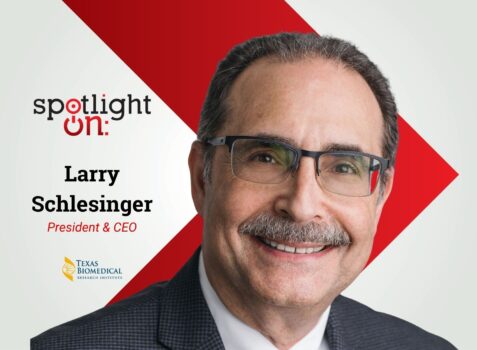 September 2026 — In an interview with Invest:, Larry Schlesinger, president and CEO of Texas Biomedical Research Institute, discussed the institute’s infectious disease and biosecurity mission, campus modernization, and role in San Antonio’s life sciences economy. “Our goal is to bring leading pharmaceutical R&D and manufacturing to San Antonio and grow the city as a national hub for infectious disease research, biodefense, and national security,” Schlesinger said.
Join us at caa’s upcoming leadership summits! These premier events bring together hundreds of public and private sector leaders to discuss the challenges and opportunities for businesses and investors. Find the next summit in a city near you!
What have been Texas Biomed’s most significant recent milestones?
Texas Biomed continues to grow in depth and breadth. We now have more than 500 employees and are focused on strengthening the nation’s ability to prevent and respond to infectious disease threats. We are also expanding programs related to populations at risk for infection. This includes inflammation science, which examines how infection can trigger chronic inflammatory diseases. Our programs extend into cancer, heart disease, neurodegenerative disease, diabetes, and aging.
One major growth area is our impact on national and international biosecurity. Infectious disease remains one of the greatest threats to global health, from Ebola outbreaks in the Democratic Republic of Congo and Uganda to hantavirus and the New World screwworm affecting livestock and people. The countermeasures we develop are important to national security and economic stability.
We are in the second half of a 10-year strategic plan and have more than $220 million in construction completed or underway to modernize our campus. These facilities will support the science required to develop treatments and cures for infectious diseases. We are advancing potentially curative therapies for Ebola with our long-standing partner Regeneron. At the same time, we are working with an international partner called Flyttr on strategies to combat New World screwworm, and most recently, we signed a Cooperative Research and Development Agreement with the U.S. Department of War to strengthen our collaboration on biodefense research and capabilities.
How are funding uncertainties affecting the institute’s strategy?
New policies are creating uncertainty about what funding will be available and when it will arrive. That complicates budgeting for a private nonprofit. Our strengths are resilience, nimbleness, and a diversified business model.
We have outstanding fundamental science programs supported by the National Institutes of Health, and that funding continues, even when timing is uncertain. Our contract business is growing quickly and generating resources that help fuel basic science. Integrating fundamental research, translational work, and preclinical studies is an important advantage for us. Our nonprofit status makes us unique in the sector, and we are responding to the headwinds by finding opportunities and developing strategies that can succeed over the long term.
How is campus investment strengthening work with government and industry?
Developing cures for infectious diseases requires safe, high-containment facilities. Our flagship project is a new maximum-containment, or Biosafety Level 4 (BSL-4), facility that is currently under construction and progressing on schedule. It is projected to open in 2028, and we already have government and industry partners preparing to use it to test therapies and vaccines safely once it opens. This is our second BSL-4 facility. Our first facility opened in 1999. Therefore, Texas Biomed has decades of experience operating these facilities. Our engineering and environmental health and safety expertise sets us apart. We are not entering this field for the first time; we are accelerating proven capabilities in response to growing threats.
How is Texas Biomed contributing to San Antonio’s economic momentum?
The institute’s progress elevates San Antonio’s status nationally and internationally. In addition to leading Texas Biomed, I chair BioMedSA, the regional nonprofit supporting the healthcare and biosciences sector. It brings together hospital systems, healthcare innovation, biomedical research, and translational organizations to advance the sector.
San Antonio’s healthcare and biosciences industry is an enterprise of more than $40 billion, and momentum continues to build through new international partners and local collaboration. I also serve on Mayor Gina Ortiz Jones’ Economic Security Advisory Group, which is developing strategies around biotechnology, space manufacturing, quantum technology, and artificial intelligence.
Texas Biomed’s goal is to be a powerful engine for innovation and economic growth in the city. As we expand our workforce and recruit talent, San Antonio becomes more attractive to manufacturers and other industry partners. The region already has one of the nation’s strongest concentrations of military medicine, healthcare, academic institutions, and life sciences research. Texas Biomed and Southwest Research Institute are two particularly distinctive, large nonprofit research organizations.
The city’s ability to collaborate remains its secret sauce. Strengthening each participating organization and communicating across institutions will help San Antonio compete. We have not yet reached the level of the country’s top life sciences cities, but we are hungry and building the educational and research platforms needed to advance.
How are you supporting the next generation of scientists?
I am passionate about supporting the next generation of scientists and the scientific workforce, and have placed great emphasis on education and mentoring throughout my career. Texas Biomed is more robust than ever in what we call cradle-to-career education.
We have strong science, technology, engineering, and mathematics programs for K-12 students. Recently, 60 high-school students participated in our annual four-week Valero Young Scientist summer program, conducting research in laboratory space created for them. We also operate a nationally competitive internship program and externally funded educational programs supported by the National Institutes of Health. Together, these initiatives help develop the next generation of scientific leaders.
The United States has long been the envy of the world for its biomedical research engine. We must continue to support science. Many major discoveries begin with discovery-based research that later becomes an invention or cure. We need to move promising work more effectively through the difficult transition between discovery and commercialization so products can reach people and keep them safe.
What challenges remain in moving discoveries into real-world applications?
Resources are fundamental, and we must continue supporting the full research process. We also need to work with government partners to streamline processes while maintaining rigor and safety. Global competition is intense, and countries including China are moving quickly in healthcare and biosciences.
Public understanding matters as well. Over the past 50 years, vaccines have saved more than 150 million lives globally, yet scientists must continue explaining how research and development work. Through social media, press releases, and our subject-matter experts, we educate the public and keep people engaged. I believe that will be one of our most important responsibilities over the next decade. The private sector has an increasingly important role in helping discoveries move efficiently toward the clinic.
How are artificial intelligence and other technologies changing biomedical research?
Artificial intelligence is transforming biomedical research. It can shorten the path from basic discovery to vaccines, therapeutics, and diagnostics, allowing researchers to focus on the highest-value scientific questions. Texas Biomed is using AI in drug discovery while also concentrating on governance, accuracy, and responsible use.
We are investing in new approach methodologies such as microphysiological systems and spatial biology; the latter helps us examine disease sites, immune circuits, and gene-expression profiles in tissue. We are also expanding live imaging, single-cell sequencing, genomics, computational science, modeling, biostatistics, and validation. These dry-lab capabilities complement laboratory science and make our work more efficient. For young scientists, this is an extraordinary opportunity to integrate more data and ask better biological questions.
What are your priorities for the next three to five years?
I am optimistic because, as a physician-scientist, I begin each day thinking about helping people live healthier lives and avoid disease. Remaining mission-focused will provide a foundation for success.
We will continue to expand and modernize the campus to meet our business needs, create the best environment for our work, and attract and retain talent in San Antonio. We will deepen partnerships with academic institutions, nonprofits, and the private sector, strengthen government relationships in biosecurity, and solidify international partnerships. Our goal is to bring leading pharmaceutical R&D and manufacturing to San Antonio and grow the city as a national hub for infectious disease research, biodefense, and national security.
Want more? Read the Invest: San Antonio report.