


Spotlight On: Cathy Hampton, Partner, Entertainment and Sports and Corporate practice groups, Greenspoon Marder LLP

Cathy_Hampton_Spotlight_OnNovember 2025 — Cathy Hampton, partner at Greenspoon Marder’s Entertainment and Sports and Corporate practice groups, sheds light on the dramatic transformations sweeping through the sports, entertainment, and corporate sectors, with a particular focus on Atlanta’s unique role. Hampton told Focus: that legal shifts have redefined entire industries, pointing to the “rapid-fire change” in collegiate sports driven by name, image, and likeness (NIL) policies. This fundamental shift has not only transformed the lives of athletes but has also sparked an explosion of economic opportunities and global events across the country.

What are some of the biggest changes you have seen in the sports, entertainment and corporate legal industries?

In sports, the NIL changes in amateur athletics have completely transformed how we view amateur versus professional athletes. Years ago, no one would have imagined that college athletes would have an opportunity to participate in the fruits of their labor.

The NIL changes are a significant departure from where we were not long ago. The Alston case and other antitrust cases marked a pivotal moment in weakening the NCAA’s control over athlete compensation, paving the way for the rapid adoption of NIL policies.

Many scholars wrote think-tank papers, but no one really thought that just a few years later we would be in the current space. So, in sports, I would say the biggest changes are in collegiate athletics. Atlanta has also been an excellent host for major events — from the Super Bowl to the Final Four, and the upcoming FIFA World Cup.

Part of the story in sports is the evolving landscape of collegiate athletics, but also Atlanta’s strong track record of hosting global events. The city first stepped onto the world stage with the 1996 Olympics, and since then has been an explosion of global sports activity, with all the accompanying economic development.

I take great pride in having worked on the construction of Mercedes-Benz Stadium during my tenure as Atlanta’s City Attorney, when we successfully led the legal aspects of building a new stadium — taxes, commercial paper, winning litigation defending the issuance of that commercial paper.

What we accomplished with the Atlanta Falcons and the city’s sports community contributed to the growth of the sports ecosystem and all of the economic advantages, incentives, jobs and businesses that have flourished as a result.

On the entertainment side, Atlanta has been a center of music, but we cannot overlook the growth of the film and TV industries. Thanks to our partnership with the state of Georgia, the city’s film office helped drive that expansion. We worked on the legal issues to establish and develop the Atlanta Film Office, securing tax credits and streamlining the permitting process to attract major film productions with years of economic ripple effects. 

This boom has drawn not only productions, but also businesses and people who often decide to stay, raise families, and contribute to our communities. The explosion in film and TV, combined with Atlanta’s established music industry and growing sports presence, has made the city a hub for cultural creation.

On the corporate side, visitors are sometimes surprised at just how many Fortune 100 companies are headquartered here. Most people know about the big ones — Delta Air Lines, Coca-Cola, Home Depot, and UPS, but many others — such as Newell, NCR and Global Payments — are here too.

The growth of Fortune 100 companies based in Atlanta offers more opportunities for law firms to expand from local to regional, national and even global practices. Atlanta has shifted from being “the center of the South” to one of the key business centers of the country — and the world.


Join us at caa’s upcoming leadership summits! These premier events bring together hundreds of public and private sector leaders to discuss the challenges and opportunities for businesses and investors. Find the next summit in a city near you!


What differentiates your firm from others in the market?

There’s a special place for professional services, and lawyers play a key role in ensuring that clients remain compliant. Of course, there are risks when you’re entering new business areas, but I see our role as partnering with our clients, so the answer isn’t “no,” or the old adage, “it depends,” but rather “yes, and.”

Having that mentality is what distinguishes the Greenspoon Marder family of lawyers; we see ourselves as true partners, working with clients to navigate risks and reach solutions together.

To solve problems effectively, there’s no substitute for knowing a client’s business. The more ingrained you are in a client’s operations, the easier it becomes to proactively spot risks and prevent or mitigate them.

What I’m seeing is more of a partnership with clients, sometimes even through secondments, where firms loan lawyers to work directly with clients. The more you learn about a client’s business, the more effective you become at balancing creativity and innovation with compliance and risk management.

Where do you see the most promising opportunities emerging right now?

One area that has grown in surprising ways is video games. What began as entertainment has now been expanded into E-sports, with Atlanta emerging as a center for E-sports and gaming.

This wasn’t something many could have foreseen. Today, esports is a massive business, especially with virtual play enabling global competition. Another area is content creation. Social media platforms continue to dominate daily life, helping people connect with family and friends, but also play a massive role in branding and business. Sponsors are investing heavily in growing their social media footprint, and influencers have turned influence into an industry of its own. Advising creatives now means thinking not only about what to capture on film, but also how it ismarketed. It’s not just about producing a TV show — it’s about securing streaming rights, managing distribution and product placement.

Do you remember when you’d see something on TV and think, “I wish I could buy that?” Now, with streaming services, you can click and buy instantly. That convergence of entertainment, sports, and retail is an enormous shift, and it’s only going to expand.

How do you protect brand value in an era of remix culture, fan content and marketplaces that move faster than traditional enforcement?

The fundamentals are still the same: trademarks, patents, copyrights, the U.S. Patent and Trademark Office, and the U.S. Copyright Office. Everything you learned in law school about intellectual property hasn’t changed.

What has changed is execution and speed. Online registrations, protections, and social media, now require much faster action.

There used to be a window of opportunity to decide whether to protect your brand. That window no longer exists. The moment you post something, it’s exposed. Ideas, products, and processes all must be protected much sooner. It’s crucial to utilize monitoring tools, platform-specific takedown strategies and NIL contract clauses to ensure brand protection.  

The advice we give our intellectual property clients is simple: the steps remain the same, but the urgency has changed. You move faster to protect your brand in today’s fast-paced environment.

What are your top priorities for your practice areas over the next three to five years?

We are focused on managing growth strategically. At Greenspoon Marder, we’ve been having thoughtful conversations about opportunistic hires — whether individuals or groups — who can strengthen our existing  practices while bringing fresh approaches to client service and outreach.

That requires a clear understanding of what our clients need and what they are asking of us, ensuring our growth aligns with theirs. For that reason, you will see continued expansion in our Atlanta office.

As the city grows and our client base broadens, we will need additional lawyers to grow alongside our clients and serve them in a thoughtful, comprehensive way.

Want more? Read the Focus: Atlanta report.

Subscribe to Our Newsletters

"*" indicates required fields
Address*
Would You Like To Receive Our National Newsletter?*
Interests
Markets
This field is hidden when viewing the form

Spotlight On: Taneisha Harvey, General Manager, Nashville Municipal Auditorium

Taneisha_Harvey_Spotlight_OnNovember 2025 — In an interview with Invest:, Taneisha Harvey, general manager of the Nashville Municipal Auditorium, emphasized the venue’s commitment to revitalization and community engagement amid a rapidly evolving event landscape. “We want the community organizers and promoters to know that the Municipal Auditorium is here and available, our doors are open. We are the people’s house,” she said.

What changes over the past year in terms of the market, operations, or community engagement that have had the greatest impact on the auditorium?

Over the past year, one major shift has been an uptick in sporting events. The Municipal Auditorium is known for being the home of the Nashville Kats, a professional arena football team. However, with our strong partnerships with the Mayor’s Office, Sports Authority, and Nashville Convention & Visitors Corp (NCVC), we secured a three-year agreement with Athlete’s Unlimited, which is a professional women’s basketball league. Those partnerships have also led to increased inquiries for other sporting events, ranging from gymnastics to professional fighting. We’ve hosted several concerts and rehearsals throughout the year as well.

We want the community organizers and promoters to know that the Municipal Auditorium is here and available. Our doors are open, and we are the people’s house.


Join us at caa’s upcoming leadership summits! These premier events bring together hundreds of public and private sector leaders to discuss the challenges and opportunities for businesses and investors. Find the next summit in a city near you!


How has Nashville’s growth in tourism and entertainment influenced the types of events you are able to attract now, compared to previous years?

Nashville’s tourism and entertainment boom has pushed the Municipal Auditorium to reinvent itself. Once the city’s main stage for major performances, it now must compete with newer venues. Rather than competing head-to-head with state-of-the-art arenas, it now attracts mid- sized concerts, cultural gatherings, sporting events, and niche entertainment that align with the city’s diverse visitor base.

What partnerships do you have in place with hotels, restaurants, tourism groups, or others to help strengthen your event pipeline?

We partner with Live Nation as our preferred promoter to bring in concerts and strengthen our entertainment pipeline. In addition, we invest in targeted advertising through local news outlets and the Nashville Business Journal to reach both residents and visitors. We also collaborate with the Nashville Convention and Visitors Corp (NCVC) to align with the city’s broader tourism initiatives, ensuring our events are promoted alongside Nashville’s growing reputation as a premier destination.

How are inflation and rising operational costs impacting your strategy, and how are you navigating those hurdles?

Rising costs have pushed us to be more strategic with our operations and partnerships. We’re streamlining expenses, strengthening relationships, and diversifying our event mix to drive revenue. By working closely with tourism partners and focusing on high-impact events, the auditorium is able to manage inflation while still delivering quality experience for both guests and organizers.

What are your top strategic priorities for expanding the auditorium’s reach and solidifying its role in Nashville over the next three to five years?

Our top priorities over the next three to five years are to broaden the mix of events we host, from concerts to sports and community gatherings. I would like to see more corporate clients while strengthening partnerships with tourism groups and local businesses. We’re focused on upgrading technology, improving guest amenities, and streamlining operations so the Municipal Auditorium continues to be a versatile and culturally significant venue in Nashville.

Want more? Read the Invest: Nashville report.

Subscribe to Our Newsletters

"*" indicates required fields

Address*
Would You Like To Receive Our National Newsletter?*
Interests
Markets
This field is hidden when viewing the form

Spotlight On: Mark Parthemer, chief wealth strategist of Glenmede

Mark_Parthemer_Spotlight_OnNovember 2025 — In an interview with Invest:, Mark Parthemer, chief wealth strategist of Glenmede, emphasized the importance of personalized, holistic planning in today’s complex wealth management landscape. “Our goal is to empower clients in shaping their financial futures. That requires a holistic, yet highly customized approach,” he said.

What is Glenmede’s overall wealth management philosophy and how does that distinguish the firm?

At Glenmede, we focus on the idea that every client represents a universe of one. Families, endowments, and foundations all require tailored wealth management solutions. These services span investment advice, philanthropy, next-generation education, trust and estate planning, tax strategies — the full spectrum. Our goal is to empower clients in shaping their financial futures. That requires a holistic, yet highly customized approach.


Join us at caa’s upcoming leadership summits! These premier events bring together hundreds of public and private sector leaders to discuss the challenges and opportunities for businesses and investors. Find the next summit in a city near you!


Given the current economic climate and fluctuating markets, how has Glenmede adjusted its strategies to help clients protect, project, and grow their wealth?

Much of what we do involves continuous engagement with our clients. We apply robust analytics and perform ongoing assessments of how likely they are to achieve their financial goals, factoring in macroeconomic conditions, taxes, and market volatility. Based on that analysis, we design portfolios that aim to improve the probability of success. It’s an iterative, personalized process. Each client has unique goals, family dynamics, risk tolerance, and perspectives on wealth. We account for those individual factors — alongside current and anticipated economic shifts, like inflation trends or geopolitical risks — and we incorporate them into the strategy we craft. It’s all woven into the framework we build to manage their investments.

How do these tax policies shape your wealth management strategies for clients in the region?

Florida is clearly a tax-favored state. There’s no personal income tax, no estate tax, and no inheritance tax. When you combine that with the climate and a vibrant business environment, it’s an appealing destination for high-net-worth individuals and businesses. However, making the transition requires strategic planning, not just to establish Florida residency but also to sever ties with previous states like New York or Connecticut, which could still claim tax jurisdiction. That process includes lifestyle and legal changes to support residency status. From an investment standpoint, the absence of state income tax opens the door for more favorable investment opportunities. Certain investments become more attractive without the drag of state taxes. Additionally, it’s important to consider where assets like trusts are located. For instance, if a client relocates to Florida but their trust remains domiciled in California or New York, that trust could still be subject to those states’ income taxes. So, changing the situs of a trust can be critical. It’s all part of our effort to ensure a client’s wealth is aligned with the most efficient tax jurisdictions.

How is Glenmede leveraging technology and innovation to enhance the client experience, streamline investment strategies, and provide real-time financial insights?

We’re all seeing the growing presence of artificial intelligence, particularly generative large language models. Glenmede is cautiously optimistic about the efficiencies AI can bring to internal operations, like using AI bots to support business processes. However, we’re very clear that these technologies are not used to provide client advice. Each client’s situation is unique, and personalized advice still requires human judgment. That said, we’re actively integrating technology to better serve clients, whether through remote meetings, document sharing, or data management. We’re also mindful of the risks technology can pose, particularly cybersecurity threats, such as phishing or attempted fraud. We’ve implemented robust cybersecurity policies to protect client assets. It’s an evolving challenge, but one we take very seriously.

How do you approach client education in areas such as investment strategies, market trends, and long-term financial planning?

I’m Glenmede’s national chief wealth strategist and also serve as the Florida regional director. My focus is on tax, estate, and trust planning, not investments. That said, we work closely with clients on structuring their wealth to be protected and transferred effectively. This includes strategies for minimizing taxes, shielding assets from divorce or creditors, and ensuring wealth supports family members without derailing their purpose or productivity in life. So, while I’m not the one providing investment advice, I do educate clients on the broader planning side — how to build a structure that supports their long-term vision and legacy.

How does Glenmede help clients align their wealth strategies with their philanthropic and social impact goals?

Glenmede’s roots are deeply tied to philanthropy. The Pew family, founders of Sun Oil (now Sunoco), established the Pew Charitable Trusts in the 1950s, and Glenmede was created to manage the trusts’ assets. That legacy continues today. We now manage around $8 billion in those trusts and have a dedicated division focused on endowments, foundations, and philanthropic strategy. High-net-worth clients increasingly seek strategic ways to give. Recent tax law changes have added complexity, limiting deductions and adding new requirements, so our role includes helping clients navigate those shifts effectively. We provide structured guidance to ensure their charitable giving is both impactful and tax-efficient.

What strategies do you implement to ensure a smooth wealth transition across generations?

We’re actively involved in what’s often referred to as the “Great Wealth Transfer” as baby boomers pass significant assets to the next generation. Our approach starts by separating the conversation into two parts. First, we ask: What does your estate plan look like? Who gets what, and how? Once those objectives are clear, we explore the tools available to meet them efficiently. These tools include generation-skipping trusts, grantor-retained annuity trusts, spousal lifetime access trusts (SLATs), and others. As a former private practice tax attorney, this is an area I’m passionate about. These structures aren’t one-size-fits-all. They’re matched carefully to each client’s goals. The end result is a strategy that reflects their values and ensures their legacy is protected and passed on as intended.

What are your expectations for the wealth management landscape in Palm Beach over the next few years?

Palm Beach has long been a destination for high-net-worth individuals, and that trend isn’t slowing. The wealth management industry here is thriving, which keeps all of us operating at a high level. I expect that to continue. We’re seeing more top-tier firms and talent establishing a presence here because this is where many key clients reside. A major development to watch is commercial real estate. West Palm Beach, just across the bridge, is experiencing rapid growth in office space development. While costs are rising, the demand indicates confidence in the area’s future. For example, ServiceNow recently announced it would move its headquarters from San Francisco to West Palm, taking over hundreds of thousands of square feet. That’s a powerful sign that the region continues to attract not only wealthy individuals but major companies and talent.

How do you approach crafting individualized strategies for clients, particularly when complex family dynamics or unique financial goals are involved?

It all begins with truly getting to know the client. You can’t walk into a meeting and start recommending solutions without understanding who they are and what matters to them. We ask questions, we listen carefully, and we continue that dialogue throughout the relationship. That insight informs not only portfolio construction but also estate planning, tax strategies, and philanthropic goals. Every aspect of the plan is shaped by what the client has shared as being most important. So, the foundation is always: listen first, then build.

What are your top priorities moving forward?

Glenmede is deeply committed to educating future generations. We’ve been doing this for 65 years, and we know how important it is to prepare children and grandchildren to become responsible stewards of wealth. We offer structured learning modules — both in-person and virtual — on everything from taxes to investing to understanding what it means to be the next generation in a wealthy family. Studies show that families with well-educated heirs have a much higher chance of preserving their wealth. In addition, we have a dedicated sustainable investing division and also offer lifestyle support services. We tailor solutions based on what’s most important to our clients and build a team of experts to meet them at their point of need.

Want more? Read the Invest: Palm Beach report.

Subscribe to Our Newsletters

"*" indicates required fields

Address*
Would You Like To Receive Our National Newsletter?*
Interests
Markets
This field is hidden when viewing the form

Industry Corner: Scaling digital health: From telemedicine to AI-driven care

IPITe3_Banner_Washington_Jefferson_College

Writer: Mirella Franzese

Industry_CornerIndustry corner is a monthly series on what company leaders believe are the most important best practices in their sector or organization to ensure growth and sustainable success.

November 2025 —  America’s healthcare systems are overburdened. Professional shortages, rising costs, federal funding cuts, the rise of chronic diseases, and an aging population have all strained the industry. As a result, hospitals and health providers are shifting towards digitalized and AI-powered care models to alleviate the burden as automation offers core advantages in treatment efficiency and effectiveness.


Join us at caa’s upcoming leadership summits! These premier events bring together hundreds of public and private sector leaders to discuss the challenges and opportunities for businesses and investors. Find the next summit in a city near you!


“The global health landscape is on the cusp of a significant transformation, driven by the rapid integration of digital technologies and artificial intelligence (AI),” said Andy Moose, head of health and wellness at the World Economic Forum, in a white paper examining the future of AI-enabled health. “In healthcare, medtech, and pharma, an inflection point has been reached: the choice now lies between transforming systems or continuing down the road of incremental improvement. As this transformation unfolds, it is crucial for addressing the urgency for real, impactful change rather than small, marginal advances.”

According to IBM, AI-driven diagnostics can improve health outcomes by 40% and reduce treatment costs by up to 50%. Similarly, the World Health Organization (WHO) estimates that spending an additional $0.24 per patient per year on digital health interventions could save more than two million lives from non-communicable diseases over the next decade.

The Next Phase of Digital Health

The pandemic accelerated the adoption of telemedicine, but healthcare’s digital phase has now evolved beyond virtual care, which has struggled to scale. This evolution marks an industry-wide shift from basic telehealth toward integrated digital ecosystems linking electronic health records (EHRs), mobile apps, AI algorithms, and workflow automation. In fact, the majority of healthcare leaders (96%) say they are “ready and resourced” to use digital health, according to a newly-released survey report by the MIT Technology Review.

However, most organizations are integrating these tools for operational and administrative efficiency, but grappling with clinical adoption due to regulatory and ethical uncertainties.

“Compared to other industries, healthcare exhibits digital maturity and disruption below the global average, indicating that these sectors have yet to make full use of digital technologies to create significant value,” Moose added. “It is not yet clear whether AI will drive transformation or continue down the current path, with a sole focus on marginal efficiency. So far, many AI developments have been experimental…most of which have yet to be implemented at scale.”

Despite challenges, clinical implementation is slowly gaining momentum. In fact, AI has already been successfully applied to multiple practices within the medical field. For instance, AI agents and assistants are supporting patient triage through advanced monitoring devices. Ambient voice technology is also being leveraged to document physician and patient conversations, allowing clinicians to focus more on patient interaction, according to AdventHealth’s West Florida Division President and CEO David Ottati, who recently spoke with Invest:. In another example, AI also provides capabilities that are considered “rare” for emergency medicine, according to James Fishkin, medical director of Sollis Health, a concierge urgent care provider. As Fishkin noted to Invest:, artificial intelligence enables them to perform advanced procedures that are typically only hospital-based, such as paracentesis and thoracentesis.

The benefits of AI adoption are clear. With the implementation of digital solutions, health systems can scale infrastructure at length and improve patient and data security. Even as labor shortages and rising costs continue to pressure hospitals, digital tools offer both operational relief and measurable improvements in clinical care — ones that are bridging social divides and health gaps.

Smarter Diagnostics and Filling in Care Gaps

According to healthcare experts, AI and medical imaging are being increasingly employed in radiology, dermatology, ophthalmology, pathology, and clinical triage, among other areas, for smarter diagnostics. These tools essentially help physicians interpret scans, identify anomalies, and predict disease progression faster and more accurately, as Ottati notes. Even more importantly, AI-enabled diagnostics expands access to healthcare, making detection easier for remote or underserved patients who are unable to visit physicians in person. 

For instance, Triangulate Labs, a Boca Raton-based technology company, is leveraging AI-powered total body photography (TBP) through its mobile app, Skinmap, to detect skin cancer early when it’s 99% curable, according to CEO and Founder Bill Hall. The Skinmap app captures 300 high-quality images in 60 seconds, while AI maps them onto a 3D body model, comparing prior and current scans to highlight changes. For Hall, this technology isn’t just critical for supporting dermatologists’ accuracy, but also for filling in gaps in access. 

“Of the 110 million high-risk Americans, only 12 million see a dermatologist annually, leaving nearly 100 million without access. Skinmap aims to bridge this gap by extending dermatologists’ reach to primary care providers, specialists, and remote patients, helping filter high-risk cases for early intervention,” Hall told Invest: reporters. 

Beyond dermatology, digital health is being used to help address critical gaps in women’s health, according to a 2025 Boston Consulting Group (BCG) report. In general, women live 25% more of their lives in poor health compared to men, but traditional medical ‘hardware’ fails to consider sex-based differences in treatment. Femtech innovations are therefore expected to transform mechanisms of health, tailoring care towards the female experience, as per BCG. 

For health systems, closing these divides means cutting down costs and operational burdens. AI tools like Skinmap essentially replace existing detection solutions (such as booths) that are economically impractical, and substitute mobile apps, which disrupt clinic workflows. 

So by leveraging these devices at scale, hospitals stand to gain more precise diagnostics and reduced clinician burnout — all of which enhance patient outcomes, mitigate revenue loss, and bolster operational resilience.

Addressing Risks: Ethics, Privacy & Regulation

For most healthcare providers, implementation isn’t the biggest roadblock for broader AI use — it’s regulation and ethics. With greater use of AI and automation comes heightened attention to ethics, data governance, and compliance, as Ben Horner,  managing director and partner at Boston Consulting Group, noted in a WEF report

“AI in health faces dual challenges. First, the inherently sensitive nature of health, where the protection of individuals is paramount, leads to a highly risk-averse environment. Second, societal skepticism towards AI, as highlighted by consumer sentiment surveys, presents a hurdle,” said Horner. 

Regulation is critical for security and trust. An American Medical Association (AMA) survey of nearly 1,200 doctors from 2023 to 2024 found that 47% of physicians consider increased oversight as the number one regulatory action needed to increase their confidence in AI tools. They also rated increased feedback, data privacy assurances, seamless workflow integration, and adequate training and education as essentials to scale AI implementation.   

“There remain unresolved physician concerns with the design of health AI and the potential of flawed AI-enabled tools to put privacy at risk, integrate poorly with EHR systems, offer incorrect conclusions or recommendations, and introduce new liability concerns,” explained AMA’s immediate past president Jesse M. Ehrenfeld, MD, MPH, in a report

However, healthcare organizations are responding by building in-house AI governance frameworks and transparency protocols to align innovation with both patient and physician trust.  One example is the Healthcare New Jersey Innovation Institute, which is developing its own internal AI governance and compliance tools. 

“We created a governance toolkit that consolidates guidance from providers and associations to help organizations safely deploy AI solutions,” said Jennifer D’Angelo, COO and EVP of Healthcare New Jersey Innovation Institute, in an interview with Invest:. “Internally, we’ve (also) developed a proprietary tool similar to ChatGPT, tailored specifically for NJII. This allows us to manage its learning process in a controlled environment, ensuring data privacy and compliance.”

Future Outlook: Intelligent Care Ecosystems

With greater regulatory frameworks and ethical protections in place, the hospital of the future will not just be connected, but also intelligent. Institutions that balance innovation with ethics and governance will define the next generation of patient-centric care. However, scaling digital transformation in the healthcare sector will require significant training and preparation, according to D’Angelo. 

“As healthcare shifts from manual to digital processes, these programs are crucial. The more we integrate technical solutions, the more we need to invest in training. That includes AI literacy, compliance, security, and privacy. Especially in healthcare, we must be vigilant, maintaining HIPAA (Health Insurance Portability and Accountability Act) compliance and minimizing risk. To do that effectively, we need to ensure our workforce is well-trained,” D’Agenlo told Invest:.

Want more? Read Invest:’s Industry Corner here.

Subscribe to Our Newsletters

"*" indicates required fields

Address*
Would You Like To Receive Our National Newsletter?*
Interests
Markets
This field is hidden when viewing the form

Leaders discuss shaping the region’s future at Invest: San Antonio Leadership Summit

Writer: Andrea Teran

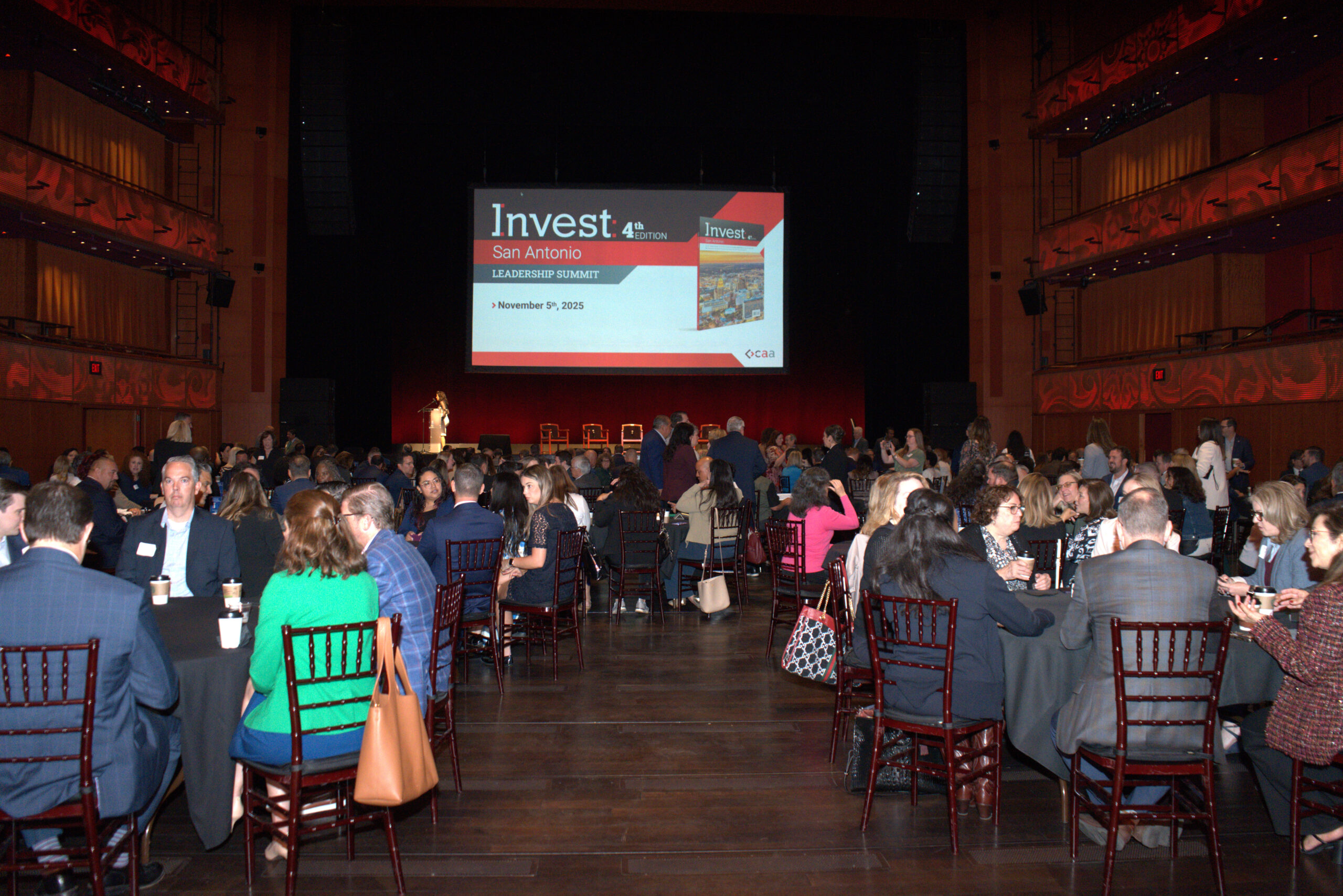
November 2025 — San Antonio is growing fast, but regional leaders are not just thinking about expansion — they are focused on doing it the right way. That message came through at the Invest: San Antonio 4th Edition Leadership Summit, hosted by caa at the Tobin Center for the Performing Arts.

More than 250 attendees from across business, government, education and nonprofit sectors came together for a morning of honest conversations about the future of the city. Through keynote insights and three dynamic panels, the event explored how San Antonio can continue to grow while protecting what makes it special — its people, its culture, and its deep sense of place.

Abby Lindenberg, caa founder and CEO, opened the event with a powerful message — not just about the city’s future, but about the 10-year milestone her company is celebrating this year.

“From growing from one market — Miami — to close to 20 today, including San Antonio, it has been a privilege to carve out my own slice of the American Dream,” Lindenberg shared. “The supportive ecosystem here and the focus on innovation resonate with me. I connect easily and feel inspired each and every time I am here. You are creating something so special — something you should all be proud of.”

San Antonio Mayor Gina Ortiz Jones followed with keynote remarks that focused on the city’s momentum and its future. “San Antonio has everything we need to succeed — we have the talent, we have hardworking people, we have rich culture, we have spirit and resilience, and we have incredible growth ahead of us,” Mayor Jones said. “We literally cannot afford business as usual; we need to invest in solutions that strengthen our economic core.”

The first panel of the morning, “Building for Tomorrow: How San Antonio leaders are future-proofing infrastructure strategies while protecting its historical roots,” brought together leaders in energy, construction, aviation, and recycling. Moderated by Rob Killen, partner at Killen, Griffin and Farrimond, the panel featured leaders from CPS Energy, Joeris General Contractors, City of San Antonio Aviation, and Monterrey Metal Recycling Solutions who shared how they are working to ensure the region’s infrastructure keeps pace with demand—without compromising on culture or community.

“We’ve got a big job in San Antonio. Nobody sees the growth that’s coming as far in advance as we do,” said Rudy Garza, CEO of CPS Energy. “And we take that responsibility really seriously. That’s our number one focus — to be the best we can be for you all and do it as affordably as we possibly can.”

Jesus Saenz, director of airports for the City of San Antonio Aviation, spoke about the $1.6 billion terminal expansion underway at San Antonio International Airport. “Right now is the time for us to cook in San Antonio,” he said. “We’re moving more than 11 million passengers — more than ever before — and building a new terminal with 18 gates, 850,000 square feet, and 40,000 square feet of new concessions. We’re making sure people don’t just see San Antonio when they land, but they taste it too.”

Jordan Vexler, CEO of Monterrey Metal Recycling Solutions, added: “Modernization can’t only mean building new. It has to mean reinvesting in older parts of the city, supporting family-owned and small businesses, and making sure that growth benefits everyone.”

The second discussion, “Unity in Progress: Balancing expansion with authenticity through cross-sector collaboration,” focused on partnerships across industries — and how those collaborations are shaping a more inclusive version of growth. Moderated by Mike Koch, regional president of Happy State Bank, the panel featured voices from construction, healthcare, banking, and economic development — all working across sectors to align growth with cultural authenticity.

For Josh Schneuker, executive director of the Seguin Economic Development Corporation, workforce development stood out as a key theme. Just a day before the summit, Texas voters passed Proposition 1, directing $850 million to support technical education across the state.

“Yesterday was not only a great day for the city of San Antonio with Prop A and Prop B, but it was a great day for Seguin and the state of Texas,” Schneuker said. “That’s going to help accelerate the construction of the TSTC campus in Seguin, ensuring our region has the talent in place to remain economically competitive.”

Andro Herrera-Mendoza, senior vice president and chief innovation officer at PAM Health, brought attention to the role healthcare providers play in local culture. “All healthcare is local,” he said. “What works in San Antonio may not work in Harrisburg, PA. We’re designing care systems that meet people where they are — because no one wants to be in the hospital, but they do want to be home.”

On the financial side, Parker Hensley, market president for Bank of Texas, described authentic growth as investment rooted in community: “Authentic growth for San Antonio has always been defined—and will continue to be defined—as capital investment from people who understand our culture, who understand our community, and who are focused on long-term growth.”

Wrapping up the summit, the final panel, “Classrooms and Community: The role of educators in preserving San Antonio’s cultural character amid economic growth,” turned the spotlight to education. Moderated by William Handmaker, head of school at Keystone School, the panel explored how schools and universities are responding to both workforce needs and the responsibility to honor the city’s cultural legacy.

Scott Brown, president and head of school at TMI Episcopal, described how his school is encouraging students to get off campus and into the broader community. “We want our students to know their neighbors,” he said. “It’s easy to stay in your own pocket of the city, but we believe students should experience the full beauty of San Antonio. Our ‘Religion in the San Antonio Context’ class sends them to visit mosques, missions, and local landmarks — not just to study them, but to understand them.”

Our Lady of the Lake University President Abel Chávez emphasized the need for cross-disciplinary and culturally grounded education. “We’re preparing students not only to lead but to lead with awareness,” he said. “They’re tackling real challenges — like housing, energy, and water access on the West Side of San Antonio — and doing so with cultural fluency and lived understanding. That’s how we build community-based problem solvers.”

The event closed with a strong message: San Antonio’s strength comes from its people and its partnerships. The conversations made it clear that while growth is inevitable, it can also be thoughtful — and grounded in the values that have always made San Antonio unique.

“This turnout and the energy in the room speak volumes — not just about the value of business intelligence and smart growth, but about the character of this region,” said Alina Manac, senior executive director at caa. “San Antonio is a community that shows up, leans in, and strives to make things better.”

To read the brand-new Invest: San Antonio 4th Edition report, click here. (Subscription required.)

For conference panel discussions, please subscribe and stay tuned to our YouTube Channel as those videos are released in the coming week.

About caa & Invest: San Antonio

caa is an integrated media platform that produces in-depth business intelligence through its annual print and digital economic reviews, high-impact conferences and events and top-level interviews via its video platform, Invest:Insights.

Invest: San Antonio is an in-depth economic review of the key issues facing the San Antonio economy, featuring the exclusive insights of prominent regional leaders. Invest: San Antonio is produced with two goals in mind: 1) to provide comprehensive investment knowledge on the region for local, national, and international investors, and 2) to promote the region as a place to invest and do business.

The report conducts a deep dive into the top economic sectors in the region, including technology, real estate and construction, infrastructure, banking and finance, healthcare, education, and tourism. The publication is compiled from insights collected from more than 200 economic leaders, sector insiders, political leaders, and heads of important institutions. It analyzes the leading challenges facing the market and uncovers emerging opportunities for investors, entrepreneurs, and innovators.

For more information, please contact:

Alina Manac

Senior Executive Director

305-731-2342


The rise of concierge medicine in South Florida

IPBe6_Banner_Cardinal_Newman

Writer: Pablo Marquez

Concierge_HealthcareNovember 2025 — Concierge medicine, which provides personalized, premium medical services, is experiencing a surge in demand across South Florida. The region has seen a notable increase in patients seeking exclusive care models that promise greater accessibility, more time with doctors, and tailored health services.


Join us at caa’s upcoming leadership summits! These premier events bring together hundreds of public and private sector leaders to discuss the challenges and opportunities for businesses and investors. Find the next summit in a city near you!


One key driver is the rise of private, membership-based healthcare models that offer more direct access to physicians. In concierge medicine, patients typically pay an annual fee in exchange for comprehensive and preventive care, expedited services, and 24/7 access to medical professionals. Hospitals across South Florida have expanded their concierge offerings to meet growing demand, positioning these services as a luxury option that delivers high-quality care without the delays often seen in traditional practices.

“We are thrilled to bring concierge medicine to Coral Gables and offer a new level of access and personalized care for our patients. This model reflects our commitment to delivering the kind of healthcare experience people want — one that is convenient, proactive and highly personalized,” said Baptist Health’s Ravindra Ganesh. The South Florida-based healthcare organization opened a concierge medicine location in April 2025, next to its current primary care and pharmacy sites in Coral Gables.

Florida’s economic landscape has also supported the growth of concierge healthcare. The sector has attracted private equity investment, helping scale operations across the state. Some hospital groups have embraced the trend, viewing it as an opportunity to serve a more affluent demographic willing to pay for premium services — a shift that is reshaping Florida’s healthcare industry.

“Hospitals are attracted to physicians that offer concierge services because their patients do not come with bad debts or a need for charity care, and most of them have private insurance, which pays the hospital very well. They are the ideal patient, from the hospitals’ perspective,” said Gerard Anderson, a hospital finance expert at Johns Hopkins University, as cited by WUSF.

Palm Beach County has emerged as a hotspot for concierge medicine, with both patients and physicians increasingly favoring the model for its efficiency and patient-centered approach. The county’s rapidly growing and affluent population has driven up demand for personalized care as well as healthcare professionals. (Read about the partnerships supplying South Florida’s healthcare workforce pipeline here.) Many physicians, often overwhelmed in traditional settings, find that concierge medicine allows for more meaningful patient interactions and a more manageable workload.

“Sollis Health is a unique provider of concierge urgent and emergent care, operating five clinics in Manhattan, one in the Hamptons, and two in Palm Beach County, including a flagship in Palm Beach and a new clinic in Boca Raton,” said James Fishkin, medical director at Sollis Health, in a recent interview with Invest:. “We’re expanding into Coral Gables, with 3,000 members in Palm Beach and 150 already waiting in Miami.” According to Fishkin, the company has seen strong patient and investor interest, raising $35 million in a Series B led by Foresite Capital.

“We’ve grown steadily over eight years, now serving nearly 20,000 patients, with a focus on personalized, high-quality care,” Fishkin added.

As more Floridians turn to concierge care, experts project continued market growth. A study by Towards Healthcare forecasts substantial expansion in the global concierge medicine market, driven by rising demand for customized, attentive care models like those thriving in Florida.

“This concierge model meets the needs of a population seeking efficient, personalized, and high-level medical care,” said Fishkin.

Want more? Read the Invest: reports.

Subscribe to Our Newsletters

"*" indicates required fields
Address*
Would You Like To Receive Our National Newsletter?*
Interests
Markets
This field is hidden when viewing the form

Buyers gain leverage as housing markets shift nationwide

IMIAe10_Banner_ALTA_Developers

Writer: Mirella Franzese

HousingNovember 2025 — The power balance in America’s housing market has shifted, according to a recent Redfin report. Sellers outnumber buyers by nearly 37% across the nation — a near-record imbalance, which is giving buyers growing leverage to negotiate purchases.

“We have a lot of inventory — more than we have seen since the housing crisis,” said Erin Cestero, president of JBGoodwin REALTORS San Antonio division, in an interview with Invest:. “Sellers must adjust to slower sales, while buyers have more choices and better negotiation power.”


Join us at caa’s upcoming leadership summits! These premier events bring together hundreds of public and private sector leaders to discuss the challenges and opportunities for businesses and investors. Find the next summit in a city near you!


The gap is most pronounced in seven metros where there are at least twice as many sellers as buyers — six of which were in Texas and Florida.

The strongest market for those looking to buy is in Austin, TX, where sellers exceed buyers by 130%. This was followed by Fort Lauderdale (118.5%), West Palm Beach (113.0%), Miami (112.2%), Nashville (109.4%), Dallas (100.4%), Jacksonville (96.3%), Las Vegas (89.6%), and Houston (83.8%).

Other notable buyer’s markets include: Atlanta (52.9%), Charlotte (75.6%), and Fort Worth (68.2%).

Nationally, the only other time there were more sellers than buyers in the market was in June 2025, based on records dating back to 2013, according to Redfin.

By comparison, just five metro areas remain sellers’ markets, with Newark, considered the most robust (-41.9% sellers-to-buyers). Meanwhile, sale prices are rising more sharply in seller’s markets, with a 3.8% year-over-year increase compared to just 1.3% in buyers’ markets, highlighting the ongoing shifts in the housing landscape.

Despite power swinging in favor of prospective homeowners, many have been shut out of the marketplace due to higher home prices. Some would-be buyers have defaulted to rent instead or have delayed purchases, waiting to see if home prices will go down. Others face “decision paralysis” given the number of different homes available.

“It is an interesting time in the market,” said Alex Akel, president of Akel Homes, a South Florida homebuilder, in an interview with Invest:. “New home prices remain elevated despite higher interest rates. (This) has locked many owners into their current homes, which … keeps some local move-up buyers “trapped” in place.”

For sellers, this means increased competition and deals going under. “Sellers in Nashville are outpacing buyers by 97%, and 30% of homes are not making it to the closing table. There’s a good chance that a home doesn’t sell, goes under contract during the inspection period, or the terms change before getting to the closing table,” Christian LeMere, president and founder of Nashville’s Move Up Home Group, told Invest:.

Nationally, though, the market has swayed in favor of buyers due to varying factors. 

The Sun Belt, for instance, attracted a dramatic population shift during the pandemic as homebuyers moved in from more expensive regions. “In cities like Nashville, people move in from higher-cost markets like Chicago, New York, and California. For them, Nashville is still relatively affordable,” explained Marshall Crawford, president and CEO of The Housing Fund. 

Home prices skyrocketed as a result and many locals were effectively priced out of the market, according to Crawford. “For lifelong residents, rising home prices have outpaced wage growth, making homeownership increasingly difficult,” he told Invest:.

In an effort to meet the growing demand, homebuilders increased construction activity, but this led to the sharp imbalance between the number of homes for sale and the people who want to buy them — a dynamic which is still at play today.

At the same time, Texas and Florida continue to build more homes at a faster pace than any other state in the country, per the U.S. Census Bureau Building Permits Survey, which tracks authorizations for new privately-owned housing units.

 The margin between the two states and the rest of the nation when it comes to homebuilding is also substantial. As of March 2025, both Texas and Florida were granted more than 32,000 permits for the construction of new housing units — more than double that of runner-up state North Carolina.

In Florida, high insurance premiums, natural disasters, and rising condo HOA fees are also pushing many homeowners to sell, further widening the gap between sellers and buyers in the marketplace. 

New Jersey and Pennsylvania, on the other hand, face high regulatory scrutiny, which stalls homebuilding. 

“One of the primary challenges is that New Jersey is a highly regulated state. The timeline for obtaining entitlement approvals, along with permits … is long, arduous, and expensive. This creates a high barrier to entry for development in New Jersey,” said Thomas Trautner, district council co-chair of the New Jersey Urban Land Institute, in an interview with Invest:. “Delayed approvals can kill projects, preventing new housing from being built.” 

The level of new construction significantly influences market dynamics, as it affects the balance of supply and demand, tipping regions with reduced development activity into sellers territory. 

For instance, the South leads in issuing building permits, and many of the nation’s buyers’ markets are located in those regions. The Northeast, however, grapples with tighter permitting restrictions, so sellers’ markets tend to be concentrated in metro areas like Newark and Montgomery County, where the supply of newly built homes remains limited.

Generally, though, the cluster of homebuyers is shrinking as a result of high home prices, elevated mortgage rates, and economic instability — all of which have discouraged purchases. At the same time, the number of home sellers was increasing (at least up until recently) due to sluggish buyer demand causing stale listings to pile up and mortgage rate lock-ins compound the effect. 

Now some sellers are pulling back from the market to avoid selling in conditions where demand is weak and buyers have greater negotiating power. Yet, the buyer-seller gap remains large, and even more so in rapidly growing states like Florida and Texas, where opportunities to buy are plentiful.

For Roger Sargent, CEO and executive team leader of Keller Williams Realty in Mt. Juliet, Tennessee, selling a home in today’s market requires a different type of approach: “The skill set that an agent required to do business (back) then is quite different from what is needed today. Then you had to be quick to get to client opportunities. Now it is a matter of how well you can serve that client’s needs.” 

“Listings are sitting on the market longer,” Sargent told Invest: “Agents need to consider … how they can market the available home versus just putting it on the MLS and waiting for an offer to come in.” 

“The key to our success is understanding what opportunities are out there and becoming the bridge between the buyer and seller,” added MoveUp’s Lemere.

For more real estate trends, check out caa’s latest Industry Corner on smart real estate investments.

Want more? Read the Invest: reports.

Subscribe to Our Newsletters

"*" indicates required fields

Address*
Would You Like To Receive Our National Newsletter?*
Interests
Markets
This field is hidden when viewing the form

Spotlight On: Mario Bass, President & CEO, Visit San Antonio

Mario_Bass_Spotlight_OnNovember 2025 — Mario Bass, president and CEO of Visit San Antonio, talked to Invest: about the many factors contributing to the city’s consistent growth. “San Antonio has a strong history of investment that produces a high rate of return. From a meetings and tourism standpoint, San Antonio has always been a steady destination,” he said.

How are you approaching the transition from strategic lead to president, and what priorities are you carrying forward from your previous roles?

We are cautiously optimistic as we move forward in promoting San Antonio as a premier travel destination. Economic headwinds reported in the news are guiding Visit San Antonio’s current priorities. In 2025, we started to see disruption in the marketplace on both the leisure and meetings sides. The organization is getting back to our core business model: selling and marketing the destination. We’re focused on “putting heads in beds” and ensuring everything we do is driving Hotel Occupancy Tax (HOT) and sales tax to the destination. We want to see a strong group base in the destination. We are realigning our priorities to ensure that they achieve our core mission.


Join us at the Invest: Houston 2nd Edition Leadership Summit! This premier event brings together hundreds of Houston’s business and regional leaders to discuss the challenges and opportunities for businesses and investors. This year’s theme centers on Houston’s role as a leader in world innovation. Buy your ticket now!


What external changes have you noticed over the past year in travel trends and regional infrastructure developments?

The largest external force is economic uncertainty, which will influence what people buy. People are still coming, but there have been fewer travelers. Our international numbers are down about 10% for 2025 compared to 2024. The main international markets driving the majority of demand are Canada and Mexico, with Mexico leading the way with almost 2 million visitors. As an organization, we are focusing our efforts on where we will have the biggest impact—our regional and nearby international markets, and finding a strong group base. A strong group base will take out the volatility associated with the leisure traveler, who is more susceptible to economic uncertainties. Leisure is a more fickle market segment, one that is critical to the success of our destination. There are more than 40 million Texans in our backyard who can drive here, creating a strong regional market.

What makes San Antonio attractive to tourists, investors, and businesses?

Individuals and developers are still building hotels. The community is investing in a new convention and entertainment district. Like any investment, it’s not about what’s happening in the marketplace today, but what’s happening in the future. San Antonio has a strong history of investment that produces a high rate of return. From a meetings and tourism standpoint, San Antonio has always been a steady destination. This point is not lost on investors. What makes San Antonio special for the group customer, which drives a lot of investment, is its central location to the rest of the United States. Our walkable downtown campus for meetings and conventions is a big draw, with over 4,000 hotel rooms within a several-block radius. The Henry B. Gonzalez Convention Center is within walking distance. The San Antonio River Walk is known colloquially as “The World’s Largest Hotel Lobby.” Seventy percent of our visitation comes from leisure. We have many attractions, including the Alamo, River Walk, theme parks, a rich and historic culinary scene, and the Pearl District. Consumer sentiment in summer 2024 was positive. Even with the economic uncertainty, travelers still chose to travel, but stayed closer to home. This bodes well for San Antonio.

What is it about the culture in San Antonio that makes travelers feel immersed in the city?

One of San Antonio’s top tourism assets is its people. We have a warm heart and an authentic culture that we convey to visitors. We like to say, “Every Texan has two homes: where they’re from, and San Antonio.” We are always warm and welcoming, which enhances the city’s experience. The 300-year history of the city resonates with visitors. Authenticity is a powerful attractor for visitors, and San Antonio provides that with our UNESCO World Heritage at the Alamo and National Park Service Missions. The Alamo site is undergoing redevelopment to be brought back to its original place of history and gravitas, giving it a stronger sense of place within the city. Paired with the River Walk and UNESCO World Culinary designation, the city offers an experience with soul.

How are the enhancements at San Antonio International Airport supporting your goals?

Post-pandemic, the airport has added 10 new destinations, including significant expansion throughout Mexico. San Luis Potosi and Morelia are two notable recent additions. We are up to 48 nonstop flights from other destinations into the city. With a new terminal, we are adding 18 more gates, which will significantly increase our capacity and double the square footage of the airport. These developments are critical for supporting future tourism and economic development of the city. This infrastructure supports San Antonio’s status as one of the fastest-growing cities in the United States.

How is Visit San Antonio helping businesses develop the local workforce?

Tourism is one of the Top 4 economic drivers for San Antonio. About 150,000 San Antonians are employed in the service industry. We work closely with the city of San Antonio, local education institutions, hotel partners, and greater:SATX to maintain the talent pipeline. Hospitality is a place for many people to start their careers, even if they don’t stay in the industry. It’s also a place where many people finish their careers. We can fill the full career spectrum and workforce gaps.

Are there any additional partnerships beyond the typical tourism core that you use to enhance the visitor experience?

We emphasize a high level of collaboration between Visit San Antonio and the other resources in the city, not only to impact tourism but also to impact the investment and economic development of the region. We focus on intentional partnerships with the city, the San Antonio Hotel Lodging Association, the Visitor Alliance, Centro Antonio, and greater:SATX. Our collaborative decisions balance business and community impact. The tourism landscape is becoming more and more competitive every year. Investors going into Austin, Dallas, and Houston are investing heavily in tourism and creating more competition. We have to be intentional on how, as a destination, we elevate the reputation of San Antonio.

What impact will the Sports & Entertainment District project have on Visit San Antonio?

The Sports & Entertainment District project is a top priority and presents a game-changing opportunity for group and convention business and events, drawing leisure travelers. We’re particularly excited about adding 200,000 square feet of contiguous exhibit space, allowing us to go after large groups. There is also the addition of a ballroom and breakout rooms. This opportunity will enable the pursuit of $1 billion in new group business.

Want more? Read the Invest: San Antonio report.

Subscribe to Our Newsletters

"*" indicates required fields

Address*
Would You Like To Receive Our National Newsletter?*
Interests
Markets
This field is hidden when viewing the form

Spotlight On: Kathleen Patrick, President, CarepathRx & Chartwell Pharmacy

Kathleen_Patrick_Spotlight_OnNovember 2025 — Kathleen Patrick, president of CarepathRx & Chartwell Pharmacy, spoke with Invest: about the company’s innovative approach to home infusion therapy. “We have more than 25,000 patients that depend on us, and our employees provide them with the best care available. Our job is to help them receive their therapy in the most successful, yet unobtrusive, way possible,” she said.

What changes over the past year have most impacted CarepathRx’s operations in Pittsburgh?

Pittsburgh has been a hub for healthcare innovation for several decades. We work with patients that do not need to be cared for in a hospital setting. Our pharmacists and nurses work very hard to help our patients live their lives however they wish, with minimal interruption of work schedules or family responsibilities. We make sure their disease state or chronic condition is not what is driving their everyday schedules. 

With the nursing shortage, we are expanding the role of technology, particularly when monitoring our home infusion patients. Many new drugs coming to market require a different skillset and monitoring from our clinicians. In the past, those drugs would have only been administered in a hospital, but now we are safely delivering them in the home every day. Chartwell Pharmacy, which CarepathRx manages on behalf of UPMC health system, is the only pharmacy in the country that can track all aspects of home infusion through cloud-based technology: from electronic coolers to ensure appropriate drug temperature is maintained, to wearable devices tracking patient vitals, and cloud-based pumps that control and record the rate of the infusion.

We are going to see additional technological advancements as we move forward. People prefer not to go to assisted living or long-term care facilities, so technology must keep up with those expectations. 

We continually look at ways to transform the business — for both home infusion and specialty pharmacy — in innovative ways. We partner with pharma on many new drug releases and how to bring them into the home in new ways. We focus on the patient so they can receive their medication in a way that is most appropriate for their lifestyle. We want to expand our practice creatively in a way that makes the patient happy, satisfied, and committed to staying on therapy. We have a well-trained clinical team that works with a patient’s family to determine any untoward reactions to help keep them on their prescribed treatment.


Join us at the Invest: Pittsburgh 3rd Edition Leadership Summit! This premier event brings together hundreds of Pittsburgh leaders to discuss the challenges and opportunities for businesses and investors. This year’s theme centers on workforce and innovation. Click here to learn more.


How are you approaching workforce development to meet growing demand?

The nursing shortage is very challenging. During COVID, hospitals wanted to move their patients to the community setting. We had to change our approach to how we partnered with nursing, how we educated nursing, and how we did so much of it virtually. 

In home infusion, the goal is for the patient to be self-sufficient in their care. Nurses are utilized for a period, then teach the family how to maintain their medication. We created QR codes so patients and community-based nurses can easily access information and education. We have a library with information on every medication, since each must be handled differently. 

You can’t replace a nurse, but you can extend care through teaching and support. We have highly trained nursing staff internally, and they train other nursing agencies across the country.

What challenges do you see in delivering infusion and specialty pharmacy care?

There are many great new drugs coming out, but they have high price tags. Ensuring patients can afford these drugs is very important to us. We work with foundations and pharma partners to reduce costs and keep patients on their prescribed drugs. This year, we provided between $60 million to $70 million in foundation care for our patients. With so many new drugs reaching the market, there are different indications and clinical pathways to provide that drug in the home in the most appropriate way. We have a team that evaluates new drugs and how to provide care for patients, and we share the work with our partnered health systems across the country.

Looking ahead, what are your key goals and priorities for CarepathRx in Pittsburgh and for the industry more broadly?

We want to bring the great clinical programs of Chartwell Pharmacy to the rest of the country, either through expansion of Chartwell’s footprint, or through partnerships with other health systems. Our story is not just focused on growth, but on patient-focused care. We will continue to expand our technology and work with pharma to bring care into the home. We will work with all of the key stakeholders in a way that builds hub services and new partnerships to continue to take our patient service models to health systems across the country. We set up our partner pharmacies to compete with national pharmacies, who are not innovating at quite the same scale as you would expect from an academic health system like UPMC.

Want more? Read the Invest: Pittsburgh report.

Subscribe to Our Newsletters

"*" indicates required fields

Address*
Would You Like To Receive Our National Newsletter?*
Interests
Markets
This field is hidden when viewing the form

Spotlight On: Eric Goldstein, President & CEO, King of Prussia District

Eric_Goldstein_Spotlight_OnNovember 2025 — King of Prussia District has experienced a notable shift over the past year, moving beyond its established reputation for retail and dining to dramatically increase its focus on experiential and entertainment-based economic development projects. “The economic results are clear: King of Prussia boasts a high-performing commercial economy and its vacancy rates are exceptionally low across multiple sectors,” Eric Goldstein, President and CEO of King of Prussia District, told Invest:.

What is the most meaningful progress that the district has made in the past year?

King of Prussia has seen a notable surge in entertainment and experiential economic development projects over the past year. This is a welcome and necessary expansion of King of Prussia’s core reputation for pure retail and dining as more and more employees and residents seek family-friendly entertainment options. For my organization, we’ve made significant progress developing several multimodal trail networks within the township. This has been a major organizational priority as we seek to improve pedestrian connections and connect the residential and business areas to the surrounding Circuit Trail systems.


Join us at the Invest: Philadelphia 6th Edition Leadership Summit! This premier event brings together hundreds of Southeast Pennsylvania and South Jersey’s regional leaders to discuss the challenges and opportunities for businesses and investors. This year’s theme centers on the regional strengths of the eds and meds. Click here to learn more.


What are the trends that are most influencing the evolution of suburban districts like King of Prussia?

King of Prussia has thrived in the post-pandemic environment, largely due to its unparalleled accessibility. Located at the intersection of major southeastern Pennsylvania highways, this prime location has been the bedrock of its success for decades. This excellent access, coupled with a wide array of amenities and resources, is precisely what today’s companies and residents seek. The traditional corporate park is no longer appealing; to successfully bring employees back to the office, a community must offer compelling reasons beyond the workspace itself, such as quality restaurants, retail, and entertainment. This focus on growing entertainment and amenities is a key factor in the area’s ongoing appeal.

King of Prussia experienced significant residential growth over the last 10 years, with the population expanding from roughly 28,000 to nearly 37,000. Over 4,000 new, high-quality housing units of various types have been added, creating a vibrant character and strong offerings. On the office front, the vacancy rate is roughly half that of downtown Philadelphia, positioning King of Prussia as a high-performing commercial office market that is routinely significantly outpacing most of our suburban competitors as well. The community continues to see substantial development across new retail, restaurants, and entertainment offerings.

How do you promote the district to attract new businesses?

King of Prussia District has had numerous campaigns to attract businesses over the years. The most recent initiative is the HQKOP campaign, which is evolving into a new campaign set for release in 2026. This evolution is informed by extensive feedback from stakeholders, commercial brokers, and C-suite executives.

Consistently, the two most important factors highlighted by all groups — stakeholders, CEOs, commercial brokers, and residents — are access and amenities. This was repeatedly emphasized. These two elements are considered crucial for a community to thrive in the post-pandemic environment, helping companies encourage employees to return and fostering a dynamic live, work, play environment.

Why do you think big brands like Netflix choose King of Prussia?

King of Prussia is an exceptional hub for retail. In most major U.S. cities, core retail and department store anchors are situated downtown, but Philadelphia is an anomaly — its last downtown department store, a Macy’s, closed years ago. In King of Prussia, however, the retail scene is a juggernaut. The area is home to the world-famous King of Prussia Mall, boasting approximately 470 stores and nearly 3 million square feet of space, featuring major department stores like Nordstrom, Neiman Marcus, Bloomingdale’s and Macy’s.

Brands consistently choose King of Prussia due to the long-established strength of retail in the area and the presence of world-class facilities like the mall. King of Prussia has become a key testing ground for brands; many stores within the mall are the only locations in the entire Commonwealth of Pennsylvania. This market strength extends beyond traditional retail to entertainment, too. The decision by Netflix to open its first Netflix House in the country here in King of Prussia highlights this community’s strong appeal in both retail and entertainment. It’s the same reason Eataly chose King of Prussia as their first PA location.

What are your top priorities for the next three to five years?

King of Prussia is an established and successful economic hub poised for continued growth across several sectors. Projected areas of development include the expansion of existing retail and dining options, which is a community strength. Significant development is also anticipated in the family-oriented entertainment sector. Additionally, growth in residential development is expected, with demand continuing to remain strong. My organization will also continue to prioritize quality of life improvements such as park development and additional trails as well as maintaining our focus on business recruitment and retention.

Want more? Read the Invest: Philadelphia report.

Subscribe to Our Newsletters

"*" indicates required fields

Address*
Would You Like To Receive Our National Newsletter?*
Interests
Markets
This field is hidden when viewing the form